Home Blog Page 79

Cilantro McFlurry? Weired menu items are a thing in Asia

0

McDonald’s for one created a stir on social media over the weekend when it introduced a McFlurry sundae that comes with vanilla ice cream, cilantro flakes and is drizzled with lemon coriander sauce. 

The combo inspired some people to describe it as a “big food crime” on Twitter.

But the herbal sundae, which is available at restaurants in China through Feb. 25, is mild compared to its spicy chili oil sundaes launched in January for a limited time.

In fact, McDonald’s has promised its Chinese customers who are “members” of the chain that each month this year it will unveil a new menu item, according a Mashable report.

In the past, McDonald’s has offered a wasabi filet of fish and a squid ink-dyed, black bun burger in China, according to a US franchisee who did not want to be identified. The fast food giant has also offered taro root pie instead of apple pie, the franchisee added.  


KFC Singapore just brought fried chicken skins back to its menu after a brief launch last year to critical acclaim. “The Goldspice Chicken Skin is pieces of chicken skin tossed in a blend of salted egg, curry leaves and sweet basil seasoning and fried until golden and crispy,” according to food blog, Chew Boom. 

In 2020, McDonald’s China introduced a burger mashup of two Spam slices from Hormel Foods topped with Oreo crumbs mixed with the chain’s classic burger sauce for one day only.

The Spam burgers were described on the company’s China website as “tender and juicy” with a “hint of sweet aftertaste” that is “an unimaginable surprise.”

“In general, quick service concepts seem more willing to roll out some pretty whacky menu items in parts of Asia, because they’ve had success doing it” restaurant analyst Mark Kalinlowski told The Post. 

In July, Domino’s Pizza Japan introduced Crispy Fish and Chipa Pizza that comes with fried fish and potato slices, basil, tartar and tomato sauces and lemon slices. And in 2019 it debuted a bubble tea topped pizza in Taiwan, according to NYPOST.


Home prices skyrocketed last year: Two regions saw the biggest increases

0

Home prices rose 18.8% in 2021, according to the S&P CoreLogic Case-Shiller US National Home Price Index, the biggest increase in 34 years of data and substantially ahead of 2020’s 10.4% gain.

All regions saw price gains last year, but increases were strongest in the South and the Southeast, each of which were up over 25%.

Phoenix, Tampa and Miami reported the highest annual gains among the 20 cities in the index in December. Phoenix led the way for the 31st consecutive month with prices 32.5% higher than the year before. It was followed by Tampa with a 29.4% increase, and Miami, with a 27.3% increase, reported by CNN.

Mortgage rates, which had risen only gradually since August, began to abruptly climb in late December and have since risen to nearly 4% for a 30-year fixed-rate mortgage. 

“A marked change may be ahead for growth as rising mortgage rates eat into homebuyer purchasing power,” said Danielle Hale, Realtor.com’s chief economist. 

Higher mortgage rates have added more than $200 to the monthly cost of a typical for-sale home since December 2020 — when rates were at all-time lows. More than half of that increase has occurred over the past eight weeks, Hale said.

“With home prices expected to continue rising, even at a slower pace, affordability will increasingly challenge 2022 buyers as a decade-long underbuilding trend has left the housing market 5.8 million homes short of household growth,” said Hale. “At the same time, we expect pandemic trends like workplace flexibility and competitive labor market conditions to give workers the boost in income and wider search areas they need to navigate a still-challenging housing market successfully.” 

“We continue to see very strong growth at the city level,” said Craig J. Lazzara, managing director at S&P Dow Jones Indices. “All 20 cities saw price increases in 2021, and prices in all 20 are at their all-time highs.”

Over the past several months home prices have been rising at very high, but decelerating rates, said Lazzara. But that deceleration paused in December. After peaking at 19.8% in August, the annual price increase declined through the fall to 18.8% in November, where it stayed in December. 

Month-to-month, home prices in the US National Index, which covers all nine U.S. Census divisions, increased 1.3% in December from November, after seasonal adjustment.

Lazzara said the strength of the US housing market is being driven, in part, by Americans who decided to move during the pandemic. 

A persistent low inventory of homes dropped to record low levels in December, according to a recent report from the National Association of Realtors. In the face of continued strong demand, prices were pushed higher. Newly constructed homes are in the pipeline, but a long-running shortage, combined with the lingering effects of the pandemic mean it will take years to meet demand.

However, rising mortgage rates could start to quell some of that demand, Lazarra said. “In the short term, we should soon begin to see the impact of increasing mortgage rates on home prices.”

S. Korea approves Pfizer’s COVID vaccine for ages 5-11

0

South Korean health officials on Wednesday approved Pfizer’s COVID-19 vaccine for children aged 5 to 11, expanding the country’s immunization program in the face of a massive omicron outbreak that is driving up hospitalizations and deaths, according to AP.

Officials have significantly eased quarantine restrictions and reduced contact tracing, while more than 520,000 people with mild or moderate symptoms are currently being treated at home to save hospital space. The country has also reshaped its testing policy around rapid antigen test kits, despite concerns over their accuracy and propensity for false-negative results, to save laboratory tests mostly for priority groups.

Many South Koreans are wary of the bend-but-not-break approach as the country continues to report some of the world’s highest daily infection numbers.

Authorities seem to have limited political capacity to strengthen social distancing ahead of the March presidential election, given people’s fatigue and frustration with extended restrictions and the strain on service sector businesses. Despite the growing outbreak, officials last week extended restaurant dining hours by an hour to 10 p.m. over economic considerations, although they have so far maintained a six-person limit on private social gatherings.

“It would be crucial for us to weather the virus spread while minimizing serious illnesses and deaths,” Health Ministry official Son Youngrae said during a briefing. He said South Korea’s COVID-19 hospital capacities had expanded since the delta wave and are now able to handle around 2,000 patients with serious illnesses.

The Korea Disease Control and Prevention Agency reported a record 171,452 new virus cases on Wednesday, nearly a 40-fold increase from levels in mid-January when omicron first emerged as the country’s dominant strain. The 99 new deaths were the highest daily tally since Dec. 31, when the country was grappling with a delta-driven surge that buckled hospital systems.

More than 500 virus patients are now in serious or critical condition, up from around 200 in mid-February.

In a long-awaited announcement, the Ministry of Drug and Food Safety said it approved the Pfizer vaccine as the country’s first shot to be used for children aged 5 to 11. The KDCA said it will announce a vaccine rollout plan for this age group in March.

The Pfizer shot is already used for children aged 5 to 11 in more than 60 countries, including the United States and in the European Union, the MDFS said in a press release. The vaccine will help protect younger children from infections or serious illness amid South Korea’s fast-developing omicron surge, it added.

Teenagers and younger children have been linked to a rising number of infections in recent weeks, according to KDCA data, a worrisome development as schools prepare for new semesters in March.

The country had earlier approved vaccinations for people 12 years and older. As of Wednesday, 86.4% of South Korea’s more than 51 million people have been vaccinated and nearly 60% have received booster shots.

South Korea was seen as a success story early in the pandemic after it contained infections and hospitalizations more effectively than most countries in the West. Health authorities worked closely with biotech companies to ramp up laboratory tests and aggressively mobilized technological tools and public workers to trace contacts and enforce quarantines.

But officials were accused of prematurely easing social distancing rules ahead of a devastating delta-driven spread in December and early January. The country’s strengths have been further eroded by the highly transmissible omicron variant, which is stretching worn-out health and public workers.

The country has been forced to reshape its pandemic response in a way that effectively tolerates the virus’ spread among the broader population while concentrating medical resources to protect high-risk groups, including people 60 years or older and those with pre-existing medical conditions.

BTS announced another concert location and dates for “Permission To Dance On Stage”

0

On February 23, Big Hit Music announced on Twitter that BTS would next bring their “Permission to Dance On Stage” concert to Las Vegas at the Allegiant Stadium, from April 8 to 9 and April 15 to 16. The April 16 will have an online live-streaming component. All four dates will also be broadcast live on a big screen at the MGM Grand Garden Arena in a “Live Play” event.

“Permission to Dance On Stage” kicked off in October 2021 with a fully online concert, held at the Seoul Olympic Stadium without an audience due to COVID-19 restrictions at the time. BTS then brought the concert to an in-person audience at SoFi Stadium in Los Angeles over four nights from November 27 to 28 and December 1 to 2.

It was announced that “Permission to Dance On Stage” would also be held for in-person audiences in Seoul at the Olympic Stadium in March 2022. This will be BTS’s first Seoul concert since their “LOVE YOURSELF : SPEAK YOURSELF THE FINAL” world tour in October 2019. It have an in-person audience but there will also be online and theater live-streaming components.

Meanwhile, the 64th Grammy Awards will be taking place at the MGM Grand Garden Arena in Las Vegas on April 3. The Grammys were originally supposed to take place in January in Los Angeles but was rescheduled and relocated due to concerns over the Omicron variant of COVID-19. BTS had been scheduled to fly to the United States for the original date and canceled their flight when it was postponed, but the group is expected to attend the rescheduled date. The group has been nominated at the Grammys for the second consecutive year.

South Korea’s presidential race puts misogyny in spotlight

0

For years, South Korean women have made slow but steady progress in the workplace as they confronted an entrenched culture of male chauvinism and harassment. But this extremely tight presidential race, which culminates March 9, has exposed the fragility of what’s been won.

“Women are being treated like they don’t even have voting rights,” the 27-year-old office worker in the capital, Seoul, said.

As South Korea enters a bitter presidential race, Hong Hee-jin is one of many young women who feel that the country’s politics has become dominated by discrimination against women, even outright misogyny, reported by AP.

South Korea has by far the largest gender pay gap among developed economies at around 32%, according to the Paris-based Organization for Economic Cooperation and Development, and women remain significantly underrepresented in corporate boardrooms and politics. The country’s record-low birth rate underscores how many women find it impossible to combine careers and family.

Top conservative candidate Yoon Suk Yeol and his liberal rival Lee Jae-myung — both men above 55 — are fighting for what they see as a “male” vote crucial for victory. They have increasingly focused their messages on young men who decry gender equality policies and the loss of traditional privileges in a hyper-competitive job market.

“Politicians are taking the easy path,” Hong said. “Instead of coming up with real policies to solve problems facing young people, they are fanning gender conflicts, telling men in their 20s that their difficulties stem from women receiving too many benefits.”

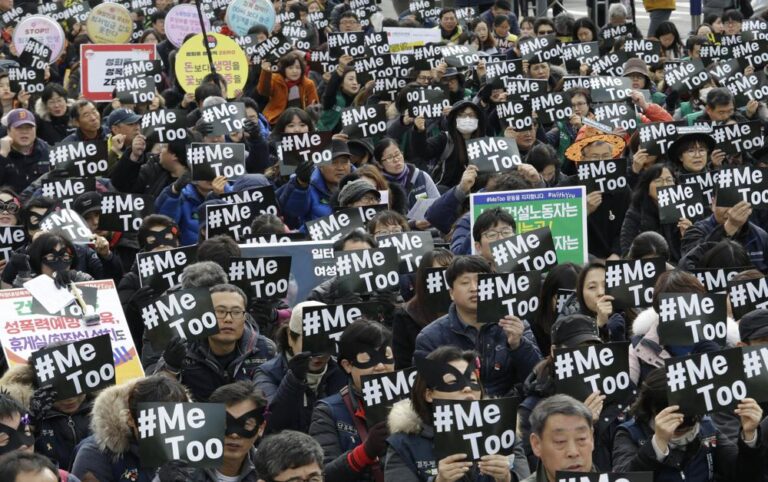
The tensions can be seen on the streets. Hundreds of women have marched in protest against the “election of misogyny.” Small but vocal groups of anti-feminist men have staged rallies in response.

Divisive gender politics has grown as South Korea deals with a fast-aging population, a plummeting birth rate, soaring personal debt, a decaying job market and stark inequality. There’s also the growing nuclear threat from North Korea and fears of being squeezed in the confrontation between the United States and China.

No campaign issue, however, has caused more debate than Yoon’s vow to abolish the Ministry of Gender Equality and Family, which the candidate says promotes policies unfair to men.

A former prosecutor general, Yoon, 61, has also vowed stronger penalties for false sexual crime reports. Critics say this makes up only a small number of rape claims, and that the threat of tougher punishment could intimidate victims from coming forward amid a recent male backlash against the #MeToo movement.

Liberal ruling party candidate Lee, 57, has taken a cautious approach to gender issues, while clashing with Yoon over the economy and North Korea policy.

Narrowly trailing Yoon in the polls, Lee has faced calls to appeal to more young men, whose support of conservative candidates in mayoral by-elections in Seoul and Busan may have led to a shocking double-defeat for the liberals.

Lee has described gender tensions as related to joblessness and says men shouldn’t be discriminated against. He said he plans to keep the gender ministry, but under a different Korean name that no longer includes the word “women.”

Yoon’s campaign has been influenced by his party’s chairman, Lee Jun-seok, a 36-year-old Harvard-educated “men’s rights” advocate who describes hiring targets for women and other gender equality policies as “reverse discrimination.” Lee calls feminist politics “blowfish poison.”

Yoon during a presidential debate on Monday repeated an argument that South Korea no longer has any structural barriers to women’s success, saying discrimination is now about “individual versus individual.”

The World Economic Forum ranks South Korea 102 out of 156 nations in an index that examines gender gaps in jobs, education, health and political representation.

Scrapping the gender ministry could weaken women’s rights and “take a toll on democracy,” said Chung Hyun-back, a scholar who served as gender equality minister in 2017-18, under current liberal President Moon Jae-in. It is also a key government department committed to helping single parents, sexual abuse survivors and the families of minorities and migrants.

The prospect frustrates Kang Ji-woo, a 36-year-old single mother who once struggled to find a job in a deeply conservative society and who receives child care support from the gender ministry. Unwed mothers in South Korea are sometimes pressured and shamed into having abortions or relinquishing their children for adoption.

“There’s no candidate worth trusting on polices aimed at helping the disadvantaged,” she said.

South Korean conservatives are galvanizing around a Trump-like brand of divisive “identity politics” that speaks almost exclusively to men after years of disarray following the 2017 ouster of the country’s first female president, Park Geun-hye, over a massive corruption scandal, according to Park Won-Ho, a Seoul National University politics professor.

Park Geun-hye had drawn power from older conservative voters who saw her dictator father, Park Chung-hee, as a hero who lifted the nation from the devastation of the 1950-53 Korean War.

Yoon is tapping into the resentment of men in their 20s and 30s who face a bleak job market while agonizing over soaring housing prices and dimming prospects for marriage and parenthood. They are increasingly sensitive to competition from women, who often outpace them at school and are more eager to break from traditional gender roles for professional advancement.

Even as many men cling to the notion that their female colleagues have it easier in the workplace — including being exempt from a mandatory 18-month military service — women have begun to more loudly criticize a male-centered corporate culture that exposes them to harassment, unequal pay and promotions, and often derails their careers after they have children.

Hong Eun-pyo, a 39-year-old who runs an anti-feminist YouTube channel, justifies higher pay for men, insisting they put in longer hours or perform more difficult tasks. “If they want to reach as high as their male peers and be paid the same wages, they should keep working and not get pregnant,” he said.

Song Tae-woong, an office worker, says young men, worried about a life path that seems tougher than their fathers, resent women’s increasing complaints about society.

“Our parents’ generation, now in their 50s and 60s, got married early and progressed step by step,” he said. “People today are … extremely restless.”

Some experts, including Chung, think politicians are overplaying the gender grievances of certain middle-class, college-educated men who have become radicalized over the internet as they compete with women for a shrinking number of decent jobs.

Recent surveys, however, show a striking political divide between increasingly conservative young men and their more left-leaning female peers, not just over gender issues but also on the economy and national security, says Park, the politics professor. This indicates conservatives are successfully mobilizing their young male supporters to back broader agendas, including tougher approaches on North Korea and policies emphasizing economic growth over welfare spending. Younger women are left feeling largely unrepresented, polls show.

Lee Ji-young, a teacher who has risen to the top of her field in the highly competitive private tutoring business, remembers years of verbal and physical sexual harassment and unwanted advances by male colleagues who constantly questioned her competitiveness.

One colleague told her that Korean society was stable during the medieval era “because women were quiet, but that now they have ruined South Korea,” Lee said.

She said she once twisted the wrist of a male colleague when he tried to touch her backside.

“Usually women wouldn’t react this way,” Lee said. “I’ve witnessed women who would cry at home or quit work … because they were afraid of being judged, personally and professionally.”


‘Air rage’ is complicating travel in US and Europe – but not so much in Asia

0

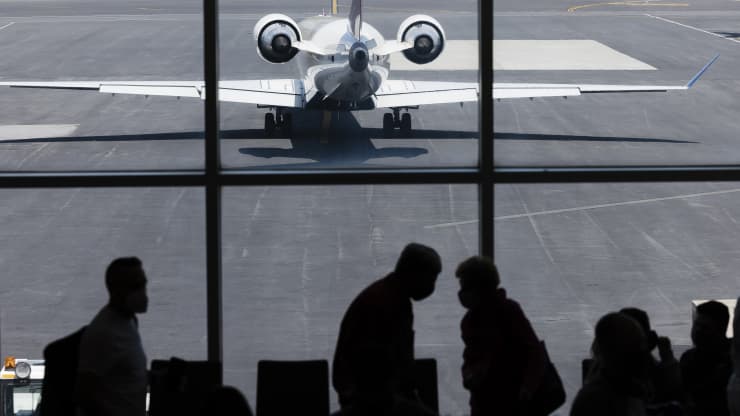
People in the U.S.A. were fighting about wearing masks on a plane, and people in India were fighting for masks to protect themselves.(Trish Riswick-SOCIAL ENGAGEMENT SPECIALIST AT HOOTSUITE)

Before the pandemic, there were between 100 to 150 reports of unruly passengers in a typical year on U.S. airlines.

According to CNBC, in 2021, there were nearly 6,000, according to the Federal Aviation Administration, with some 72% related to mask disputes.

While many airlines may be reluctant to talk, fellow travelers often aren’t. Many in-flight incidents are posted on social media by witnesses, where they can be viewed by millions and picked up by media outlets.

Globally, Twitter users mentioned “air rage” and unruly passenger incidents more than 117,000 times during the pandemic, according to the social media management company Hootsuite.

Yet only 1,860 — fewer than 2% — came from users in Asia, according to the data.  

Additionally, many posts in Asia pertained to passenger incidents that occurred outside of the region, said Trish Riswick, a social engagement specialist at Hootsuite. 

Regarding users in Asia, she said: “There appears to be a lot of conversation about American or European airlines or passengers being unruly or refusing to wear masks.”

Riswick said her research picked up several conversations about rule-breaking incidents from flights departing from Japan and India.

However, most conversations about problematic flyers during the pandemic came from the United States (56,000+ mentions), followed by Canada and the United Kingdom, according to Hootsuite. The data showed that the most mentions in Asia came from users in India, Japan and Indonesia.

“The issue is mostly a U.S. problem,” said Shem Malmquist, a visiting instructor at Florida Institute of Technology’s College of Aeronautics. “Part of this is absolutely related to the politicization of the pandemic in U.S. politics. That aside, U.S. passengers are considered to be more generally problematic by most cabin crew.”

Europe is also grappling with its share of disruptive passengers. High-profile incidents have been reported on flights departing from SpainScotlandAmsterdam and Glasgow.

Australia’s major airlines launched a joint campaign in 2021, following an increase in abusive behavior among flyers. Videos and airport signage have been put up to remind travelers to bring masks and respectful attitudes on board.

Last year, Canadian authorities reported that nearly 1,600 hundred people refused to comply with mask rules during flights. Others were denied boarding or deplaned before take-off, according to Transport Canada, the country’s transportation department.

In Asia, news of unruly flyers remains scarce.

“I have not heard of any incidents — zip, none,” said Jeffrey C. Lowe, CEO of the Hong-Kong-based aviation services company Asian Sky Group.

“Airline schedules are still greatly reduced,” he said of travel within Asia. Plus, there is “the pre-existing acceptance for masks in Asia before the pandemic … and, last but not least, a different perception here in Asia as to what infringes on our personal freedoms.”

Mask-wearing is an accepted practice in many Asian countries to prevent spreading or getting an illness. In an CNBC Travel story about Japan’s Shibuya Crossing, a 360-degree image shows at least eight people wearing masks near Tokyo’s famous intersection — long before the pandemic began.

Malmquist agrees that the issue is “certainly a large part cultural.” However, he said, “we cannot rule out that the flying is still so restricted in Asia that those who are flying are heavily supervised, with the ratio of cabin crew to passengers quite high.”

Plus, there have been fewer leisure travelers in Asia, he said, noting flyers there have been “almost exclusively business” travelers.

Korean Airlines indicated mask acceptance is helping to quell in-flight meltdowns.

An airline representative initially told CNBC: “We haven’t observed any outstanding increases or changes of in-flight unruly passengers since Covid-19 partially due to a social background where people wear a facial mask voluntarily.”

Later, the source issued a second statement, stating that the airline has experienced mask-related issues, “but those cases haven’t significantly increased the total number of unruly incidents.” 

Similarly, Doha-based Qatar Airways told CNBC: “We don’t have major issues … Most of our passengers comply to the rules, and there are a small number of them who might be difficult. … The crew tell them nicely to put on a mask and most obliged to it.”

Others airlines aren’t talking.

Thai Airways, EVA Air, Philippines Airlines and Cathay Pacific didn’t respond to CNBC’s questions about unruly passengers on their flights. Without providing additional details, Singapore Airlines said “passengers are largely supportive” of its mask policy.

A Japan Airlines spokesperson said, “Unfortunately, we do not share in-cabin matters with media.” Online media reports show several Japanese airlines have had in-flight dustups over masks.

In 2020, the Japanese budget carrier Peach Aviation made an unplanned domestic stop to boot a passenger from the plane, according to the non-profit website Nippon.com. The man, labeled “Japan’s no-mask crusader,” was arrested several times for refusing to wear a mask when flying and while in public places, according to local reports.

South Korea prime minister calls for calm as COVID cases hit new record

0

 South Korea’s prime minister on Wednesday called on people not to panic about a major increase in coronavirus infections as new daily cases surged past 170,000 for the first time, reported Reuters.

Serious cases and deaths are at manageable levels despite record cases caused by the highly infectious Omicron variant, Prime Minister Kim Boo-kyum told a pandemic response meeting.

A study by the Korea Disease Control and Prevention Agency (KDCA) of some 67,200 infections confirmed since December showed the Omicron variant’s severity and death rates averaged 0.38% and 0.18%, respectively, compared with 1.4% and 0.7% for the Delta cases.

Around 56% of 1,073 people who died over a five week period were either unvaccinated or had received only one dose, the study showed, with people aged 60 or older accounting for 94% of deaths, officials said on Monday.

“Although our awareness and implementation of anti-COVID rules should not be loosened, there is no reason at all to fear or panic about the numbers of new cases as in the past,” he said, according to a transcript.

South Korea reported 171,452 new coronavirus cases for Tuesday, another daily record and a sharp increase from 99,573 a day before, the Korea Disease Control and Prevention Agency said on Wednesday.

Deaths have slowly ticked up, reaching a near-record high 99 on Tuesday, but South Korean authorities say real-world data shows people infected with the Omicron coronavirus variant are nearly 75% less likely to develop serious illness or die than those who contract the Delta variant.

More than 86% of South Korea’s 52 million population have been double vaccinated and nearly 60% have received a booster shot.

South Korea has approved Pfizer’s (PFE.N) COVID-19 vaccine for use with children aged 5-11, the country’s food and drug ministry said on Wednesday.

Children should get one-third of the regular dose, administered twice with a three week interval, the ministry said in a statement. Children with significantly declined immunity can get a booster four weeks later.

Kim said social distancing rules will be relaxed after the current wave peaks, which some experts estimate may come in mid-March.

“Omicron’s spread is still racing to its peak, but once it is assured that severe cases and deaths can be stably managed, we will reform the broad framework of our anti-virus quarantine policy including social distancing,” Kim said.

Current rules include mask mandates for public places, vaccine passes for certain locations and events, a six-person limit on private gatherings, a 10 p.m. curfew for eateries and a seven-day quarantine for international arrivals.

South Korea has reported a total of 2.3 million cases since the pandemic began, with 7,607 deaths.

Hong Kong orders mandatory COVID-19 tests for all residents

0

Hong Kong will test its entire population of 7.5 million people for COVID-19 in March, the city’s leader said Tuesday, as it grapples with its worst outbreak driven by the omicron variant, according to AP.Other measures announced Tuesday include ending the school year early and moving the normal July-August summer holidays forward to March and April so that schools can be turned into facilities for testing, isolation and vaccination.

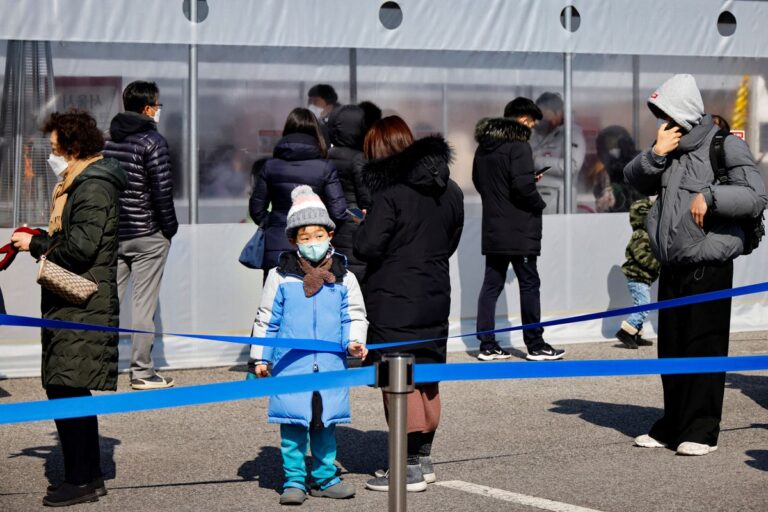
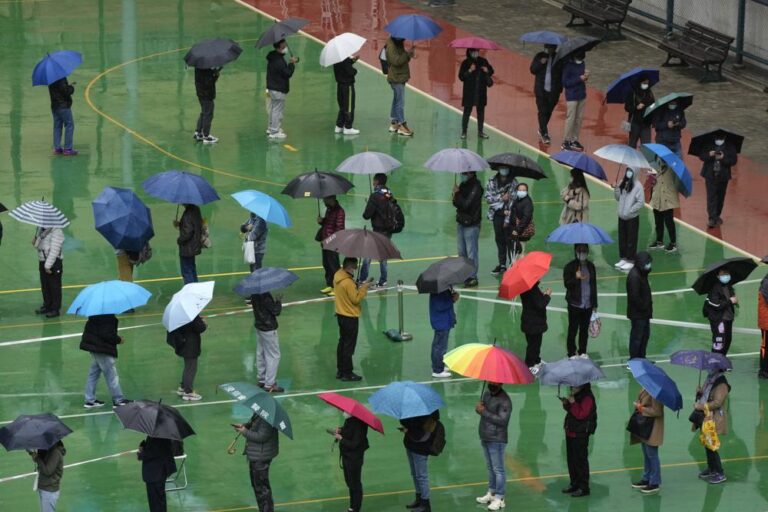
The population will be tested three times in March, Hong Kong Chief Executive Carrie Lam said.

She said testing capacity will be boosted to 1 million a day or more.

“Since we have a population of some 7 million people, testing will take about seven days,” she said.

Current social-distancing measures, such as a ban on dining at restaurants after 6 p.m. and the closure of businesses such as gyms and bars, will be extended until April 20.

“This is not good news to the sectors affected, but really at this stage of the pandemic we have no choice but to take these measures,” Lam said.

She said the city hopes to boost its vaccination rate to 90% by early March.

Other measures announced Tuesday include ending the school year early and moving the normal July-August summer holidays forward to March and April so that schools can be turned into facilities for testing, isolation and vaccination.

Flight bans from countries classified as high risk, including Australia, Canada, India, Nepal, Pakistan, the Philippines, Britain and the U.S., will be extended to April 20.

Hong Kong has reported about 5,000 new daily infections since Feb. 15, with the cases threatening to overwhelm its healthcare system. Since the current surge began at the beginning of the year, the city has recorded nearly 54,000 cases and 145 deaths.

The order for citywide testing comes after mainland Chinese authorities dispatched epidemiologists, health workers and other medical resources last week to help contain the outbreak in the semi-autonomous Chinese city.

Hong Kong has largely aligned itself with mainland China’s “zero-COVID-19” policy, which aims to totally stamp out outbreaks, even as many other countries are shifting their approach to living with the virus.

Lockdowns of entire cities have been imposed in a number of areas of the mainland, but Lam said no such measure is currently being considered in Hong Kong because it is “not realistic.”

She also denied that the central Chinese government is giving instructions to Hong Kong on how to handle the epidemic.

“I reiterate that the central government never issued any instructions on our anti-epidemic work,” she said. “The central government will offer support as needed or upon our request, but of course we will always exchange our views.”

The “zero-COVID-19” strategy means that Hong Kong authorities often take measures such as locking down residential estates for mass testing when positive cases are detected, imposing strict quarantine requirements on travelers and ordering the shuttering of businesses.

The rapid surge of infections in the city has threatened to overwhelm its healthcare system.

Health officials said last week that hospitals were already at 90% of capacity and isolation facilities were full. People who test positive for the virus in Hong Kong must either be admitted to a hospital or a quarantine facility.

Lam acknowledged on Tuesday that the city’s isolation facilities are “severely inadequate” and that it is “working very hard with the full support of the central authorities” to build more.

Japan said it is ready to join U.S.-led sanctions on Russia

0

Japan said on Tuesday it stood ready to join the United States and other G7 industrialised nations in slapping sanctions on Russia, should President Vladimir Putin order an invasion of Ukraine.

According to Reuters, Japan’s toughening stance against Russia contrasts with the softer diplomatic approach to Moscow taken in the past. Previous governments have courted Putin in a bid to secure the return of islands occupied by Russian forces at the end of World War Two.

Japan’s delicate diplomacy has also been shaped by its reliance on Russia for some of its energy needs. In 2021, Russia provided more than 12% of Japan’s thermal coal, and almost a tenth of its liquefied natural gas. read more

That economic anguish, however, has been overtaken in recent years by growing concern about a revival in Russian military activity in East Asia and Moscow’s growing security cooperation with neighbouring China.

“Ukraine is facing a tense situation now, so we must firmly watch how it could affect Japan’s economy,” Finance Minister Shunichi Suzuki told a briefing on Tuesday.

The confirmation by the world’s No. 3 economy comes as the crisis in Europe worsens, with the Russian leader ordering troops into two breakaway regions in Eastern Ukraine that Russia now recognizes as independent states. 

That action was “unacceptable and a violation of international law,” Prime Minister Fumio Kishida, who called Putin on Thursday to urge restraint, told reporters.

Japan was ready for a strong response that could include sanctions, he added.

Kishida’s office said he later held telephone talks with Olaf Scholz, the leader of Germany, which holds the presidency of the G7, when the two re-affirmed cooperation on the Ukraine situation and agreed to monitor developments.

Late on Monday the White House said it would announce new sanctions on Russia in response to Moscow’s decisions and actions. A White House spokesperson added, “We are coordinating with allies and partners on that announcement.”

New sanctions by Japan, which would add to those imposed on Russia in 2014 after it occupied the Crimea, would include a ban on semiconductor chips and other key technology exports and tougher curbs on Russian banks, the Yomiuri newspaper has said.

Although Japan, with just a 10% share of the global chip market, is no longer a major exporter of semiconductors, it is a key maker of specialised electronic components, from automotive chips to image sensors, and dominates fields such as high tech manufacturing equipment.

Kishida and other government officials who spoke on Tuesday did not say what sanctions Japan was considering.

New K-Dramas coming to Netflix in March 2022

0

Tomorrow (Season 1) N

Seasons: 1 | Episodes: 16
Genre: Drama, Fantasy | Runtime: 60 Minutes
Cast: Kim Hee Sun, Rowoon, Lee Soo Hyuk, Yoon Ji On, Kim Chae Eun
Netflix Premiere Date: Friday, March 25th, 2022 | New Episodes: Fridays, Saturdays

Netflix jas rarely seen dramas emerge from MBC, but that’s not to say we aren’t looking forward to seeing what Tomorrow has in store for us. We expect plenty of K-Pop fans will be tuning in to stream to see Rowoon of the K-Pop boy band SW9 in action.

Despite his prestigious background, Choi Joon Woong just can’t seem to find a job, no matter how hard he tries. But one night, he accidentally comes into contact with two death angels, Gu Ryeon and Im Ryoog Gu, who work for a crisis management team that tries to stop people from committing suicide.

Misty (Season 1)

Seasons: 1 | Episodes: 16
Genre: Drama | Runtime: 70 Minutes
Cast: Kim Nam Joo, Ji Jin Hee, Jeon Hye Jin, Im Tae Kyung, Go Jun
Netflix Release Date: Tuesday, March 1st, 2022

The second new JTBC drama coming soon, it appears that Netflix is getting some of the best of the network’s dramas from 2018.

Go Hye Ran is an ambitious anchorwoman for the popular news show, News 9. She is passionate about her job and doesn’t stop until she gets what she wants. One day, she meets an old lover and his wife and gets tangled in a murder case. Her husband Kang Tae Wook, who is a public defender, decides to defend his wife and fix their failed marriage.

Thirty-Nine (Season 1) N

Seasons: 1 | Episodes: 12
Genre: Drama | Runtime: 70 Minutes
Cast: Son Ye Jin, Jeon Mi Do, Kim Ji Hyun, Yeon Woo Jin, Lee Moo Saeng
Netflix Finale Date: March 24th, 2022 | New Episodes: Wednesdays & Thursdays

Three women, who each met other during their second year in high school, have remained friends for years and are now all on the verge of turning 40. With such a landmark birthday on the horizon, there are still lots the trio wishes to achieve such as lessons in love, careers, and family matters.

Forecasting Love and Weather (Season 1) N

Seasons: 1 | Episodes: 16
Genre: Romantic, Comedy | Runtime: 60 Minutes
Cast: Park Min Young, Song Kang, Yoon Park, Yura, Kim Mi Kyung
Netflix Finale Date: April 3rd, 2022 | New Episodes: Saturdays & Sundays

At the Korea Meteorological Administration, Korea’s national weather forecast service, Jin Ha Kyung, has alienated herself, by choice, from the rest of her colleagues as she prefers to play things by the book, and keep personal and professional lives separate. However, when the free-spirited Lee Shi Woo is employed, he impresses Jin Ha Kyung, through his intelligence and his obsession with the weather, he slowly begins to break down the barriers that Jin Ha Kyung has built around her heart.