Floods that had devastated much of Malaysia in recent weeks have caused an estimated 6.1 billion ringgit ($1.46 billion) in overall losses, a government report said on Friday.
Malaysia’s government has previously said it would provide about 1.4 billion ringgit ($334.37 million) in cash aid and other forms of relief to those affected by the floods, as stated in Reuters.
In a special report on the floods’ impact, the Department of Statistics said damage to public assets and infrastructure caused losses of 2 billion ringgit, followed by 1.6 billion ringgit in damage to homes.
Manufacturing losses accounted for 900 million ringgit, most of which were recorded in the central state of Selangor, one of the country’s wealthiest and populous regions surrounding the capital Kuala Lumpur.
Selangor was also the worst hit overall, with about half of Malaysia’s losses recorded in the state, the report said.
The department also reported heavy damage to vehicles, business premises and the agricultural sector.
Dozens of people died while more than 120,000 were displaced after unusually heavy rain caused severe flooding in multiple states in mid-December and early January.
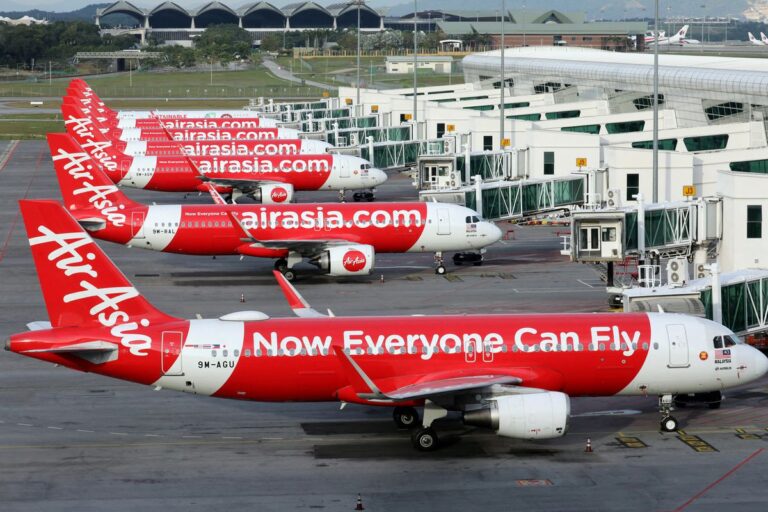
According to Reuters, Malaysia’s AirAsia Group Bhd (AIRA.KL) said on Friday it had changed its name to Capital A Bhd to reflect its growing portfolio of businesses beyond the core budget airline.
“Over the past two years we have spent the downturn in flying building a solid foundation for a viable and successful future, which is not solely reliant on airfares alone,” Capital A Chief Executive Tony Fernandes said in a statement.
The airline business will retain the AirAsia brand, which is well known in Asia, he added.
The airline business has been hard-hit during the pandemic due to strict travel rules in Asia, leading Malaysia’s stock exchange to this month classify the firm as financially distressed though it has been raising funds to bolster its balance sheet.
The group proposed changing its name on Jan. 3.
Capital A has been investing heavily in payments business BigPay, logistics arm Teleport and its mobile Super App to gain other sources of revenue, though they remain in growth phases and were loss-making in the quarter ended Sept. 30, 2021.
Fernandes told reporters at a launch event in Kuala Lumpur the carrier, which has five affiliate airlines including long-haul operator AirAsia X, planned to introduce two more to its stable. He declined, however, to give further details.
The group is also seeking to raise about 1 billion ringgit this year, as it continues efforts to regularise its finances, Fernandes said.
“The group has more than enough liquidity… we’re very focused on growing and adding value,” he said.
The carrier on Thursday reported it filled 80% of seats on offer in the fourth quarter of 2021 and had the highest number of passengers since the start of the pandemic as travel rules began to ease.
The Winter Games will take place without foreign tourists or ordinary spectators under China’s “zero tolerance” strategy that aims to keep the virus out of the country. Athletes, reporters and officials are required to stay within areas that isolate them from general public.
Some 106 of the 3,695 people who arrived from abroad for the Games so far tested positive for the coronavirus. Two are athletes or team officials.
The Chinese capital has tightened anti-virus measures and ordered mass testing of some 2 million people in one district following outbreaks. Some families are barred from leaving their homes.
Foreign sports brands see growth opportunities in China but are frustrated that marketing and business development are hampered by the anti-virus controls and ban on most foreigners from entering China.
“That’s kind of put a damper on things,” said Jeffrey Potter, president of Proskatecorner Pte. Ltd., the China distributor of American hockey equipment maker True.
Holding his skis beside a bunny slope, Li Wei enthuses over his winter job as a farmer-turned-ski coach on the northwestern outskirts of Beijing.
The tall, tanned 36-year-old works December to March at a resort in the Yanqing district, which will host skiing, luge and other sliding events at the Winter Olympics, which open next week.
According to AP, the ruling Communist Party is using the Games to promote winter sports, many of which are new to most Chinese, for fitness and business opportunities.
Skiing “boosted my income to another level,” said Li, who charges 400 to 500 yuan ($60 to $80) per lesson — almost as much as his family earns in a week growing corn during warmer months. He also finds skiing relaxing.
“After a few slides down the intermediate slope, all my troubles are gone,” he said.
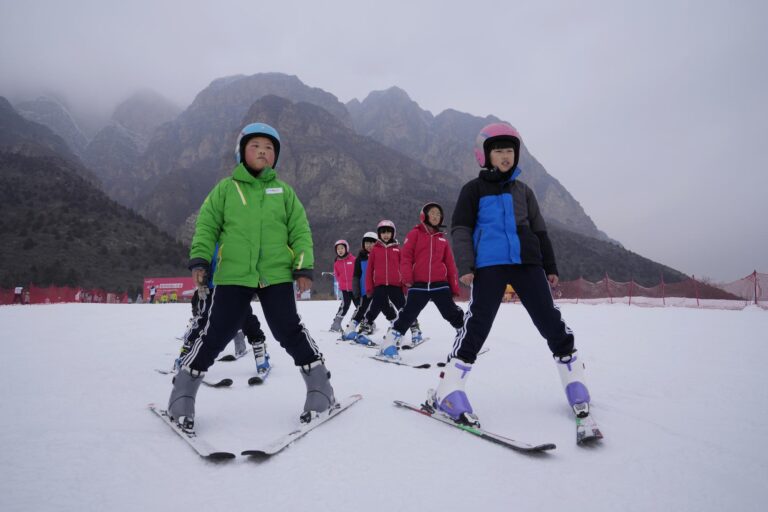
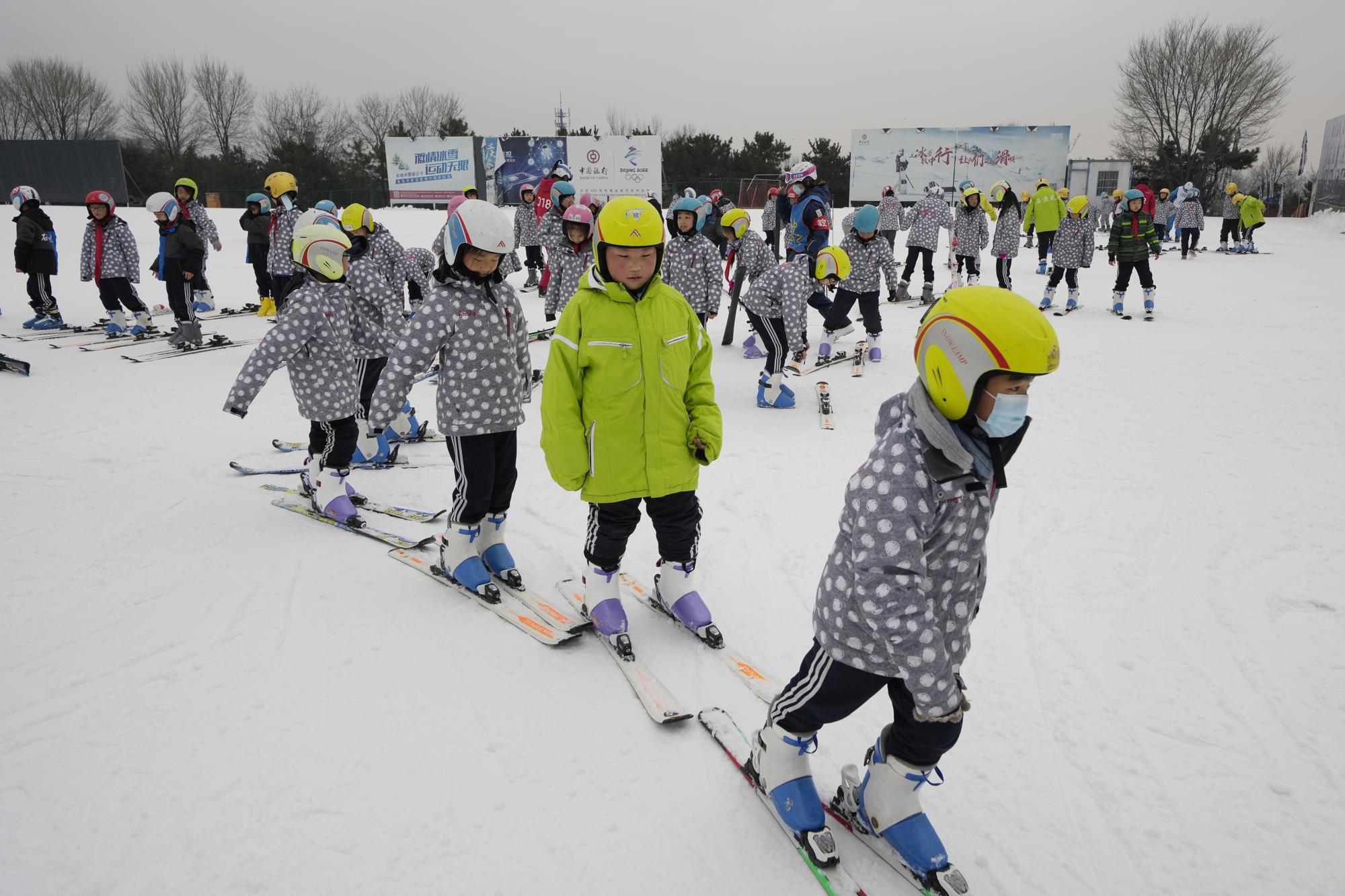
School children learning to ski take to the slope at the Vanke Shijinglong Ski Resort in Yanqing on the outskirts of Beijing, China, Thursday, Dec. 23, 2021. (AP Photo/Ng Han Guan)
Many in Beijing have long enjoyed winter ice skating on canals and lakes. But now, young Chinese are expanding their aspirations from basketball, football and gymnastics to sports such as hockey and skiing.
The government and private companies have built ice rinks and ski runs. Public schools are adding skating and other winter sports. Parents are opening their wallets to pay for hockey teams and skating lessons. Villages near ski slopes are building inns to serve well-heeled tourists.
“I want to be an ice hockey player in the future,” said 8-year-old Guo Yuchen, who took up the sport at 4 and trains seven hours a week at a rink in Beijing. “Then I can bring glory to my country.”
Wu Mengkai, 11, said hockey made him more extroverted and a “very sunny person.”
“You can’t be introverted when you play ice hockey,” Wu said. “You have to be brave enough to fight.”
The buildup to the Winter Olympics set these trends in motion, said Mark Dreyer, author of the book “Sporting Superpower: An Insider’s View on China’s Quest to Be the Best.”
“We’ve also seen a more organic push from China’s middle class, recognizing the value of sports not just for their children, but for themselves,” Dreyer said.
If not for the virus, the marketing boost from the Olympics would have been bigger, really helping the economy and making hockey more popular, Potter said in a video conference interview from Toronto.
At the Vanke Shijinglong Ski Resort, where Li teaches, visitor Long Xuelian said she fell in love with skiing on her first try despite taking many spills.
“More and more friends of mine know how to ski,” said Long, who was taking a break from skiing and chatting with her friend.
The resort’s visitor numbers have risen by 15% to 20% a year since Beijing and neighboring Zhangjiakou were awarded the Winter Games in 2015, according to its marketing manager, Liu Yingkai. Liu said numbers were up 40% last year, even with the pandemic.
Zhang Xiaodong grew up in Zhangjiakou but never learned to ski, so he’s taking up the sport as an adult. “I have to learn how to ski so when I bring my kid here next time, I’ll know how to teach my kid,” the IT engineer said.
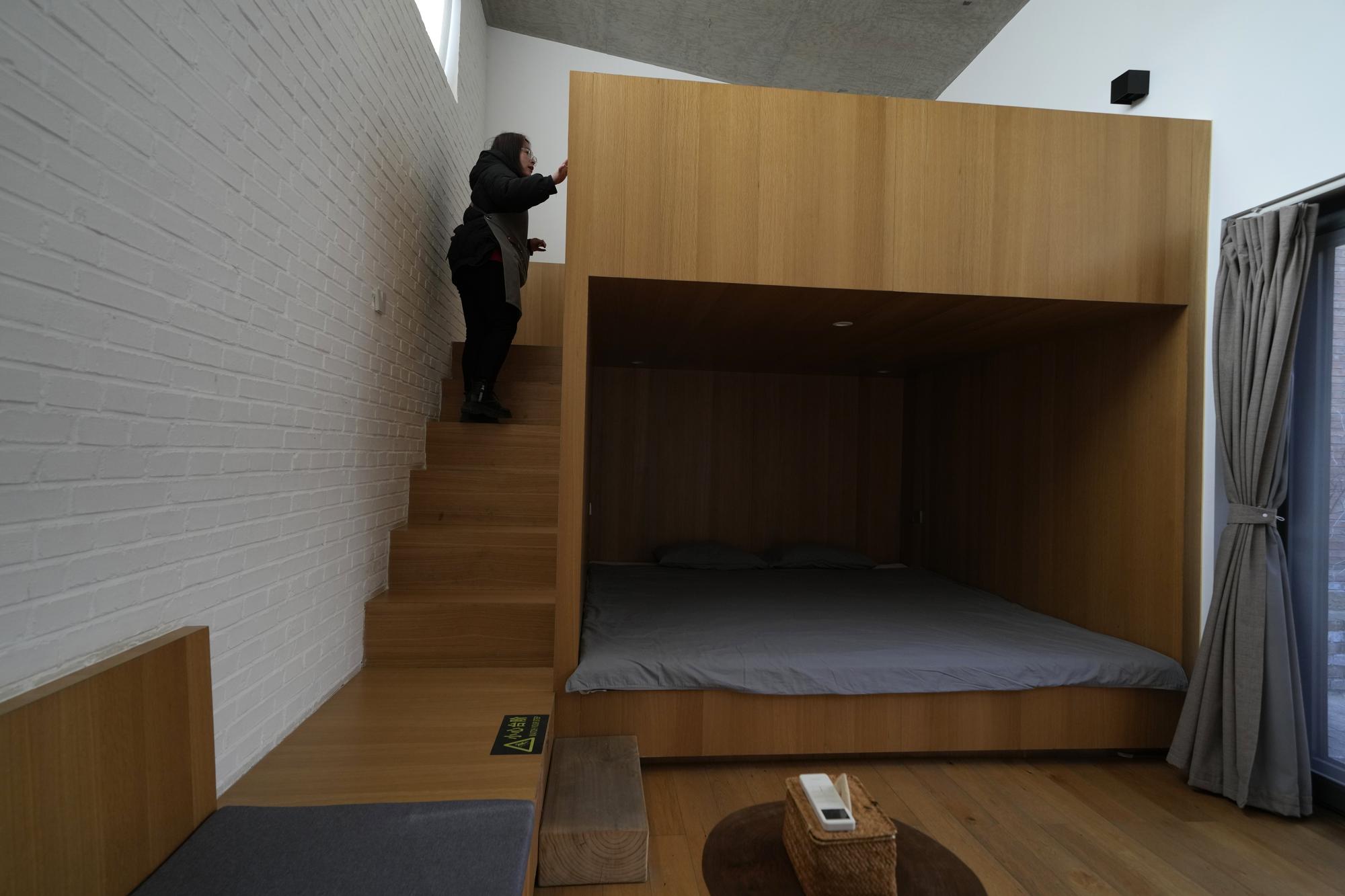
A local resident hired as a cleaner for a traditional courtyard house turned into lodging for tourists, inspects one of the rooms in Houheilong Miao, a village in Yanqing on the outskirts of Beijing, China, Wednesday, Jan. 5, 2022. (AP Photo/Ng Han Guan)
At least 8,000 people in Beijing are on hockey teams, the Communist Party newspaper People’s Daily quoted Xing He, the deputy secretary general of the Beijing Ice Hockey Association, as saying.
“Matches are held more frequently, and school teams come here for training,” said Wang Yuming, general manager of the Star Hong-ao Ice Sports rink in western Beijing.
Nationwide, more than 450 ice rinks and 300 snow resorts have been built since 2015, though some have closed at times during the pandemic, said Li Sen, director of the Beijing Olympic organizing committee’s General Planning Department.
Skiing and other sports have given an economic boost to villages near resorts.
“For tourists to eat, there must be restaurants around,” said Jiang Xinwei of Analysys International, a research firm in Beijing.
Houheilong Miao, a village in Yanqing, has a view of the Olympics skiing venue in the distance. Its 20 mostly vacant traditional courtyard houses have been turned into lodgings and a cafe dubbed the “Winter Olympic Home.”
Wang Haifang, a mother of two, is among local residents hired to work as baristas, butlers and cleaners. She welcomed seeing the once-rundown village cleaned up like modern urban areas of Beijing.
“In the past year, everything got into shape,” she said.
President Joe Biden and first lady Jill Biden have finally added the long-promised cat to their pet family.
The White House hasn’t had a feline resident since India, President George W. Bush’s cat.
Willow joins Commander, a German shepherd puppy Joe Biden introduced in December as a birthday gift from the president’s brother James Biden and his wife, Sara, according to AP.
Her name is Willow, and she’s a 2-year-old, green-eyed, gray and white farm cat from Pennsylvania.
“Willow is settling into the White House with her favorite toys, treats, and plenty of room to smell and explore,” said Michael LaRosa, the first lady’s spokesperson.
Jill Biden had said after Joe Biden was elected in November 2020 that they would bring a kitty to the White House, but her arrival had been delayed. Last month, the White House said the cat would come in January.
“Seeing their immediate bond, the owner of the farm knew that Willow belonged with Dr. Biden,” he said.
The Bidens had two other German shepherds, Champ and Major, at the White House before Commander.
But Major, a 3-year-old rescue dog, started behaving aggressively after he arrived in January 2021, including a pair of biting incidents. The White House had said Major was still adjusting to his new home, and he was sent back to the Bidens’ Delaware home for training.
The Bidens, after consulting with dog trainers, animal behaviorists and veterinarians, decided to follow the experts’ collective recommendation and send Major to live in a quieter environment with family friends, LaRosa said last month.
Japanese fascination with the moon has been growing.
A private Japanese venture called ispace Inc. is working on lunar rovers, landing and orbiting, and is scheduled for a moon landing later this year. Businessman Yusaku Maezawa, who recently took videos of himself floating around in the International Space Station, has booked an orbit around the moon aboard Tesla CEO Elon Musk’s Starship.
Toyota engineer Shinichiro Noda said he is excited about the lunar project, an extension of the automaker’s longtime mission to serve customers and the moon may provide valuable resources for life on Earth.
“Sending our cars to the moon is our mission,” he said. Toyota has vehicles almost everywhere. “But this is about taking our cars to somewhere we have never been.”
According to AP, Toyota is working with Japan’s space agency on a vehicle to explore the lunar surface, with ambitions to help people live on the moon by 2040 and then go live on Mars, company officials said Friday.
The vehicle being developed with the Japan Aerospace Exploration Agency is called Lunar Cruiser, whose name pays homage to the Toyota Land Cruiser sport utility vehicle. Its launch is set for the late 2020’s.
The vehicle is based on the idea that people eat, work, sleep and communicate with others safely in cars, and the same can be done in outer space, said Takao Sato, who heads the Lunar Cruiser project at Toyota Motor Corp.
“We see space as an area for our once-in-a-century transformation. By going to space, we may be able to develop telecommunications and other technology that will prove valuable to human life,” Sato told The Associated Press.
Gitai Japan Inc., a venture contracted with Toyota, has developed a robotic arm for the Lunar Cruiser, designed to perform tasks such as inspection and maintenance. Its “grapple fixture” allows the arm’s end to be changed so it can work like different tools, scooping, lifting and sweeping.
Gitai Chief Executive Sho Nakanose said he felt the challenge of blasting off into space has basically been met but working in space entails big costs and hazards for astronauts. That’s where robots would come in handy, he said.
Since its founding in the 1930s, Toyota has fretted about losing a core business because of changing times. It has ventured into housing, boats, jets and robots. Its net-connected sustainable living quarters near Mount Fuji, called Woven City, where construction is starting this year.
Japanese fascination with the moon has been growing.
A private Japanese venture called ispace Inc. is working on lunar rovers, landing and orbiting, and is scheduled for a moon landing later this year. Businessman Yusaku Maezawa, who recently took videos of himself floating around in the International Space Station, has booked an orbit around the moon aboard Tesla CEO Elon Musk’s Starship.
Toyota engineer Shinichiro Noda said he is excited about the lunar project, an extension of the automaker’s longtime mission to serve customers and the moon may provide valuable resources for life on Earth.
“Sending our cars to the moon is our mission,” he said. Toyota has vehicles almost everywhere. “But this is about taking our cars to somewhere we have never been.”
An appeal court in South Korea has halved the prison sentence of former pop star Seungri after he acknowledged he was guilty of crimes including facilitating prostitution and embezzlement, to which he had pleaded not guilty at his earlier trial.
According to SCMP, Seungri’s prosecution and conviction last year followed a series of high-profile investigations into entertainment and business industry insiders for crimes including fraud and sexual assault, many of them linked to the Burning Sun nightclub in Seoul, the South Korean capital.
His trial and appeal took place in military courts because he enlisted in South Korea’s military to perform national service – compulsory for men in the country – while under investigation.
The disgraced former member of K-pop boy band BigBang is reported to have expressed remorse for his actions in what became known as the Burning Sun scandal, named for a nightclub in Seoul.
In July, military court prosecutors reportedly declared the star had “shown no remorse and shifted blame to other people despite enjoying large benefits from his crimes”.
Born Lee Seung-hyun, Seungri, 31, pleaded guilty to only one of the nine charges he faced at trial in a lower court in August – violating foreign exchange policies related to overseas gambling.
That court convicted him on all counts, sentenced him to three years’ imprisonment and ordered him to pay 1.15 billion Korean won (US$1 million) in restitution. Following the court’s verdict he was imprisoned pending appeal.
On January 27 the South Korean High Court for Armed Forces announced his jail term would be reduced to 18 months.
Recordings of four 911 calls released Thursday described a frantic scene as a mother cried for help and strangers rushed to aid her baby.
“My baby was shot in a drive-by!” Kerri Gray said to a 911 operator. “There was a drive-by, people were driving by and shooting and they got my baby, 6 months!”
According to AJC, Investigators arrested a second suspect in connection with the shooting death of a 6-month-old boy, Atlanta police said Thursday.
Sharice Michelle Ingram turned herself in Wednesday at police headquarters. She was charged with party to the crime of aggravated assault and party to the crime of felony murder and was being held without bond Thursday at the Fulton County Jail.
No information was released on what investigators believe was Ingram’s role in the Monday afternoon shooting. But she is not believed to be the shooter, according to police.
Grayson Matthew Fleming-Gray was shot shortly before 3 p.m. while in his car seat, riding in a vehicle near the Food Mart corner store on Anderson Avenue. Less than 24 hours later, the first suspect was in custody.
Dequasie Johnathan Little, 22, was arrested Tuesday and charged with felony murder and aggravated assault. Police Chief Rodney Bryant said tips from the community, and help from neighboring law enforcement agencies, led to the arrest. Little waived his first court appearance Wednesday morning.
After Little’s arrest, Bryant said investigators felt confident they had located the shooter. But the investigation is not over, he said.
Gray told The Atlanta Journal-Constitution she had just parked at the food mart when she saw her baby slumped over. She believes the bullet went through the trunk of her car and struck Grayson, who never cried.
One witness told 911 people in two vehicles, a black Hyundai and a silver Jeep Cherokee, appeared to be chasing each other.
“Both vehicles had guns,” the woman said.
The two vehicles sped away after the baby was injured, witnesses said. One witness also reported her vehicle was hit by gunfire in a call to 911.
A former firefighter was among those who tried to help Grayson before paramedics arrived. But the baby was not breathing, the man told the 911 operator.
“There’s obviously nothing,” he said, his voice trailing off.
The child’s death was the second deadly shooting of the year involving babies.
On Thursday afternoon, Gray was at Willie A. Watkins Funeral Home to finalize arrangements for Grayson. A public visitation will be held Monday from 4-8 p.m. at the funeral home, located at 1003 Ralph David Abernathy Boulevard. A GoFundMe page was created to assist the family with costs.
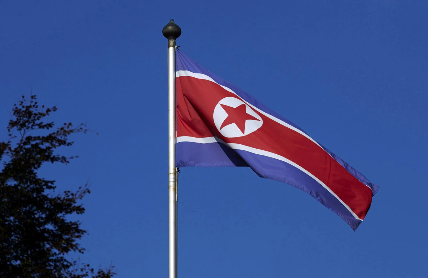
According to Reuters, nuclear-armed North Korea fired what appeared to be two short-range ballistic missiles on Thursday, drawing condemnation from the United States for what would be the sixth round of missile tests this month.
Earlier in the month, North Korea tested tactical guided missiles, two “hypersonic missiles” capable of high speed and manoeuvring after lift-off, and a railway-borne missile system.
“The (Kim Jong Un) regime is developing an impressive diversity of offensive weapons despite limited resources and serious economic challenges,” said Leif-Eric Easley, an international affairs professor at Ewha University in Seoul.
Certain tests aim to develop new capabilities, especially for evading missile defences, while other launches are intended to demonstrate the readiness and versatility of missile forces that North Korea has already deployed, he said.
“Some observers have suggested that the Kim regime’s frequent launches are a cry for attention, but Pyongyang is running hard in what it perceives as an arms race with Seoul,” Easley said.
The series of tests is among the most missiles ever launched by North Korea in a month, analysts said, as it begins 2022 with a dizzying display of new and operational weapons.
South Korea’s Joint Chiefs of Staff said it had detected the launch of what it presumed were two ballistic missiles at about 8 a.m. (2300 GMT) from near Hamhung, on the east coast of North Korea. They travelled for about 190 km to an altitude of 20 km, JCS added.
North Korea said this month it would bolster its defences against the United States and consider resuming “all temporally-suspended activities”, an apparent reference to a self-imposed moratorium on tests of nuclear weapons and long-range missiles. read more
The launch came after North Korea fired two cruise missiles into the sea off its east coast on Tuesday, adding to the tension over its tests.
In a speech to the U.N.-sponsored Conference on Disarmament on Tuesday, North Korea’s Ambassador to the United Nations in Geneva, Han Tae Song, accused the United States of staging hundreds of “joint war drills” while shipping high-tech offensive military equipment into South Korea and nuclear strategic weapons into the region.
“(This) is seriously threatening the security of our state,” Han said.
Open fires burning on the street. Dangerous vagrants. Fear after dark.
This is life these days in Soho — one of Manhattan’s ritziest neighborhoods, with home costs that soar into the millions.
Late Wednesday night, video emerged of an open fire burning on Canal Street, and people who live and work in the neighborhood told The Post that crime and chaos has gotten so far out of control, they no longer feel safe, according to NYPOST.
“I used to be more comfortable letting my children, especially the two older kids, travel by themselves to school and now I don’t,” Maud Maron, a mother of four who’s lived in Soho for over a decade, told The Post Thursday.
“The reality is, our city is not as safe as it used to be,” said Maron, 50.
“It’s unconscionable because we’re also not helping the people who are clearly suffering. I don’t wish ill on people who are obviously mentally suffering and dressed poorly in the winter but I also don’t want that person near my child.”
The Post spoke with a half-dozen New Yorkers who live and work in Soho who all said there is a noticeable change in the neighborhood compared to a few years ago.
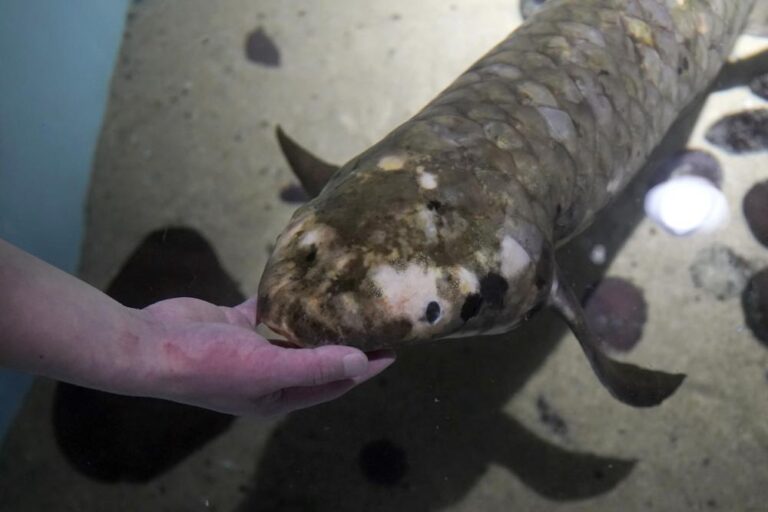
Meet Methuselah, the fish that likes to eat fresh figs, get belly rubs and is believed to be the oldest living aquarium fish in the world.
Until a few years ago, the oldest Australian lungfish was at the Shedd Aquarium in Chicago. But that fish, named Granddad, died in 2017 at the age of 95, according to AP.
Methuselah is a 4-foot-long (1.2-meter), 40-pound (18.1-kilogram) Australian lungfish that was brought to the San Francisco museum in 1938 from Australia.
A primitive species with lungs and gills, Australian lungfish are believed to be the evolutionary link between fish and amphibians.
No stranger to publicity, Methuselah’s first appearance in the San Francisco Chronicle was in 1947: “These strange creatures — with green scales looking like fresh artichoke leaves — are known to scientists as a possible ‘missing link’ between terrestrial and aquatic animals.”
In the Bible, Methuselah was Noah’s grandfather and was said to have lived to be 969 years old. Methuselah the fish is not quite that ancient, but biologists at the California Academy of Sciences believe it is about 90 years old, with no known living peers.