Home Blog Page 80

‘Flash mob’ steals $25,000 worth of clothes from Atlanta store

0

So-called “flash mob” thefts have been increasing across the county. Businesses like Home Depot have been fighting organized retail thefts.

Almost $70 billion was stolen from retailers through organized crime in 2020. This year’s total likely will exceed that figure according to Chris Carr, Georgia’s attorney general. Carr said proceeds from retail theft help fund other crimes.

The Atlanta Police Department is asking for help identifying suspects who stole more than $25,000 worth of merchandise from an Atlanta clothing store, according to WSB-TV.

Police said that before 7:45 p.m. Feb. 15 six Black males entered Toussaint Namdi on Piedmont Avenue and began snatching clothing off racks and mannequins before running away.

North Korea’s Kim congratulates China on Olympics

0

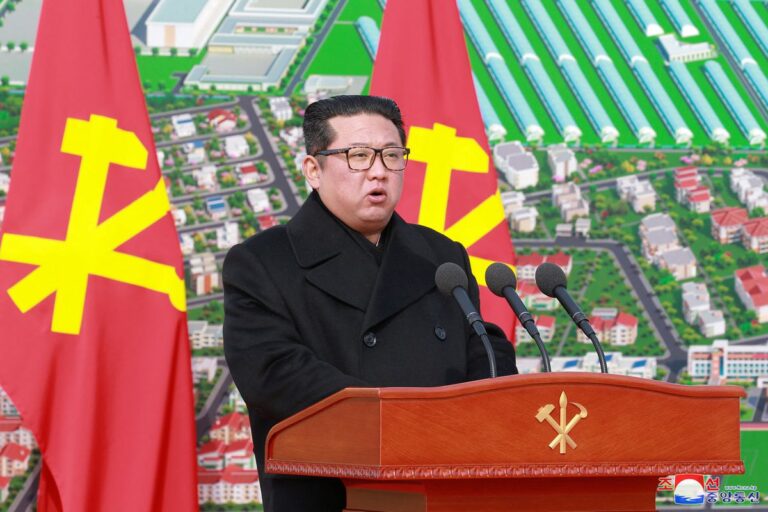
North Korea’s Kim Jong Un vowed to strengthen cooperation with China and together “frustrate” threats and hostile policies from the United States and its allies, state media reported on Tuesday.

North Korean athletes were not eligible to compete under their national flag after the country failed to send a team to the Tokyo Summer Olympics last year, citing COVID-19 concerns.

China has been North Korea’s only major ally since the two signed a treaty in 1961.

According to Reuters, Kim made the remarks in a verbal message to Chinese President Xi Jinping, congratulating him on the successful completion of the Beijing Olympics, state news agency KCNA said in a summary.

North Korea and China are defending and advancing socialism, while “frustrating the undisguised hostile policy and military threat of the U.S. and its satellite forces” by strengthening strategic cooperation and unity, Kim said.

Kim praised the Games for making a mark on history, and said under Xi’s leadership, China had persevered in the face of an “unprecedentedly severe health crisis and the hostile forces’ maneuvers.”

North Korea did not participate in the Games, which ended on Sunday.

In a previous letter from sports authorities in January, North Korea blamed “hostile forces” and COVID-19 risks for its not being able to attend.

South Korea “Omicron COVID variant 75% less likely to kill than Delta strain”

0

People infected with the Omicron coronavirus variant are nearly 75% less likely to develop serious illness or die than those who contract the Delta variant, real world data released on Monday by South Korea’s health authorities showed, reported by Reuters.

A study by the Korea Disease Control and Prevention Agency (KDCA) of some 67,200 infections confirmed since December showed the Omicron variant’s severity and death rates averaged 0.38% and 0.18%, respectively, compared with 1.4% and 0.7% for the Delta cases.

The KDCA classed severe cases as people who were hospitalised in intensive care units.

Contact tracing and mandatory isolation for vaccinated people was scrapped in favour of self diagnosis and at-home treatment to free up medical resources. Among changes to strict curfews, restaurants will be open for an extra hour for groups of up to eight diners, up from six.

The long-running curfews have emerged as a political hot potato ahead of the election, with small business owners urging them to be lifted while some experts warn of likely strain on the medical system. 

The KDCA said Omicron became the dominant variant in the third week of January and up to 90% of new cases were Omicron by the first week of February.

The KDCA reported 99,444 new cases for Monday, bringing total infections to 2,157,734, with 7,508 deaths.

Around 56% of 1,073 people who died over the past five weeks were either unvaccinated or had received only one dose, the study showed, with people aged 60 or older accounting for 94% of deaths.

More than 86% of South Korea’s 52 million population have been double vaccinated and nearly 60% have received a booster shot.

South Korea had kept cases and deaths relatively low thanks to widespread social distancing measures and aggressive testing and tracing.

The Omicron variant has led to a surge in cases – daily new infections topped a record 100,000 last week – but authorities have pushed ahead with slightly easing social distancing rules amid the lower fatality rate and ahead of a presidential election next month.

S. Korea parliament approves $14 billion extra budget before election

0

South Korea’s National Assembly approved a 16.9-trillion-won ($14.2 billion) supplementary budget on Monday aimed partly at funding the response to COVID-19 and supporting businesses hit by pandemic restrictions.

The amount approved was 2.9 trillion won more than the sum unveiled last month.

To finance the added 2.9 trillion won, the government will utilise public fund reserves and net budget surplus, and therefore there will be no change to the debt-to-GDP ratio of 50.1%, the ministry added.

With the latest supplementary budget, total government spending increases to a record 624.3 trillion won this year.

South Korea’s new daily COVID-19 cases topped 100,000 for the first time last week amid its Omicron outbreak, with authorities saying social distancing measures would be only slightly eased ahead of the March election.

Businesses have complained about the current curfew and other restrictions such as vaccine passes and a six-person cap on private gatherings that will be in place until at least March 13.

The bill includes provisions for more than 3 million small businesses and self-employed people to receive 3 million won each in relief money, starting as soon as the end of this month, according to a Finance Ministry statement.

The extra budget comes as the ruling Democratic Party struggles to recover public support before a presidential election on March 9.

The additional 2.9 trillion won added to the final bill includes 1.3 trillion won earmarked for financial support for pandemic-hit businesses such as cafes, restaurants, and accommodation facilities, according to the ministry statement.

Another 1.3 trillion won was added to secure more COVID-19 treatments, test kits, hospital beds and for other quarantine measures, the ministry said.

Australia fully reopens borders after two years

0

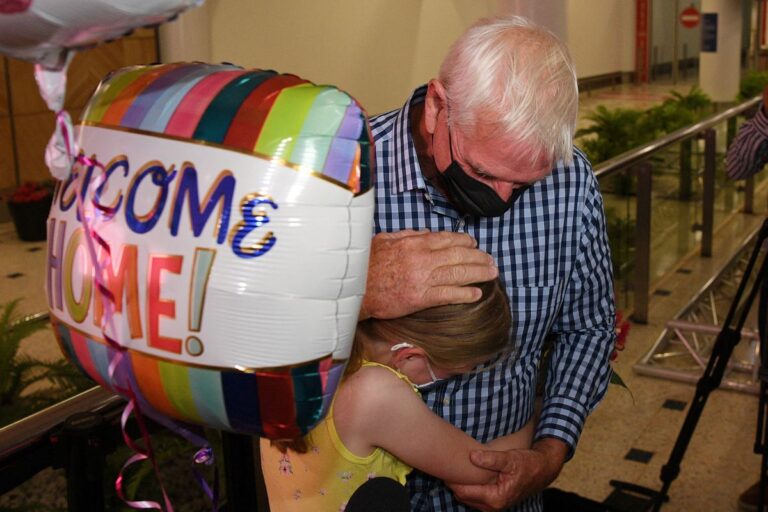
Australia on Monday fully reopened its international borders to travellers vaccinated against the coronavirus after nearly two years of pandemic-related closings as tourists returned and hundreds of people were reunited with family and friends, according to Reuters.

More than 50 international flights will reach the country through the day, including 27 touching down in Sydney, its largest city, as the tourism and hospitality sectors look to rebuild after getting hammered by COVID-19 restrictions.

“It is a very exciting day, one that I have been looking forward to for a long time, from the day that I first shut that border right at the start of the pandemic,” Prime Minister Scott Morrison told reporters in the island state of Tasmania, which relies heavily on tourism.

After being away from loved ones for months there were many emotional reunions, including for Cindy Moss who travelled from the U.S. state of Kentucky to see her daughter.

“I just haven’t seen her in so long and it was such a big thing to be able to get over here. So I’m so excited,” she said after hugging her daughter, her voice cracking with emotion.

All trains in Sydney, meanwhile, were cancelled on Monday after pay disputes between the union and the state government, taking some shine off the reopening.

As borders fully reopen, Australia’s outbreak of the Omicron coronavirus variant appears to have passed its peak with hospital admissions steadily falling over the past three weeks. The bulk of Australia’s pandemic total of about 2.7 million confirmed cases has been detected since the emergence of Omicron in late November. Total deaths stood at 4,929.

Just over 17,000 new cases and 17 deaths were registered by midday on Monday with theNorthern Territory due to report later.

Tourism is one of Australia’s biggest industries, worth more than A$60 billion ($43 billion) and employing about 5% of the country’s workforce. But the sector was crippled after the country shut its borders in March 2020.

Once a champion of COVID-suppression strategy, Australia shifted away from its fortress-style controls and relentless lockdowns since late last year and began living with the virus after reaching higher vaccination levels. Skilled migrants, international students and backpackers have been allowed to fly into Australia since November in a staggered reopening exercise.

“IT’S A PARTY OUT HERE”

Passengers flying to Sydney were greeted from the air with “Welcome Back World!” painted on a sign near the runways while people in kangaroo costumes welcomed travellers and a DJ played music from a van festooned with a banner saying “You were worth the wait”.

“It is a party out here, music playing, smiles on people’s faces, they will be dancing soon, I’m sure,” Tourism Minister Dan Tehan told broadcaster ABC from Sydney airport as he gave travellers gift jars of Vegemite, an iconic Australian food spread, and stuffed koala toys.

Tehan said he was hopeful for a “very strong” rebound in the tourism market, with Qantas (QAN.AX) looking to fly more than 14,000 passengers into Australia this week. Virgin Australia said it was seeing positive trends in domestic bookings and continued to assess demand for international flights.

($1 = 1.3959 Australian dollars)

Trump’s Truth Social app appears set to launch in Apple’s App Store on Monday

0

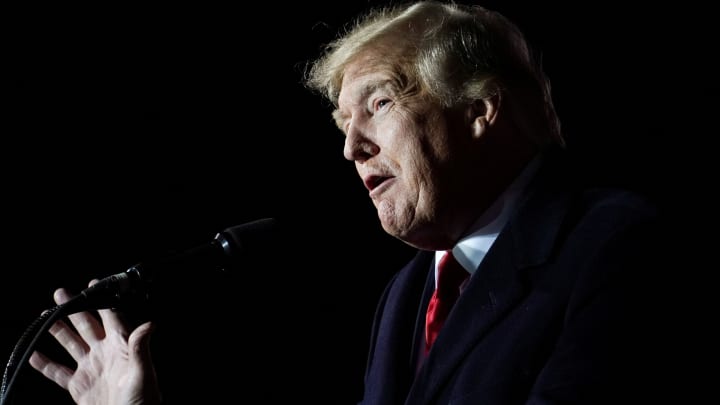
Donald Trump’s new social media venture, Truth Social, appears set to launch in Apple‘s App Store on Monday, according to posts from an executive on a test version viewed by Reuters, potentially marking the return of the former president to social media on the U.S. Presidents Day holiday, reported by CNBC.

In a series of posts late on Friday, a verified account for the network’s chief product officer, listed as Billy B., answered questions on the app from people invited to use it during its test phase. One user asked him when the app, which has been available this week for beta testers, would be released to the public, according to screenshots viewed by Reuters.

“We’re currently set for release in the Apple App store for Monday, Feb. 21,” the executive responded.

The launch would restore Trump’s presence on social media more than a year after he was banned from TwitterFacebook and Alphabet‘s YouTube following the Jan. 6, 2021, attack on the U.S. Capitol by his supporters, after he was accused of posting messages inciting violence.

On Feb. 15 Trump’s eldest son Donald Jr. posted on Twitter a screenshot of his father’s verified @realDonaldTrump Truth Social account with one post, or “truth,” that he uploaded on Feb. 14: “Get Ready! Your favorite President will see you soon!”

Led by former Republican U.S. Representative Devin Nunes, Trump Media & Technology Group (TMTG), the venture behind Truth Social, will join a growing portfolio of technology companies that are positioning themselves as champions of free speech and hope to draw users who feel their views are suppressed on platforms such as Twitter, Facebook and YouTube. So far none of the companies, which include Twitter competitors Gettr and Parler and video site Rumble, have come close to matching the popularity of their mainstream counterparts.

TMTG is planning to list in New York through a merger with blank-check firm Digital World Acquisition (DWAC), and stands to receive $293 million in cash that DWAC holds in a trust, assuming no DWAC shareholder redeems their shares, TMTG said in an Oct. 21 press release.

Additionally, in December TMTG raised $1 billion committed financing from private investors; that money also will not be available until the DWAC deal closes.

Digital World’s activities have come under scrutiny from the Securities and Exchange Commission and the U.S. Financial Industry Regulatory Authority, according to a regulatory filing, and the deal is likely months away from closing.

In addition to the post disclosing Monday’s launch date, the screenshots seen by Reuters show the app is now at version 1.0, suggesting it has reached a level ready for public release. As late as Wednesday, it was at version 0.9, according to two people with access to that version.

Apple’s App Store listing indicates that Truth Social is expected to be released on Feb. 21, a date that a source familiar with the venture confirmed in January. But in recent weeks Nunes had said publicly that the app would launch by the end of March.

On Friday, Nunes was on the app urging users to follow more accounts, share photos and videos and participate in conversations, in an apparent attempt to drum up activity, according to a person with knowledge of the matter.

Among Nunes’ posts, he welcomed a new user who appeared to be a Catholic priest and encouraged him to invite more priests to join, according to the person with knowledge of the matter.

A fourth Covid-19 doses might be recommended this fall

0

As the world approaches the second anniversary of the declaration of the Covid-19 pandemic by the World Health Organization, on March 11, more nations are rolling out — or are discussing the possibility of — fourth doses of coronavirus vaccine for their most vulnerable. In the United States, leading public health officials say they are “very carefully” monitoring if or when fourth doses might be needed, reported by CNN.

Israel was the first nation to roll out fourth doses, announcing in December that adults 60 and older, medical workers and people with suppressed immune systems were eligible to receive the extra shot if at least four months have passed since their third dose.

The United States has seen significant improvements recently in Covid-19 cases, hospitalizations and deaths. As of Friday, cases were down 44% from the prior week, hospitalizations dropped 26%, and deaths were 13% lower, according to Johns Hopkins University data.

“Vaccination and boosting will be critical in maintaining that downward trajectory, particularly when you’re talking about the red curve of severe disease leading to hospitalization,” Dr. Anthony Fauci, director of the National Institute of Allergy and Infectious Diseases, said during a White House Covid-19 Task Force briefing Wednesday.

The “potential future requirement” for an additional boost or a fourth shot of the Pfizer/BioNTech or Moderna mRNA vaccines or a third dose of the Johnson & Johnson vaccine “is being very carefully monitored in real time,” Fauci said. “And recommendations, if needed, will be updated according to the data as it evolves.”

The CDC has no recommendation of fourth doses of coronavirus vaccine for the general public, but the agency updated its guidelines in October to note that certain people who are moderately or severely immunocompromised may receive a fourth dose of the Moderna or Pfizer/BioNTech vaccines.

“For the immunocompetent people, a single booster shot continues to provide high levels of protection against severe disease caused by Omicron,” Fauci said Wednesday. “This should not be confused with the fact that for many immunocompromised people, already a second booster shot — namely a fourth dose of an mRNA — is recommended because of what we know about their poor response to the initial regimen.”

More recently, the Public Health Agency of Sweden announced last week that second booster doses are recommended for everyone 80 and older in the country. The United Kingdom’s Department of Health and Social Care announced Monday that an extra booster dose of coronavirus vaccine will be offered in the spring to adults 75 and older, residents in care homes for older adults and immunosuppressed people 12 and older.

In the United States, health officials emphasized late last year that fourth doses were not yet needed and said it was too premature to be discussing a potential fourth dose of coronavirus vaccine for most people.

Now, the US Food and Drug Administration “is indeed continually looking at the emerging data on the pandemic and variants in the United States and overseas in order to evaluate the potential utility and composition of booster doses,” FDA spokesperson Alison Hunt wrote in an email to CNN on Friday.

She confirmed that although Dr. Peter Marks, director of the FDA’s Center for Biologics Evaluation and Research, has noted that there is still much uncertainty as to how the pandemic may further evolve, he also has said it is possible that a fourth dose might be recommended as we move into fall.

A fall timeline coincides with the administration of flu shots, which could be convenient for people and makes sense scientifically because respiratory viruses — like the coronavirus and influenza — tend to peak in the winter months that follow.

“As more data become available about the safety and effectiveness of COVID-19 vaccines, including the use of a booster dose, we will continue to evaluate the rapidly changing science and keep the public informed,” Hunt wrote. “Any determination that additional booster doses are needed will be based on data available to the agency.”

If or when the FDA authorizes a fourth dose for the public, the next step would be for the US Centers for Disease Control and Prevention to review the data before making a recommendation for use, as the agency has done for other coronavirus vaccine recommendations.

Meanwhile, vaccine makers continue to study fourth doses in broader populations.

New athletic field houses are coming to four Atlanta high schools

0

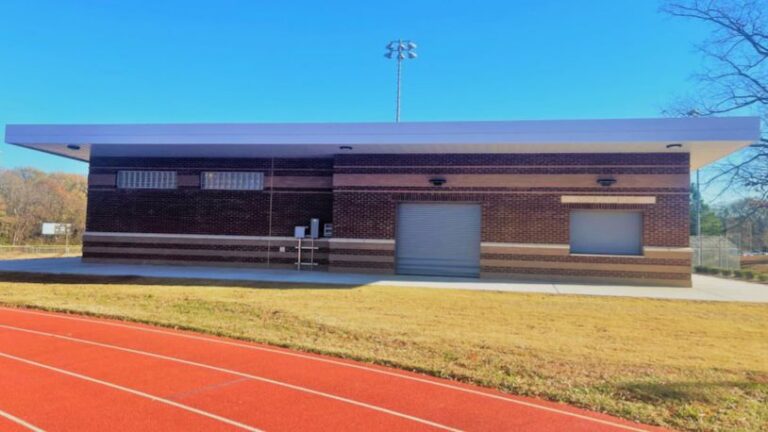
The Atlanta Board of Education recently approved a construction contract worth more than $5.8 million to build the facilities at Maynard Jackson, Mays, Therrell and Booker T. Washington high schools, reported by AJC.

Ensuring that all Atlanta high schools have field houses has been part of the district’s spending plan since 2016. The facilities feature restrooms, an area to sell concessions and space for storage.

In 2019, APS built two field houses, including one at Douglass High School. The other serves students who attend the all-girls Coretta Scott King Young Women’s Leadership Academy and the all-boys The B.E.S.T. Academy.

In 2021, Carver and South Atlanta high schools got their field houses.https://12a2801d864873afcd656c19fa91292b.safeframe.googlesyndication.com/safeframe/1-0-38/html/container.html

Student-athletes at Midtown High School use the Walden Athletic Complex, which opened in 2018, and its field house.

North Atlanta High School has a field house that dates to 2013.

The cost will be covered through a one-cent sales tax, known as an education special purpose local option sales tax, which generates money for Atlanta Public Schools’ building projects.

Construction is expected to be complete by fall, according to APS documents. The district awarded the contract to the Winter Construction Co.

Ukraine crisis tests partnership between China and Russia

0

Russia’s military buildup along its border with Ukraine is testing the possibility of a Moscow-Beijing axis lining up against the U.S. and its allies.

Russian leader Vladimir Putin’s meeting with Chinese counterpart Xi Jinping in Beijing this month fed speculation that a new alliance could form between the two great powers as they face off with the U.S. over a range of issues.

Russia and China have backed each other’s positions on opposing a NATO expansion in former Soviet republics and buttressing China’s claim to the self-governing island of Taiwan.

But the relationship remains lopsided. China’s confident rise as an economic and political force contrasts with Russia’s growing isolation and reversion to Cold War tactics of intimidation and bullying.

China also remains opposed to actions that could damage its territorial ambitions, from the South China Sea and Taiwan to the Indian border.

China has not criticized Russia over its moves against Ukraine, and has joined in verbal attacks on Washington and its allies. Addressing the Munich Security Conference over the weekend, Chinese Foreign Minister Wang Yi lashed out against the U.S., accusing “a certain power” of “stirring-up antagonism.”, according to AP.

However, in response to a question from conference Chairman Wolfgang Ischinger, Wang said the “sovereignty, independence and territorial integrity of any country should be respected and safeguarded, because this is a basic norm of international relations.”

“Ukraine is no exception,” Wang added.

He also stated that major powers should act in defense of global peace and no country should “repeat the past mistake of forging rival alliances.”

That chimes with China’s longstanding opposition to military alliances and often invoked — but often breached in practice — policy of non-interference in other countries’ internal affairs.

The comments were also in keeping with Beijing’s quest to replace a global order underpinned by alliances it considers threatening to its own development. Those include NATO and newer groupings joining the U.S. with Japan, India, Australia and other states with which China has substantial foreign policy disputes.

China is not putting its weight behind Russia’s foreign policy gambits, but the frostiness in relations with Washington shows no sign of thawing, said Shi Yinhong, a professor of international relations and director of the Center on American Studies at Beijing’s Renmin University of China.

“I believe that the Chinese government will continue to take care of China itself in the first place rather than take care of Russia,” Shi said. In the meantime, relations with Washington will remain fraught, particularly over the issue of Taiwan.

Beijing blames heightened tensions with the U.S. on what it calls a false depiction of China as a strategic rival.

This week marks the 50th anniversary of Richard Nixon’s visit to China that led to the establishment of formal diplomatic ties in 1979 and a new era of trade and economic relations. No joint celebrations have been announced.

US-China ties as fraught as ever, 50 years after Nixon visit

0

U.S. President Joe Biden has said he wants a more predictable relationship with China but major differences over trade and human rights make mutual understanding elusive. The prospect of long-term stability in ties raised by Nixon’s visit seems to be ever farther out of reach.

“China-U.S. relations are terrible,” said Xiong Zhiyong, a professor of international relations at China Foreign Affairs University. “There are indeed people hoping to improve relations, but it is utterly difficult to achieve.”

At the height of the Cold War, U.S. President Richard Nixon flew into communist China’s center of power for a visit that, over time, would transform U.S.-China relations and China’s position in the world in ways that were unimaginable at the time.

The relationship between China and the United States was always going to be a challenge, and after half a century of ups and downs, is more fraught than ever. The Cold War is long over, but on both sides there are fears a new one could be beginning. Despite repeated Chinese disavowals, America worries that the democratic-led world that triumphed over the Soviet Union could be challenged by the authoritarian model of a powerful and still-rising China, reported by AP.

“The U.S.-China relationship has always been contentious but one of necessity,” said Oriana Skylar Mastro, a China expert at Stanford University. “Perhaps 50 years ago the reasons were mainly economic. Now they are mainly in the security realm. But the relationship has never — and will never — be easy.”

Nixon landed in Beijing on a gray winter morning 50 years ago on Monday. Billboards carried slogans such as “Down with American Imperialism,” part of the upheaval under the Cultural Revolution that banished intellectuals and others to the countryside and subjected many to public humiliation and brutal and even deadly attacks in the name of class struggle.

Nixon’s 1972 trip, which included meetings with Chairman Mao Zedong and a visit to the Great Wall, led to the establishment of diplomatic relations in 1979 and the parallel severing of formal ties with Taiwan, which the U.S. had recognized as the government of China after the communists took power in Beijing in 1949.

Premier Zhou Enlai’s translator wrote in a memoir that, to the best of his recollection, Nixon said, “This hand stretches out across the Pacific Ocean in friendship” as he shook hands with Zhou at the airport.

For both sides, it was a friendship born of circumstances, rather than natural allegiances.

China and the Soviet Union, formerly communist allies, had split and even clashed along their border in 1969, and Mao saw the United States as a potential counterbalance to any threat of a Soviet invasion.

Nixon was seeking to isolate the Soviet Union and exit a prolonged and bloody Vietnam War that had divided American society. He hoped that China, an ally of communist North Vietnam in its battle with the U.S.-backed South, could play a role in resolving the conflict.

The U.S. president put himself “in the position of supplicant to Beijing,” said June Teufel Dreyer, a Chinese politics specialist at the University of Miami. Chinese state media promoted the idea that a “prosperous China would be a peaceful China” and that the country was a huge market for American exports, she said.

It would be decades before that happened. First, the U.S. became a huge market for China, propelling the latter’s meteoric rise from an impoverished nation to the world’s second largest economy.

Nixon’s visit was a “pivotal event that ushered in China’s turn outward and subsequent rise globally,” said the University of Chicago’s Dali Yang, the author of numerous books on Chinese politics and economics.

Two years after Mao’s death in 1976, new leader Deng Xiaoping ushered in an era of partial economic liberalization, creating a mix of state-led capitalism and single-party rule that has endured to this day.

China’s wealth has enabled a major expansion of its military, which the U.S. and its allies see as a threat. The Communist Party says it seeks only to defend its territory. That includes, however, trying to control islands also claimed by Japan in the East China Sea and by Southeast Asian nations in the South China Sea, home to crucial shipping lanes and natural resources.

The military has sent a growing number of warplanes on training missions toward Taiwan, a source of friction with the United States. China claims the self-governing island off its east coast as its territory. The U.S. supplies Taiwan with military equipment and warns China against any attempt to take it by force.

Still, Nixon’s trip to China was touted afterward as the signature foreign policy achievement of an administration that ended in ignominy with Watergate.

Embarking on the process of bringing China back into the international fold was the right move, but the past half-century has yet to put relations on a stable track, said Rana Mitter, professor of Chinese history and modern politics at Oxford University.

“The U.S. and China have still failed to work out exactly how they will both fit into a world where they both have a role, but find it increasingly hard to accommodate each other,” he said.

Chinese officials and scholars see the Nixon visit as a time when the two countries sought communication and mutual understanding despite their differences. Zhu Feng, the dean of the School of International Studies at Nanjing University, said the same approach is key to overcoming the current impasse.

“The commemoration of Nixon’s visit tells us whether we can draw a kind of power from history,” he said.

Though his trip to China gave the U.S. leverage in its Cold War rivalry with the Soviet Union, America now faces a new geopolitical landscape — with echoes of the past.

The Soviet Union is gone, but the Russian and Chinese leaders, Vladimir Putin and Xi Jinping, are finding common cause as they push back against U.S. pressure over their authoritarian ways. The Vietnam War is over, but America once again finds its society divided, this time over the pandemic response and the last presidential election.