Home Blog Page 49

Kemp has strong shot to knock out Perdue according to an AJC poll

0

Gov. Brian Kemp has a chance of landing an outright victory against former U.S. Sen. David Perdue, according to an Atlanta Journal-Constitution poll that shows the Republican incumbent with a hefty advantage over his Donald Trump-backed challenger

Kemp led Perdue 53% to 27% in the poll of likely voters in the Republican primary, which is now less than a month away. That would put the governor above the majority-vote threshold needed to avoid a June runoff. Other challengers were in the single digits; an additional 15% were undecided, according to AJC.

Charlie Defrancesco, a health care executive in Mineral Bluff, said he’s no fan of either candidate, but he’s more concerned about Stacey Abrams, the presumptive Democratic nominee. Kemp is the only candidate who has ever defeated her, and Defrancesco believes he can do it again.

“It’s the lesser of two evils, but Stacey Abrams is the worst,” he said. “I would vote for Kemp because I know how he’ll behave, where with Perdue I’m not so sure.”

The poll was conducted April 10-22 by the University of Georgia’s School of Public and International Affairs and involved 886 likely Republican primary voters. The margin of error is 3.3 percentage points.

The governor dominated Perdue in almost every category of voters polled by the AJC. Perdue fared best with lower-income voters, but he still trailed Kemp significantly. The governor’s campaign is racing to slam the door shut on Perdue in the May 24 primary, wary of an unpredictable runoff.

Perdue only outpolled Kemp among likely GOP voters who said a Trump endorsement would make them more likely to vote for a candidate, leading him 55% to 30% among that group. But a majority of respondents said Trump’s blessing made no difference or made them less likely to back a contender.

Adding to Perdue’s challenge, 71% of respondents gave Kemp a positive review, compared with 21% who viewed him unfavorably. By contrast, 57% of likely GOP voters had a favorable view of Perdue and nearly one-third had a negative image of him.

The poll’s results come at a crucial stage in the GOP race for governor. With the early-voting period beginning next week, Perdue is running out of time to cut into Kemp’s lead. And the governor plans a spate of bill signings — including a visit to Perdue’s hometown Tuesday — to press his advantage.

Perdue, meanwhile, has veered even more sharply to the party’s right flank to rally Trump supporters in hopes of forcing a runoff. Once known as a business-friendly conservative, Perdue’s campaign now centers on lies about a “rigged” election that he promoted to open Sunday’s debate and attempts to paint Kemp as a moderate.

“It’s going to be real close,” said Ben Williams, the fire chief of the west Georgia town of Manchester. “I’m pro-Kemp. I’m not anti-Perdue, but I think the governor has been on top of things during the pandemic for me and for my firefighters.”

Oil slumps 4% on Monday as Shanghai lockdowns stoke demand fears

0

Oil slumped about 4% on Monday to its lowest in two weeks on growing worries about the global energy demand outlook due to prolonged COVID-19 lockdowns in Shanghai and potential increases in U.S. interest rates, according to Reuters.

“The prospect of slower economic growth this year amid U.S. interest-rate hikes … has already led to a downward revision of oil-demand forecasts,” analysts at the Eurasia Group consultancy said, noting “The longer the Ukraine war and the China lockdowns persist, the higher the risk that demand growth will be even weaker.”

Shanghai’s COVID-19 lockdown misery dragged into a fourth week, as orders for mass testing in Beijing’s biggest district sparked fears that the Chinese capital could be destined for a similar fate.

Russia’s NK Rosneft PAO (ROSN.MM) failed to sell oil in a jumbo tender after demanding prepayment in roubles, meaning the country’s top oil company must find ways to divert more crude to Asian buyers via private deals.

In the United States, which will reopen its embassy in Ukraine soon, officials said domestic oil and gas production is rising and will continue to rise to make up for the 1 million to 1.5 million barrels of oil per day that has been pulled off the market after Russia’s invasion of Ukraine. 

France’s TotalEnergies SE (TTEF.PA) has provisionally chartered a tanker to load Abu Dhabi crude in early May for Europe, the first such shipment in two years. 

China is the world’s biggest oil importer.

Brent futures fell $4.33, or 4.1%, to settle at $102.32 a barrel, while U.S. West Texas Intermediate (WTI) crude fell $3.53, or 3.5%, to settle at $98.54.

Both benchmarks closed at their lowest since April 11 after losing nearly 5% last week. Since soaring to their highest since 2008 in early March, prices have collapsed by about 25%.

That retreat prompted U.S. speculators to cut their net long futures and options positions last week to the lowest since April 2020.

Open interest in WTI futures on the New York Mercantile Exchange last week to its lowest since July 2016, while daily futures volume dropped to its lowest so far this year.

Also pressuring oil, the U.S. dollar

Oil gained support earlier in the year from tight supplies after Russia’s Feb. 24 invasion of Ukraine caused customers to avoid Russian oil due to Western sanctions. The market could tighten further if the European Union (EU) bans Russian crude.

The EU is preparing “smart sanctions” against Russian oil imports, according to a report in The Times of London that cited the European Commission’s executive vice president, Valdis Dombrovskis. 

“Although the EU Commission is working on the sixth package of sanctions against Russia, an embargo on oil exports from Russia seems unlikely for now,” said Nikoline Bromander, senior analyst at Rystad Energy.

U.S. gasoline futures, meanwhile, slid less than crude, putting the gasoline crack spread – a measure of refining profit margins – at its highest since hitting a record in April 2020 when WTI settled in negative territory.

Panic buying triggered as Shanghai residents are fenced behind for quarantine

0

Government workers and volunteers reportedly installed green metal barriers — about 2 meters (around 6.5 feet) tall — in multiple districts over the weekend, blocking small streets and entrances to apartment buildings.

The move, which authorities describe as “hard quarantine,” adheres to China’s zero-COVID policy, the efficiency of which has been called into question as Omicron cases continue to spike in the city.

The announcement triggered panic buying in the Chinese capital, with shoppers stocking up on instant noodles, vegetables, toiletries and other essentials.

“Shanghai was a lesson,” Di, 63, who bought vegetables for up to 10 days, told Reuters.

Earlier this month, an online poll that surveyed nearly 1,000 Shanghai expat residents revealed that 85% of them were considering leaving China due to its lockdown policies.

“This has been a long time coming,” Alex Duncan, a startup founder, told Al Jazeera. “There has been a huge exodus growing since COVID first began. But this lockdown forced those who’d been considering leaving for a while to make a final decision.”

“Every compound, every gate, every door must be strictly managed,” Qi Keping, vice-head of Yangpu, a commercial district in Shanghai’s northeast, told reporters.

On Sunday, Shanghai reported 51 deaths — its highest daily tally yet — and 2,472 symptomatic cases, up from 1,401 on Saturday.

Photos and video footage of residents making pleas have gone viral on social media.

“No one can get out,” a foreigner whose residential complex was fenced told the BBC. “I feel helpless. You don’t know when the lockdown is going to end.”

Zhong Hongjun, a professor at the Shanghai University of Finance and Economics, regrets supporting the government’s zero-COVID policy. He now calls the measures “inhumane.”

“I always thought that Shanghai would never stoop to this low,” Zhong wrote on Weibo. “I was too naive and stupid.”

Meanwhile, Beijing now faces its own COVID-19 outbreak in the district of Chaoyang, where authorities on Sunday ordered residents to undergo three tests this week.

World’s oldest person, Kane Tanaka dies at 119

0

Kane Tanaka, a Japanese woman believed to have been the world’s oldest person, has died aged 119.

Tanaka died of old age at a hospital in southwestern Fukuoka city on April 19, Japanese public broadcaster NHK reported on Monday.

With Tanaka’s death, Lucile Randon, a French nun better known as Sister Andre, becomes the world’s oldest known person.

Randon was born in southern France on February 11, 1904, and recently celebrated her 118th birthday with her favourite  port-and-chocolate cocktail.

She lives at a nursing home in Toulon along the Mediterranean coast of France.

She was born in the Fukuoka region on January 2, 1903 — the same year the Wright brothers flew for the first time and Marie Curie became the first woman to win a Nobel Prize.

She was confirmed as the world’s oldest living person by Guinness World Records in 2019.

Tanaka was in relatively good health until recently and lived at a nursing home, where she enjoyed board games, solving maths problems, fizzy drinks and chocolate. She had been planning to join last year’s torch relay for the Olympic Games but pulled out because of coronavirus concerns.

Local Governor Seitaro Hattori hailed Tanaka’s life and said he was “extremely saddened” at her death.

“I was looking forward to seeing Kane-san on this year’s Respect for the Aged Day (a national holiday in September) and celebrating together with her favorite soda and chocolate,” he said in a statement on Monday.

In her younger years, Tanaka ran various businesses including a noodle shop and a rice cake store. She married Hideo Tanaka a century ago in 1922, giving birth to four children and adopting a fifth.

Japan has an ageing population with about 28 percent of people aged 65 or more.

As of last September, the country had 86,510 centenarians, and nine out of every 10 were women.

Germany will officially approve the delivery of Gepard anti-aircraft systems to Ukraine

0

Germany will officially approve the delivery of Gepard anti-aircraft systems to Ukraine, a senior lawmaker from one of the ruling coalition parties said on Tuesday.

According to Reuters, German Chancellor Olaf Scholz, who has faced criticism at home and abroad for his government’s failure to deliver heavy weapons to Ukraine, has pledged the delivery of anti-tank and anti-aircraft weapons from German military stocks, which he described however as “defensive weapons.”

Johannes Vogel, of the liberal Free Democrats, confirmed a report in daily Sueddeutsche Zeitung that Defence Minister Christine Lambrecht is set to offer the weapons at Tuesday’s meeting with allies at the United States’ Ramstein Air Base in Germany.

While the government refuses to detail what it has actually sent so far, the Bundeswehr has sent a total of 83 million euros worth of stocks (using the depreciated value), according to Defence Minister Christine Lambrecht.

Beijing expands mass COVID testing as lockdown fears grow

0

Beijing on Tuesday launched mass coronavirus testing for nearly all its 21 million residents, as fears grew that the Chinese capital may be placed under a strict lockdown like Shanghai.

China is trying to contain a wave of infections in Shanghai — its biggest city — which has been almost entirely locked down for weeks and reported 52 new Covid deaths on Tuesday, according to AFP.

Beijing authorities have ordered people in 12 central districts accounting for most of its population to undergo three rounds of PCR testing after the detection of dozens of cases in the city in recent days.

The capital reported 33 new cases on Tuesday, a fraction of the more than 16,000 tallied in Shanghai in the same period.

But Beijing officials are anxious to avoid a spiralling outbreak.

They have urged companies to allow employees to work from home, sealed off multiple buildings and suspended local group tourism ahead of the long May 1 national holiday.

Authorities on Monday urged Beijing residents not to leave the city for these holidays unless necessary.

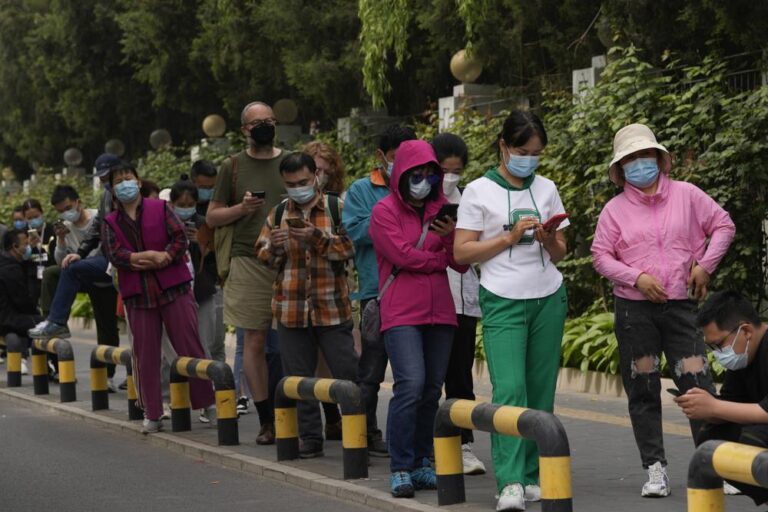
The capital’s most populous downtown district Chaoyang was the first to order mass testing from Monday, with people waiting in long lines to be swabbed by health workers in protective gear.

Eleven more districts began testing residents on Tuesday.

The testing order for Chaoyang had sparked panic buying from Sunday night, with residents lining up at supermarkets with full carts and bulging shopping bags as state media tried to reassure the public that there were plentiful supplies.

Beijing residents told AFP they feared a repeat of the sudden lockdown in Shanghai, where people have struggled to obtain food and medical care for non-Covid conditions.

Beijing health official Xu Hejian said Monday that the spread of the virus in the city was still “within the scope of control”.

Russia pounds eastern Ukraine on Tuesday as West promises Kyiv new arms

0

According to AP, Russia pounded eastern Ukraine on Tuesday as the U.S. defense secretary promised to “keep moving heaven and earth” to get Kyiv the weapons it needs to repel the new offensive even as Moscow warned such support risked widening the war.

Two months into the devastating conflict, Western arms have already helped Ukraine stall Russia’s invasion — but its leaders have said they need more support fast.

U.S. Defense Secretary Lloyd Austin said that help was on the way, as he convened a meeting of officials from around 40 countries at the United States’ Ramstein Air Base in Germany to pledge more weapons. Germany announced it cleared the way for delivery of Gepard anti-aircraft guns to Ukraine.

Britain said it believes 15,000 Russian troops have been killed in Ukraine since Russia’s invasion began — far above the 1,351 deaths acknowledged by Moscow. Defense Secretary Ben Wallace said 25% of the Russian combat units sent to Ukraine “have been rendered not combat effective.”

Ukrainian officials have said about 2,500 to 3,000 Ukrainian troops had been killed as of mid-April.

The West hopes that boosting arms supplies will help remaining fighters repel Russia’s invasion.

As he opened the meeting in Germany, Austin sought to reassure Kyiv: “We know, and you should know, that all of us have your back and that’s why we’re here today — to strengthen the arsenal of Ukrainian democracy.”

“This gathering reflects the galvanized world,” Austin said in his opening remarks. He added that he wanted officials to leave the meeting “with a common and transparent understanding of Ukraine’s near-term security requirements because we’re going to keep moving heaven and earth so that we can meet them.”

After fierce defense by Ukrainian forces thwarted Russia’s attempt to take Ukraine’s capital early in the war, Moscow now says its focus is the Donbas, the mostly Russian-speaking industrial region in eastern Ukraine. That move is already having a devastating effect on civilians trapped in the conflict.

In the small city of Toretsk, residents are struggling to survive, collecting rainwater for cleaning and washing up and fervently hoping for an end to the fighting.

“It’s bad. Very bad. Hopeless,” said Andriy Cheromushkin. “You feel so helpless that you don’t know what you should do or shouldn’t do. Because if you want to do something, you need some money; and there is no money now.”

With the potentially pivotal battle for the Donbas underway, the U.S. and its NATO allies are scrambling to get artillery and other heavy weaponry to that area in time to make a difference.

German Defense Minister Christine Lambrecht said her government decided on Monday to clear the delivery of Gepard self-propelled armored anti-aircraft guns to Ukraine, though she didn’t give details. German Chancellor Olaf Scholz has faced mounting pressure, including from within his governing coalition, to approve sending heavy weapons such as tanks and other armored vehicles to Ukraine.

Austin also noted Tuesday that more than 30 allies and partners have joined the U.S. in sending security assistance to Ukraine and more than $5 billion worth of equipment committed.

The meeting in Germany comes after Russian Foreign Minister Sergey Lavrov, speaking on Russian television, warned weapons supplied by Western countries “will be a legitimate target,” and accused NATO of “pouring oil on the fire” with its support for Ukraine, according to a transcript on the Russian Foreign Ministry’s website.

Lavrov also warned against provoking World War III and said the threat of a nuclear conflict “should not be underestimated.”

Russian President Vladimir Putin has cited NATO’s expansion and the risk that Kyiv could join the alliance as reasons for his invasion.

U.K. Armed Forces Minister James Heappey rejected Lavrov’s accusations of NATO aggression as “utter nonsense.”

He said “the reason there is a war in Ukraine right now is because Russia rolled over the borders of a sovereign country and started to invade their territory.”

Heappey also said Russia was making “unsound” military decisions and giving away tactical advantages because of Putin’s desire to secure some kind of victory by May 9, when Russia marks its victory in World War II.

Amid the talk of arms shipments, diplomatic efforts to seek an end to the fighting also continued. United Nations Secretary-General António Guterres met Lavrov on Tuesday and called again for a cease-fire. The U.N. chief is scheduled to meet Putin later.

Elsewhere, International Atomic Energy Agency Director General Rafael Mariano Grossi visited the Chernobyl nuclear plant to deliver equipment, conduct radiological assessments and restore safeguards monitoring systems after tanks and troops churned up highly contaminated soil there in the early hours of Russia’s invasion in February. His visit comes on the anniversary of the disaster at the plant in 1986, the world’s worst nuclear accident.

In its latest assessment of the fighting, the British Defense Ministry reported Russian advances and heavy fighting in the Donbas region, with one town, Kreminna, reportedly falling after days of street-to-street fighting.

Ukraine’s General Staff said Russian forces shelled Kharkiv, the country’s second-largest city that lies outside the Donbas but has seen significant attacks as Moscow seeks full control of the region. Ukrainian forces struck back in the Kherson region in the south.

A senior Russian military official has said that Russia’s goal is full control of Ukraine’s east and south, which would give it a swath of land that lies between Russia and Crimea, which Moscow seized in 2014.

Four people died and nine more were wounded on Monday in the Russian shelling of the Donetsk region of the Donbas, its governor Pavlo Kyrylenko said on Telegram. He said a 9-year-old girl and a 14-year-old boy were among those killed.

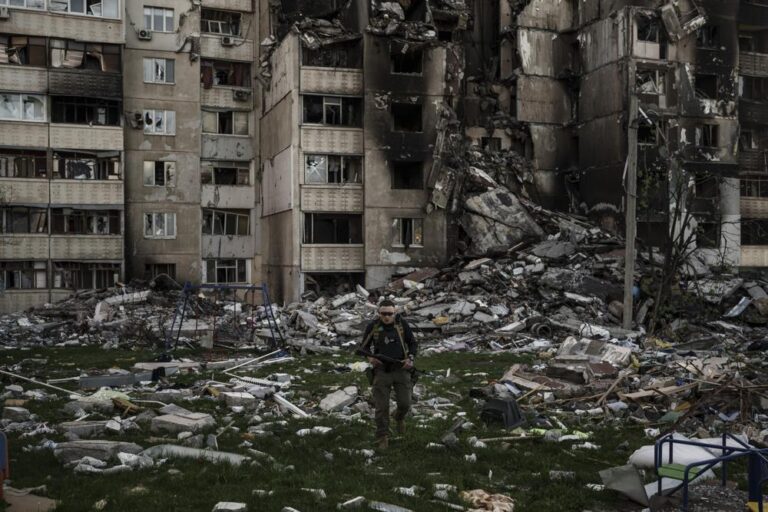
The city council and mayor of Mariupol said a new mass grave was identified about 10 kilometers (6 miles) north of the port city, which is key to the battle of the Donbas. Mayor Vadym Boychenko said authorities were trying to estimate the number of victims. It was at least the third new mass grave discovered in Russian-controlled areas near Mariupol in the last week.

Mariupol has been gutted by bombardment and fierce street fighting over the past two months. Russia’s capture of the city, where an estimated 2,000 Ukrainian troops and some 1,000 civilians are reportedly sheltering in a sprawling steel works, would deprive Ukraine of a vital port, help complete the land corridor to Crimea and free up troops to redeploy elsewhere in the Donbas.

Twitter set to accept Musk’s ‘best and final’ offer-sources

0

Twitter Inc (TWTR.N) is nearing a deal to sell itself to Elon Musk for $54.20 per share in cash, the price that he originally offered to the social media company and called his ‘best and final’, people familiar with the matter said, according to Reuters.

Twitter has not been able to secure so far a ‘go-shop’ provision under its agreement with Musk that would allow it to solicit other bids from potential acquirers once the deal is signed, the sources said. Still, Twitter would be allowed to accept an offer from another party by paying Musk a break-up fee, the sources added.

Twitter and Musk did not immediately respond to requests for comment.

Twitter may announce the $43 billion deal later on Monday once its board has met to recommend the transaction to Twitter shareholders, the sources said. It is always possible that the deal collapses at the last minute, the sources added.

Explosion at illegal oil refinery kills 100 people in Nigeria

0

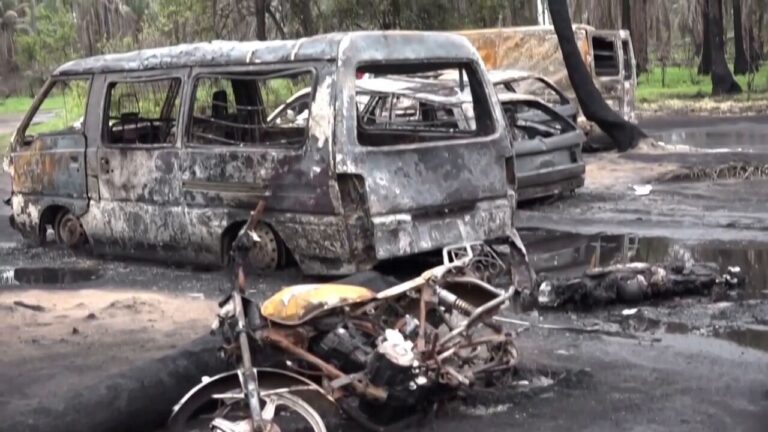
Vehicles were left burnt out and fuel pooled on the ground in Nigeria’s Imo state on Sunday following an overnight explosion at an illegal oil refining depot.

The state commissioner for petroleum resources, Goodluck Opiah, said late on Saturday that 100 people were killed in the explosion, remarking that they were “burnt beyond recognition.”

Crude oil is tapped from a web of pipelines owned by major oil companies and refined into products in makeshift tanks.

Government officials estimate that Nigeria, Africa’s biggest oil producer and exporter, loses an average of 200,000 barrels per day of oil, more than 10% of production, to those tapping or vandalizing pipelines.

The explosion was announced by a local government official late on Saturday.

The bunkering site was in the Ohaji-Egbema Local Government Area of Imo state, located in the Abaezi forest that straddles the border of neighboring Rivers state.

Unemployment and poverty in the oil-producing Niger Delta have made illegal crude refining an attractive business, albeit with deadly consequences.

Beijing locks down some areas as COVID-19 cases rise

0

China’s capital, Beijing, began mass testing of more than 3 million people on Monday and restricted residents in one part of the city to their compounds, sparking worries of a wider Shanghai-style lockdown.

While only 70 cases have been found so far in the city of more than 21 million since a new outbreak surfaced Friday, authorities have rolled out strict measures under China’s “zero-COVID” approach to try to prevent a further spread of the virus, according to AP.

Some residents worked from home and many stocked up on food as a safeguard against the possibility that they could be confined indoors, as has happened in multiple cities, including the financial hub of Shanghai. The city of Anyang in central China and Dandong on the border with North Korea also started lockdowns as the omicron variant spreads across the vast country.

Shanghai, which has been locked down for more than two weeks, reported more than 19,000 new infections and 51 deaths in the latest 24-hour period, pushing its announced death toll from the ongoing outbreak to 138.

Shanghai has buckled under a strict lockdown that has driven residents to band together to get food delivered through group buying. Goods have backed up at the port of Shanghai, affecting supplies and factory production and putting a crimp on economic growth.

Beijing locked down residents in an area about 2 by 3 kilometers (1 by 2 miles), telling them to work from home and stay in their residential compounds. It wasn’t a total lockdown — stores continued to operate — but cinemas, karaoke bars and other entertainment venues were ordered closed.

Elsewhere, the city also shut down some or all buildings in five residential compounds, adding to others that were locked down on Sunday.

Long lines formed in supermarkets in central Beijing. Shoppers snapped up rice, noodles, vegetables and other food items, while store workers hastily restocked some empty shelves. State media issued reports saying supplies remained plentiful despite the buying surge.

Shoppers appeared concerned but not yet panicked. One woman, carrying two bags of vegetables, eggs and frozen dumplings, said she was buying a little more than usual. A man said he isn’t worried but is just being cautious since he has a 2-year-old daughter.

Beijing health officials said 29 new cases had been identified in the 24 hours through 4 p.m. Monday, raising the total to 70 since Friday.

The city has ordered mass testing across sprawling Chaoyang district, where 46 of the cases have been found. The 3.5 million residents of Chaoyang, as well as people who work in the district, need to be tested on Monday, Wednesday and Friday.

Testing sites were set up overnight and in the early morning at residential complexes and office buildings around the district.

“I think Beijing should be fine,” said Gao Haiyang as he waited on line for a COVID-19 test. “Based on the previous response made by my community, if there’s any emergency, I think supply can be guaranteed. Plus there were lessons we learned from other cities. I think we can make good preparations.”