Home Blog Page 96

Teenage aviator Zara Rutherford has become the youngest woman to fly around the world solo.

0

Teenage aviator Zara Rutherford has become the youngest woman to fly around the world solo.

The 19-year-old, who has dual British-Belgian nationality, landed at Kortrijk-Wevelgem Airport in western Belgium on Thursday, completing an epic 41-country journey spanning over 52,000 kilometers (32,300 miles), and broke two Guinness World Records in the process, according to CNN.

Rutherford is currently on a gap year and plans to go to university in September to study computer engineering. Although both of her parents are pilots and she has been learning to fly since she was 14, Rutherford didn’t get her first license until 2020.

One of her main aims for this challenge, aside from breaking Waiz’s record, was to ensure greater visibility for women in aviation.

Last year, Rutherford spoke of her disappointment at the fact that just 5.1% of airline pilots around the globe are women, according to figures from the International Society of Women Airline Pilots (ISA).

“[5%] is such a small number, considering it’s a career where you basically get paid to travel around the world — obviously it’s work, but it’s an amazing career with amazing opportunities,” she told CNN.

“I made it,” Rutherford, who received a rapturous welcome on her arrival, told reporters.

Not only has she beaten the record held by American Shaesta Waiz, who was 30 when she circumnavigated the globe unaccompanied in 2017, Rutherford also now holds the title for the first woman to circumnavigate the world in a microlight aircraft.

She is also the first Belgian to fly around the world alone.

However, the teenager’s route to glory hasn’t been without its challenges.

When Rutherford departed on August 18, 2021 in a bespoke Shark ultralight aircraft, she believed her aerial escapade would take about three months.

But she was plagued by setbacks, including month-long delays in both Alaska and Russia due to “visa and weather issues,” pushing her schedule back eight weeks.

“I would say the hardest part was definitely flying over Siberia — it was extremely cold. It was minus 35 degrees Celsius on the ground,” Rutherford said during a press conference on Thursday.

“If the engine were to stall, I’d be hours away from rescue and I don’t know how long I could have survived for.”

She was also forced to make an unscheduled landing in Redding, California due to poor visibility as a result of the wildfires in the Seattle area and was later denied permission to fly over China.

China warns US after tracking warship in South China Sea

0

“The United States is defending every nation’s right to fly, sail and operate wherever international law allows, as USS Benfold did this week. Nothing PRC [People’s Republic of China] says otherwise will deter us,” it said.

“The PLA southern theatre’s statement is the latest in a long string of PRC actions to misrepresent lawful US maritime operations and assert its excessive and illegitimate maritime claims at the expense of its south-east Asian neighbours in the South China Sea.”

Bill Hayton, the author of South China Sea: The Struggle for Power in Asia, said the US mission was part of a pattern of freedom of navigation operations.

“The Americans aren’t doing anything that they haven’t done before, but of course China will call it provocative given everything else that is going on their relationship,” Hayton said. “Ironically, the more that China maintains these ‘baselines’, the more they attract American and even British warships to challenge them.”

The Chinese military has said it tracked a US warship that sailed through disputed waters in the South China Sea, accusing it of “provocative actions” and warning of “serious consequences”, according to Theguardian.com

The US Navy said its mission was in accordance with international law and in line with its commitment to defend “every nation’s right to fly, sail, and operate wherever international law allows”.

On Thursday afternoon a spokesperson for the People’s Liberation Army’s southern theatre command said the USS Benfold, a guided-missile destroyer, “illegally entered China’s Xisha territorial waters without the approval of the Chinese government”.

The spokesperson, Col Tian Junli, said China’s navy and air forces were engaged to track and monitor the ship and give an “eviction” warning.

“We solemnly demand that the US side immediately stop such provocative actions, otherwise it will bear the serious consequences of unforeseen events,” a statement from theatre command said.

In a responding statement, the US Navy said China’s statement was “false”.

The Xisha Islands, also known as the Paracels, are disputed islands in the South China Sea. China, Vietnam and Taiwan all claim sovereignty, but China holds practical control.

China has established military infrastructure on the island chain, which “plays a key role in China’s goal of establishing surveillance and power projection capabilities throughout the South China Sea,” according to the Asia Maritime Transparency Initiative.

The South China Sea, which is crossed by vital shipping lanes and also contain gas fields and rich fishing grounds, is a significant flashpoint in tensions between China and its regional neighbours, and with the US.

The US frequently carries out what it calls “freedom of navigation” missions in the South China Sea to challenge Chinese territorial claims. It said the USS Benfold on Thursday asserted “navigational rights and freedoms in the vicinity of the Paracel Islands, consistent with international law”.

“At the conclusion of the operation, USS Benfold exited the excessive claim and continued operations in the South China Sea,” it said, in apparent reference to China’s claim of a straight maritime boundary around the islands, which the US has accused China of declaring in an attempt to claim more waters and territory than it is entitled to under international law.

Theodore Roosevelt statue was hauled away from American Museum of Natural History

0

Still, some critics called the relocation a victory for cancel culture — and a blow to history.

According to NYPOST, a statue of Theodore Roosevelt that has stood in front of the American Museum of Natural History in Manhattan for more than 80 years was hauled away Wednesday, photos show.

The statue came under fire amid nationwide Black Lives Matter protests sparked by the police killing of George Floyd in May 2020.

The bronze monument depicting the nation’s 26th president on a horse flanked by an African man and a Native American man — which has sparked protests for glorifying colonialism and racism — was yanked out with a crane just after midnight, leaving behind only its concrete pedestal.

A crane removing the statue of President Theodore Roosevelt from  the American Museum of Natural History on January 19, 2022.
A crane removed the statue of President Theodore Roosevelt from the American Museum of Natural History on Jan. 19, 2022.
The statue had been at the museum for over 80 years.
The statue had been in front of the museum for over 80 years.
The crane lowering the statue down after it was removed.
The statue had been embroiled in controversy and recent protests.

The controversial effigy will be sent to a library in North Dakota on a long-term loan, officials have said.

The $2 million removal, carried out by the museum and the city, comes after the New York City Public Design Commission voted in June to relocate the monument.

Last month, the museum covered the 10-foot-tall statue with an orange tarp ahead of its shipment to the Theodore Roosevelt Presidential Library in Medora, North Dakota.

One of the ex-president’s descendants, Theodore Roosevelt V, cheered the removal plan last year, saying it’s “fitting that the statue is being relocated to a place where its composition can be re-contextualized to facilitate difficult, complex and inclusive discussions.”

The Teddy Roosevelt statue is secured before it's lifted.
The Teddy Roosevelt statue is secured before it’s lifted.
Workers putting up a scaffolding around the Roosevelt statue before it was removed.
Workers put up scaffolding around the Roosevelt statue before it was removed.
The statue is being loaned to a library in North Dakota.
The statue is being sent on a long-term loan to the Theodore Roosevelt Presidential Library in North Dakota.
A wall and tarp surround where that statue used to be located outside of the museum.
A wall and tarp surround where the statue was located outside the museum.

US researchers test pig-to-human transplant in donated body

0

For the newest kidney experiment, UAB teamed with Revivicor, the subsidiary of United Therapeutics that also provided organs for the recent heart transplant in Maryland and the kidney experiment in New York. Company scientists made 10 genetic changes to these pigs, knocking out some genes that trigger a human immune attack and make the animals’ organs grow too large — and adding some human genes so the organs look less foreign to people’s immune systems.

Then there are practical questions such as how to minimize time spent getting pig organs to their destination. UAB housed the altered pigs in a germ-free facility in Birmingham complete with an operating room-like space to remove the organs and ready them for transplant.

Revivicor chief scientific officer David Ayares said future plans include building more such facilities near transplant centers.

According to AP, researchers on Thursday reported the latest in a surprising string of experiments in the quest to save human lives with organs from genetically modified pigs.

This time around, surgeons in Alabama transplanted a pig’s kidneys into a brain-dead man — a step-by-step rehearsal for an operation they hope to try in living patients possibly later this year.

“The organ shortage is in fact an unmitigated crisis and we’ve never had a real solution to it,” said Dr. Jayme Locke of the University of Alabama at Birmingham, who led the newest study and aims to begin a clinical trial of pig kidney transplants.

Similar experiments have made headlines in recent months as research into animal-to-human transplants heats up.

Twice this fall, surgeons at New York University temporarily attached a pig’s kidney to blood vessels outside the body of a deceased recipient to watch them work. And earlier this month, surgeons at the University of Maryland Medical Center gave a dying man a heart from a gene-edited pig that so far is keeping him alive.

But scientists still needed to learn more about how to test such transplants without risking a patient’s life. With the help of a family who donated a loved one’s body for science, Locke mimicked the way human organ transplants are done — from removing the pig “donor” kidneys to sewing them inside the deceased man’s abdomen.

For a little over three days, until the man’s body was removed from life support, the pair of pig kidneys survived with no sign of immediate rejection, her team reported Thursday in the American Journal of Transplantation.

That was only one of several key findings. Locke said it wasn’t clear if delicate pig kidney blood vessels could withstand the pounding force of human blood pressure — but they did. One kidney was damaged during removal from the pig and didn’t work properly but the other rapidly started producing urine as a kidney should. No pig viruses were transmitted to the recipient, and no pig cells were found in his bloodstream.

But Locke said the kidney experiment could have more far-reaching impact — because it shows that a brain-dead body can be a much-needed human model to test potential new medical treatments.

The research was conducted in September after Jim Parsons, a 57-year-old Alabama man, was declared brain-dead from a dirt bike racing accident.

After hearing this kind of research “had the potential to save hundreds of thousands of lives, we knew without a doubt that that was something that Jim would have definitely put his seal of approval on,” said Julie O’Hara, Parsons’ ex-wife.

The need for another source of organs is huge: While more than 41,000 transplants were performed in the U.S. last year, a record, more than 100,000 people remain on the national waiting list. Thousands die every year before getting an organ and thousands more never even get added to the list, considered too much of a long shot.

Animal-to-human transplants, what’s called xenotransplantation, have been attempted without success for decades. People’s immune systems almost instantly attack the foreign tissue. But scientists now have new techniques to edit pig genes so their organs are more human-like — and some are anxious to try again.

The recent string of pig experiments “is a big step forward,” said Dr. David Kaczorowski of the University of Pittsburgh Medical Center. Moving on to first-stage trials in potentially dozens of people is “becoming more and more feasible.”

A heart transplant surgeon, Kaczorowski has done experiments testing pig organs in non-human primates that helped pave the way but “there are only things we can learn by transplanting them into humans.”

Hurdles remain before formal testing in people begins, including deciding who would qualify to test a pig organ, said Karen Maschke, a research scholar at the Hastings Center who will help develop ethics and policy recommendations for the first clinical trials under a grant from the National Institutes of Health.

Scientists also still have much to learn about how long pig organs survive and how best to genetically alter them, cautioned Dr. Robert Montgomery of NYU Langone Health, who led that center’s kidney experiments in the fall.

“I think different organs will require different genetic modifications,” he said in an email.

North Korea slams US, hints at resuming nuclear, ICBM tests

0

Kim Jong Un in recent years had showcased some new weapons he may wish to test, including what appeared to be North Korea’s largest-ever ICBM that was rolled out during a military parade in October 2020.

He also issued an ambitious wish-list of sophisticated weaponry early last year while setting a five-year plan to develop military forces, which included hypersonic missiles, solid-fuel ICBMs, spy satellites and submarine-launched nuclear missiles.

If the North does stage another nuclear test, it may use that event to claim it acquired an ability to build a nuclear warhead small enough to fit on a purported hypersonic missile it tested twice so far this year, experts say.

Last week, the U.S. Treasury Department imposed sanctions on five North Koreans over their roles in obtaining equipment and technology for the North’s missile programs, in its response to North Korea’s earlier tests this month.

The State Department ordered sanctions against another North Korean, a Russian man and a Russian company for their broader support of North Korea’s weapons of mass destruction activities. The Biden administration also said it would pursue additional U.N. sanctions over the North’s continued tests.

According to AP, accusing the United States of hostility and threats, North Korea on Thursday said it will consider restarting “all temporally-suspended activities” it had paused during its diplomacy with the Trump administration, in an apparent threat to resume testing of nuclear explosives and long-range missiles.

North Korea’s official Korean Central News Agency said leader Kim Jong Un presided over a Politburo meeting of the ruling Workers’ Party where officials set policy goals for “immediately bolstering” the North’s military capabilities to counter the Americans’ “hostile moves.”

Officials gave instructions to “reconsider in an overall scale the trust-building measures that we took on our own initiative … and to promptly examine the issue of restarting all temporally-suspended activities,” the KCNA said.

Experts say Kim is reviving Pyongyang’s old playbook of brinkmanship to extract concessions from Washington and neighbors as he grapples with a decaying economy crippled by the pandemic, mismanagement and U.S.-led sanctions over his nuclear ambitions.

The North has been ramping up its weapons demonstrations recently, including four rounds of missile launches just this month, in an apparent effort to pressure Washington over a prolonged freeze in nuclear diplomacy.

The North’s Foreign Ministry had already warned of stronger and more explicit action after the Biden administration last week imposed fresh sanctions over the North’s continued missile testing activity. The U.N. Security Council has scheduled a closed-door meeting for Thursday to discuss North Korea and non-proliferation matters.

Boo Seung-Chan, spokesman of South Korea’s Defense Ministry, said it was closely monitoring North Korea’s military activities but didn’t make presumptions about what the North’s next steps would be.

Kim announced a unilateral suspension of his nuclear and intercontinental ballistic missile tests in 2018 as he initiated diplomacy with then-President Donald Trump in an attempt to leverage his nukes for badly needed economic benefits.

Their summitry came after a provocative run in North Korean nuclear and intercontinental range ballistic missile testing in 2017 that demonstrated Kim’s pursuit of an arsenal that can viably target the American homeland and resulted in him exchanging threats of nuclear annihilation with Trump.

But negotiations have stalled since their second summit in 2019, when the Americans rejected North Korea’s demand for major sanctions relief in exchange for a partial surrender of its nuclear capabilities.

At the end of that year, Kim vowed to further bolster his nuclear arsenal in face of “gangster-like” U.S. threats and pressure and declared a “frontal breakthrough” against sanctions while urging his people to stay resilient in a struggle for economic self-reliance. He then said the North was no longer obligated to maintain its suspension on nuclear and ICBM tests, which Trump touted as a major achievement.

However, the pandemic thwarted many of Kim’s economic goals as the North imposed a lockdown and halted most of its trade with China, its major ally and economic lifeline.

North Korea appeared this month to have resumed railroad freight traffic with China that had been suspended for two years.

North Korea conducted its sixth and last test of a nuclear explosive device in September 2017 and its last launch of an ICBM was in November that year.

Some experts say that the North could dramatically raise the ante in weapons demonstrations after the end of February’s Winter Olympics in Beijing. They say Pyongyang’s leadership likely feels it would take a dramatic provocation to move the needle with the Biden administration, which has offered open-ended talks but showed no willingness to ease sanctions unless Kim takes real steps to abandon his nuclear and missile program.

Saying that U.S. hostility has reached a “danger line” that can no longer be overlooked, the North Korean Politburo members called for practical measures to “more reliably and effectively increase our physical strength for defending dignity, sovereign rights and interests of our state,” the KCNA said.

They criticized United States of continuing its military exercises with South Korea and arming its ally with advanced weaponry and claimed — apparently falsely — that Washington is continuing to send strategic assets to the region to pressure the North.

The United States since 2018 has dramatically scaled down its combined exercises with South Korea, which have mostly been reduced to computer simulations, to make room for diplomacy with North Korea and over COVID-19 concerns.

Duyeon Kim, an analyst at Washington’s Center for a New American Security, said North Korea’s claim of U.S. hostility is a pretext for continuing testing.

“Pyongyang is squarely focused on meeting its nuclear weapons milestones because of its military imperative to do so. This means more tests to come,” she said. “The pandemic has bought Pyongyang ample time to continue developing nuclear weapons because North Korea closed its borders and has been refusing direct talks, afraid of importing the virus.”

A Tongan man swam for more than 24 hours after the tsunami swept him out to sea

0

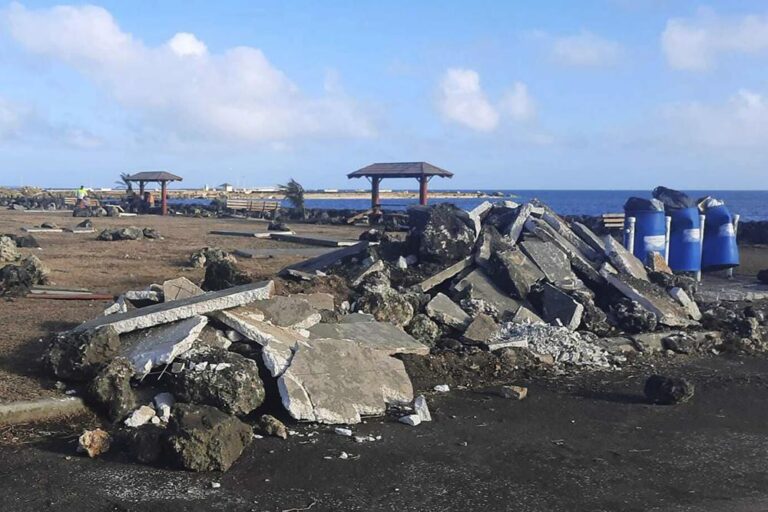
As Tonga comes back online following the eruption of its massive Hunga Tonga Hunga Ha’apai volcano on Saturday, we’re learning more about the toll it took on the environment and its people.

According to NPR, one survival story gaining attention around the world is that of Lisala Folau, a 57-year-old Tongan man who claims he swam for some 26 hours after he was swept out to sea by the tsunami waves the eruption triggered.

Folau first landed on Toketoke Island and says he saw a police boat heading back towards Atata around 7 a.m. He waved a rag at it as it passed by, but it did not stop for him.

From there Folau says he set off for the island of Polo’a, a journey that lasted from about 10 a.m. to 6 p.m. He then swam to Sopu, which is on the western edge of the capital Nuku’alofa, on the main island of Tongatapu.

He said his mind was on his family during the 7.5-km (4.7-mile) swim to the main island. He worried about his niece, who had been carried away by the wave, and the illnesses his sister and youngest daughter are facing.

“All these were racing in my minds and what point was there that now I have survived and what about them,” he said. “This drove me to get to Sopu.”

He says he reached the shore at about 9 p.m. local time Sunday, some 26 hours after the wave first swept him to sea. Folau says he crawled from the beach to the end of a public road and found a piece of timber to use as a walking stick as he tried to find help. A passing driver found him and, after a bit of questioning, helped him connect with his family.

It is not clear what happened to Folau’s other family members, but the New Zealand news site Stuff reports that his daughter later recounted the experience and her gratitude in an emotional Facebook post.

Others are sharing reports of Folau’s story on social media, hailing him as a “real-life Aquaman.” The so-called superhero sounded super humbled by the experience. He told Broadcom it was “so unexpected that I survived after being washed away, floating and surviving the dangers I just faced.”

Folau, a retired carpenter who lives on a small island called Atala, with a population of about 60 people, shared his story with Tongan media agency Broadcom Broadcasting. George Lavaka, whom The Guardian identified as a senior editor at the radio station, shared a translated transcript of Folau’s Thursday interview on Facebook.

Folau said that he was painting his house on Saturday evening when he heard from his brother about the incoming tsunami and climbed up a tree to seek refuge. He and his niece climbed down during a lull, but were caught off guard by a massive wave — he estimates more than 6 meters, or nearly 20 feet high — and swept out to sea, at about 7 p.m. local time.

Folau told the broadcaster that he has mobility issues that affect his legs and prevent him from walking “properly.” He could hear his son calling out to him from land, but didn’t respond because he didn’t want him to risk his safety by jumping in to try to rescue him.

“My thinking was if I answered him he would come and we would both suffer so I just floated, bashed around by the big waves that kept coming,” he said. “It stayed with my mind if I can cling to a tree or anything and if anything happen and I lose my life, searchers may find me and my family can view my dead body.”

World’s largest kitten at just under 2 years old

0

A Maine Coone from Stary Oskol in eastern Russia is thought to be the world’s largest kitten at just under 2 years old — with perhaps years more before he stops growing.

Until the Savannah cat was introduced in the 1980s, the muscular, broad-chested Maine Coon was considered the largest domesticated breed in the world — with an average weight of up to 18 pounds for males, and 12 pounds for females, reaching lengths over three feet, including the tail.

But according to Minina, Kefir has already eclipsed the average Maine Coon.

Since gaining 28 pounds (12.5 kilograms) — with still two more years to size up as Maine Coons are known to grow for up to four years — Minina can’t do all the things with Kefir she used to.

“At night he likes to climb on me and sleep. When he was a kitten, it didn’t cause me any inconvenience,” she explained. ”But now he has become big and heavy, and, of course, it is difficult to sleep like that.”

Owner Yulia Minina bought the alabaster tomcat named Kefir — after the creamy cultured milk drink — two years and many pounds ago.

“But when strangers come to the house, everyone first confuses him with a dog,” she added.

In fact, Kefir weighs more than the average toddler, with 2-year-olds typically clocking in at 26 to 28 pounds, according to BabyCenter.com.

“I could not even think that an ordinary baby can become so big,” joked Minina.

She told South West News Service that the commanding kitty’s stature is matched by his charming disposition. “He not only grew up big in appearance, he is also very smart and always behaves calmly,” she boasted.

For all the care he requires, Minina speaks about Kefir as if he were her own son: “The look is generally like that of a person, and Kefir has a formidable appearance, but he is a very affectionate and modest child,” she mused.

Maine Coon cat in the snow
The overgrown feline named Kefir — like the creamy, cultured drink — lives in chilly Stary Oskol in eastern Russia.

Like a newborn begging to be coddled, she suggested: “When friends and acquaintances come to the house, all the attention is on him and he willingly allows himself to be stroked.”

The Maine Coon breed, as its name suggests, hails from the state of Maine from regarded as one of the oldest homegrown breeds in North America. In the early days they were prized for their hunting skills, and since nicknamed “the gentle giant,” as they’ve taken primarily indoors as a highly regarded house cat, and even described as having friendly and playful, “dog-like” personalities.

Maine Coon cat
Kefir’s owner, Yulia Minina, swears she does “not use Photoshop” to make her cat appears so large in pictures.

Beijing residents disappointed at not being able to attend events

0

Along with coronavirus worries, the Games have been beset by political controversies, including a decision by the U.S. and its close allies not to send dignitaries in protest over China’s treatment of its Muslim Uyghur minority and other human rights abuses.

On Tuesday, athletes were urged by human rights activists to avoid criticizing China because they could be prosecuted.

The International Olympic Committee has said athletes will have freedom of speech when speaking to journalists or posting on social media. However, the Olympic Charter rule that prohibits political protests at medal ceremonies also requires “applicable public law” to be followed.

The IOC has not responded to requests in recent days to clarify how Chinese law could apply at the Games.

Asked about the free speech issues at the Olympics, Foreign Ministry spokesperson Zhao Lijian said Wednesday that China understood the IOC banned athletes from political protests.

“I would like to reiterate that China welcomes athletes from all countries to participate in the Beijing Winter Olympic Games and will ensure their safety and convenience,” Zhao told reporters at a daily briefing.

With just over two weeks before the opening of the Beijing Winter Olympics, residents of the Chinese capital say they’re disappointed at not being able to attend events because of coronavirus restrictions that have seen parts of the city placed under lockdown, according to AP.

Organizers announced Monday that no tickets will be sold to the general public and only selected spectators will be allowed. Access to the famed National Stadium, known as the Bird’s Nest, and indoor venues in the heart of Beijing have been sealed off.

People interviewed Wednesday appeared understanding of the restrictions. Many of them could be seen skating on Beijing’s frozen lakes in a sign of continuing enthusiasm for winter sports.

Because China allows no public protests or opinion polling and tightly restricts free speech, any opposition to the Games or the restrictions would be muted.

Chen Lin had planned to buy tickets for speed skating, but gave up over personal concerns about the pandemic and after it became clear that tickets would only be offered to selected spectators.

“I went to the Beijing Summer Olympic Games in 2008. It’s a pity that I won’t be able to watch the Games this time during the Winter Olympics,” the 38-year-old said. “Of course, we can still watch the Games with live broadcast on TV and live streaming online, but it doesn’t provide as strong a sense of engagement as watching the Games on the spot.”

Beijing is the first city to be awarded the right to host both the Summer and Winter Games.

Chen said the level of excitement this year was far below that of 2008, when the Games brought an outpouring of national pride.

“On the one hand, the Winter Olympics don’t get as much attention as the Summer Olympics. On the other hand, there is also the pandemic. Both of them are the reasons,” he said.

Retiree and amateur photographer Wang Shaolan, who volunteered at the 2008 Games, said she had been hoping to take her camera along to events in order to “be part of this.”

“But now with the closed-loop management, we won’t be able to be there ourselves. That’s a pity,” Wang said, referring to the restrictions separating participants from the general population.

The recent appearance of the more contagious omicron variant of the coronavirus in Beijing has heightened concerns about outbreaks, although the capital reported just one new case Wednesday.

Elsewhere in the country, around 20 million people are under some form of lockdown and mass testing has been ordered in entire cities where cases have been discovered.

China has largely avoided major outbreaks with lockdowns, mass testing and travel restrictions, although it continues to fight surges in several cities, including the port of Tianjin, about an hour from Beijing.

Restrictions were also tightened in the Henan province city of Anyang south of Beijing, where an additional 29 cases of local transmission were reported Wednesday, out of a national total of 55.

Games organizers have already announced that no fans from outside the country will be allowed.

The Olympics begin Feb. 4, just days after the start of Lunar New Year celebrations. Athletes, officials, staff and journalists are required to enter an anti-pandemic bubble without outside contact and undergo daily testing.

As an additional precaution, Beijing will require travelers to take nucleic acid tests within 72 hours of entering the city starting Jan. 22. Schools in Beijing have also closed early and moved classes online ahead of the winter holidays.

Thousands in Hong Kong volunteer to adopt unwanted hamsters amid COVID-19 fears

0

Aside from ordering the cull, authorities asked dozens of petshops to close, while imports and sales of small mammals were suspended. Buyers of hamsters after Dec. 22, 2021 were asked to hand them to authorities for culling and not leave them on streets.

Authorities set up a hotline for enquiries. It was unclear how many hamsters had been handed in.

Most Hong Kong newspapers featured pictures of people in hazmat suits in front of pet shops and illustrations of hamsters on their front page on Wednesday, with pro-Beijing Ta Kung Pao daily showcasing a tiny rodent inside a spiked virus particle.

Vanessa Barrs, professor of companion animal health at City University of Hong Kong, said the move to cull the hamsters up for sale could be justified on public health protection grounds, but fears of infection at home were overblown.

“Millions of people around the world have pets, and there have been no cases proven of pets transmitting infection to other humans,” Barrs said.

“The theoretical risk is there, but it just doesn’t happen.”

According to Reuters, thousands of people in Hong Kong volunteered on Wednesday to adopt unwanted hamsters after a mass cull order from the government over COVID-19 fears raised alarm that panicky owners would abandon their pets.

Authorities ordered on Tuesday 2,000 hamsters from dozens of pet shops and storage facilities to be culled after tracing a coronavirus outbreak to a worker in the Little Boss petshop, where 11 hamsters subsequently tested positive for COVID-19.

Scientists around the world and Hong Kong health and veterinary authorities have said there was no evidence that animals play a major role in human contagion with the coronavirus.

But having pursued a policy of zero tolerance for COVID-19, Health Secretary Sophia Chan said on Tuesday she could not rule out any transmission possibilities and therefore the government could take no chances.

Soon after, health workers in hazmat suits were seen walking out of pet shops around the city carrying red plastic bags into their vans. Some 150 of the petshop’s customers were sent into quarantine.

Public broadcaster RTHK said some hamster owners were seen handing over their animals at a government facility in the New Territories, while groups swiftly formed on social media to identify new owners for unwanted pet rodents.

Ocean, 29, a hamster owner and the administrator of ‘Hong Kong the Cute Hamster Group’ on the Telegram social media app, said the group was contacted by almost 3,000 people willing to take care of unwanted animals temporarily.

Three young owners were pressured by their families to get rid of their hamsters even though they all owned them for more than half a year, said Ocean, who declined to give her last name fearing angry reactions from those who support the cull.

“Many pet owners are unfamiliar with the exact risks and give up their hamsters,” she said.

Bowie, 27, one of those who volunteered in the group, is now the owner of two new hamsters.

“This is ridiculous,” said Bowie, who already owned three other hamsters. “Animals’ life is also life. Today it can be hamsters or rabbits, tomorrow it can be cats or dogs.”

The local Society for the Prevention of Cruelty to Animals (SPCA), which runs veterinary clinics, told Reuters “numerous” worried pet owners have been contacting them for advice.

“We urge the pet owners not to panic or abandon their pets,” SPCA said in a statement.

SPCA listed ways to maintain strict personal hygiene for the safety of humans and animals, including never to kiss, cough at or snort near pets, and washing hands after handling them.

The average lifespan of a hamster is about two years, according to animal welfare groups.

USPS COVID tests: Some tech issues arise

0

The Biden administration on Tuesday quietly launched its website for Americans to request free at-home COVID-19 tests, a day before the site was scheduled to officially go online.

Since Saturday, private insurance companies have been required to cover the cost of at-home rapid tests, allowing Americans to be reimbursed for tests they purchase at pharmacies and online retailers. That covers up to eight tests per month.

According to AP, the technical bugs that embarrassed President Barack Obama’s administration with the 2013 rollout of the HealthCare.gov website should not be a problem for the COVID-19 test kit website in part because it is so much simpler, said Alex Howard, director of the Digital Democracy Project, an open government watchdog group. Howard said the new website is also simpler than the Vaccines.gov website – for finding nearby vaccine clinics and pharmacies – that was already successfully launched by the Biden administration last year.

Howard said the task of requesting someone’s address is a straightforward one, especially when compared with the Obama-era health insurance website that involved shopping for different health plans and authenticating a secure transaction. The challenge of hosting a website application under high demand is also a “solved problem” in the private sector, he said.

“My expectation is the U.S. Digital Service and any vendors they work with will be able to pull this off,” he said. “It’s the least hard part of this.”

Two tech companies that frequently work with the federal government – Microsoft and Accenture – on Tuesday referred questions about the website to the Postal Service. Amazon, a major cloud provider for U.S. agencies, didn’t respond to requests for comment.

Howard said the trickiest part of the project is not the website but the physical distribution of kits.

“I don’t recall the last time the federal government sent something like this to everyone that wasn’t a tax document,” he said.

The website, COVIDTests.gov, now includes a link for “every home in the U.S.” to access an order form run by the U.S. Postal Service. People can order four at-home tests per residential address, to be delivered by the Postal Service. It marks the latest step by President Joe Biden to address criticism of low inventory and long lines for testing during a nationwide surge in COVID-19 cases due to the omicron variant.

White House press secretary Jen Psaki said the website was in “beta testing” and operating at a “limited capacity” ahead of its official launch. The website will officially launch midmorning Wednesday, Psaki said.

There were isolated reports Tuesday afternoon of problems relating to the website’s address verification tool erroneously enforcing the four-per-household cap on apartment buildings and other multi-unit dwellings. A spokesperson for the Postal Service said in a statement that the error was “occurring in a small percentage of orders.” He said any user needing assistance could file a service request at emailus.usps.com/s/the-postal-store-inquiry or contact a help desk at 1-800-ASK-USPS.

At points Tuesday more than 750,000 people were accessing the website at the same time, according to public government tracking data, but it was not immediately known how many orders were placed.

Psaki added that the administration was anticipating a “bug or two,” but had IT experts from across the government working to get the site ready.

Biden announced last month that the U.S. would purchase 500 million at-home tests to launch the program and on Thursday the president announced that he was doubling the order to 1 billion tests.

But Americans shouldn’t expect a rapid turnaround on the orders and they will have to plan ahead and request the tests well before they meet federal guidelines for when to use a test.

The White House said “tests will typically ship within 7- 12 days of ordering” through USPS, which reports shipping times of 1-3 days for its first-class package service in the continental United States.

Officials emphasized that the federal website is just one way for people to procure COVID-19 tests, and shortages of at-home test kits have shown signs of easing as more supply has hit the market.