Home Blog Page 94

South Korea sets high of 8,000 new virus cases ahead of holiday

0

Omicron has become the dominant variant in many countries and more easily infects those who have been vaccinated or had COVID-19 previously. But vaccination and booster shots still provide strong protection from serious illness, hospitalization and death.

More than 85% of South Korea’s more than 51 million people have been fully vaccinated. The KDCA said 50.1% of the population have been administered booster shots as of Tuesday afternoon.

According to AP, South Korea recorded more than 8,000 new coronavirus infections for the first time Tuesday as health authorities reshape the country’s pandemic response to address a surge driven by the highly contagious omicron variant.

The 8,571 new cases reported by the Korea Disease Control and Prevention Agency followed three straight days exceeding 7,000. With omicron spreading more than twice as fast as the delta strain that cause the last surge, experts say new cases may exceed 10,000 this week and possibly 20,000 after the Lunar New Year’s holiday break that begins this weekend and continues to next Wednesday.

To prevent a sudden explosion of infections from overwhelming hospitals and disrupting workplaces and essential services, South Korea will reduce quarantine periods, expand testing and treat more people at home.

From Wednesday, the quarantine periods for people who test positive after being fully vaccinated will be reduced from the current 10 days to seven days. Fully vaccinated people who comes in close contact with virus carriers won’t be placed under quarantine. Officials are also planning to treat a larger number of mild or moderate cases at home and expand the use of rapid antigen tests to detect more infections sooner.

Park Hyang, a senior Health Ministry official, pleaded people to stay home during the upcoming holidays and get vaccinated if they haven’t already. While those who aren’t fully vaccinated account for less than 7% of South Koreans who are 12 years or older, these people have accounted for about 60% of serious cases and deaths in the past eight weeks, Park said during a briefing.

“While infections are increasing, cases among people in their 60s or older, who are at higher risk of serious illness and death, have so far remained at a low level,” Park said. “We believe this is because the rate of people in that age group who received booster shots has now rose to 84.9%.”

LG Energy Solution, GM plans to build $2.1 billion battery factory in U.S.

0

South Korea’s LG Energy Solution (LGES) plans to spend $2.1 billion with General Motors (GM.N) to build a U.S. electric vehicle (EV) battery plant, parent firm LG Chem (051910.KS) said on Tuesday.

According to Reuters, LGES and GM are expected to fund the project equally via Ultium Cells, their U.S.-based battery joint venture, for what will be their third joint battery plant in the United States, LG Chem’s regulatory filings showed.

LGES commands more than 20% of the global electric vehicle battery market and supplies Tesla Inc (TSLA.O), Volkswagen AG (VOWG_p.DE) and Hyundai Motor Co (005380.KS), among others.

It is already building two plants with GM in Ohio and Tennessee to manufacture 70 GWh of batteries, which could power about 1 million EVs by 2024. read more

LGES has production sites in the United States, China, South Korea, Poland and Indonesia.

Its announcement came ahead of the company’s market debut later this week after launching South Korea’s biggest ever IPO.

The IPO attracted $12.8 trillion worth of bids from institutional investors and $96 billion from retail investors.

The IPO price values LGES at about 70.2 trillion won ($58.57 billion) and will make it South Korea’s third most-valuable company after Samsung Electronics Co (005930.KS) and SK Hynix Inc (000660.KS).

($1 = 1,198.5800 won)

LGES declined to provide detail on the location or production capacity of the new plant.

In December, Reuters reported that GM had proposed building a $2.5 billion battery plant near Lansing, Michigan, with LGES. read more

North Korea fires cruise missiles lifting nuclear moratorium

0


North Korea fired two cruise missiles into the sea off its east coast on Tuesday, South Korea’s military said, amid rising tension over a recent series of weapons tests, according to Reuters.

North Korea has not launched intercontinental ballistic missiles or nuclear weapons since 2017, but began testing a slew of shorter-range missiles after denuclearisation talks stalled following a failed summit with the United States in 2019.

The flurry of recent tests sparked a U.S. push for fresh U.N. sanctions, followed by heated reaction from Pyongyang. read more

The U.N. Security Council bans North Korea from any launches using ballistic technology, but not cruise missiles. China and Russia have recently called for removing a ban on Pyongyang’s exports of statues, seafood and textiles, and raising a refined oil imports cap. read more

South Korea’s Joint Chiefs of Staff did not specify the missiles’ range or trajectory, but said it was conducting an analysis together with U.S. authorities.

The launch was North Korea’s fifth of the year, following tests of a tactical guided missile, two “hypersonic missiles” capable of high speed and manoeuvring after lift-off, and a railway-borne missile system.

Tension has been growing, with leader Kim Jong Un vowing last week to bolster the military and warning he could lift a self-imposed moratorium on testing atomic bombs and long-range missiles. read more

A spokesperson the U.S. State Department said the United States was aware of the latest launch reports and was assessing them with South Korea and Japan. The official offered no details but reiterated that Washington remained open to dialogue with Pyongyang.

“Broadly speaking, as we have said our goal remains the complete denuclearisation of the Korean peninsula. We remain prepared to engage in serious and sustained diplomacy without preconditions to make tangible progress.”

At the same time, the spokesperson said, the United States would continue efforts in coordination with the international community to prevent the advancement of North Korea’s weapons of mass destruction and ballistic missile programs.

South Korea’s Unification Minister Lee In-young, in charge of cross-border ties, urged North Korea to return to talks, not escalate further.

“While thoroughly preparing for additional tests, we’d like to emphasise again that dialogue and cooperation is the only way to peace,” he told a meeting with foreign diplomats based in Seoul.

Japan’s Chief Cabinet Secretary Hirokazu Matsuno did not confirm the latest test but said Tokyo would work with neighbours to gather and analyse necessary information.

North Korea has said it is open to talks, but only if the United States and its allies drop “hostile policy” measures such as sanctions and military drills.

Lee Sang-min, a military expert at the Korea Institute for Defense Analyses, said the recent missile volleys could be aimed at building geopolitical tensions and perhaps pushing the United States to come up with a new strategy toward Kim.

“Cruise missiles are slower than ballistic missiles and so are regarded as less of a threat, but they hit targets with high precision, something North Korea would continue to develop,” Lee said.

Pfizer and BioNTech begin evaluating an omicron-specific COVID-19 vaccine

0

Pfizer and BioNTech have begun a clinical trial to evaluate an omicron-specific vaccine for COVID-19, the pharmaceutical companies announced Tuesday, according to NPR.

The study will include as many as 1,420 participants divided into three groups.

One group includes people who have already received two doses of the current Pfizer-BioNTech vaccine and will also receive the omicron vaccine. A second includes those with three doses of the current Pfizer vaccine who will also get the omicron vaccine. The third group includes unvaccinated people who will receive three shots of the omicron vaccine.

The Food and Drug Administration has authorized the current Pfizer-BioNTech COVID-19 vaccine for emergency use in people ages 5 and older. The Moderna and Johnson & Johnson vaccines are authorized for adults.

Though people who are vaccinated and boosted appear to be better protected against severe disease and hospitalization from omicron, the highly contagious variant has still led to breakthrough cases and a surge in overall infections around the world.

“While current research and real-world data show that boosters continue to provide a high level of protection against severe disease and hospitalization with Omicron, we recognize the need to be prepared in the event this protection wanes over time and to potentially help address Omicron and new variants in the future,” Kathrin U. Jansen, Pfizer’s senior vice president and head of vaccine research and development, said in a statement.

A veteran won a $4 million lottery prize after he used the numbers from a fortune cookie

0

A North Carolina veteran turned a restaurant meal into a Mega Millions jackpot after he used the numbers from his fortune cookie to win a $4 million prize, according to NPR.

Gabriel Fierro and his wife eat at the Red Bowl Asian Bistro in Charlotte, N.C., about once a week, according to the NC Education Lottery. Last week, however, their cookies were extra fortunate.

“I got an email in the morning and I just stared at it dumbfounded,” he said. “I took it and showed it to my wife and she thought it was an April Fool’s joke or maybe a scam.”

Then it sunk in, he said, and they ran around the house “screaming like a bunch of banshees.”

Fierro collected the prize on Thursday, taking home $2,840,401 after tax withholdings. The 60-year-old — who retired as a disabled combat veteran after spending 32 years in the Army, including time in Iraq — said he plans to invest most of his winnings.

FiveThirtyEight did an analysis several years ago in the hopes of figuring out just how lucky fortune cookie numbers really are. After plenty of calculations involving years’ worth of historical data, they found: It’s complicated.

Fierro said he decided “on a whim” to play his fortune cookie numbers in last Tuesday’s drawing — and ended up with the largest win in the history of Online Play in the state.

As the lottery explained in a blog post, Fierro bought his ticket using Online Play and added $1 to make it a Megaplier ticket (which would multiply any win). He matched all five white balls to win $1 million, which quadrupled to $4 million when the “4X Megaplier” hit.

Fierro initially couldn’t believe his own luck.

China flew 39 warplanes toward Taiwan, largest in new year

0

Chinese pilots have been flying towards Taiwan on a near-daily basis in the past year and a half, since Taiwan’s government started publishing the data regularly. The largest sortie was 56 warplanes on a single day last October.

The activity has generally been in the air space southwest of the island and falls into a zone that Taiwan’s military says it monitors out of national security considerations.

Tensions have been high since Taiwanese citizens elected Tsai Ing-wen as president in 2016, to which Beijing responded by cutting off previously established communications with the island’s government. Tsai’s predecessor was friendly to China and had endorsed Beijing’s claim that the two are part of a single Chinese nation.

The U.S. regularly carries out exercises in the South China Sea in what it calls freedom of navigation operations, in line with international law.

According to AP, China flew 39 warplanes toward Taiwan in its largest such sortie of the new year, amid tensions over the self-ruled island’s future and as the U.S. pushes to assert its presence in the region.

The Chinese formation Sunday night included 24 J-16 fighter jets and 10 J-10 jets, among other support and electronic warfare aircraft, according to Taiwan’s defense ministry.

Taiwan’s air force scrambled its own jets and tracked the People’s Liberation Army planes on its air defense radar systems, the ministry said.

The Chinese sortie came as the U.S. military said that two of its carrier strike groups were sailing on Sunday in the South China Sea, led by USS Carl Vinson and USS Abraham Lincoln. They engaged in anti-submarine, air and combat readiness operations.

China’s Ministry of Foreign Affairs declined to comment on why the PLA had flown such a large sortie on Monday, saying it was not a diplomatic matter.

Taiwan and China split during a civil war in 1949, but China claims the island as its own territory. Beijing has used diplomatic and military means to isolate and intimidate the self-ruled island, but the U.S. has continued to support Taiwan by selling it advanced weapons and fighter planes.

Japan to widen virus measures and extend COVID-19 restrictions

0

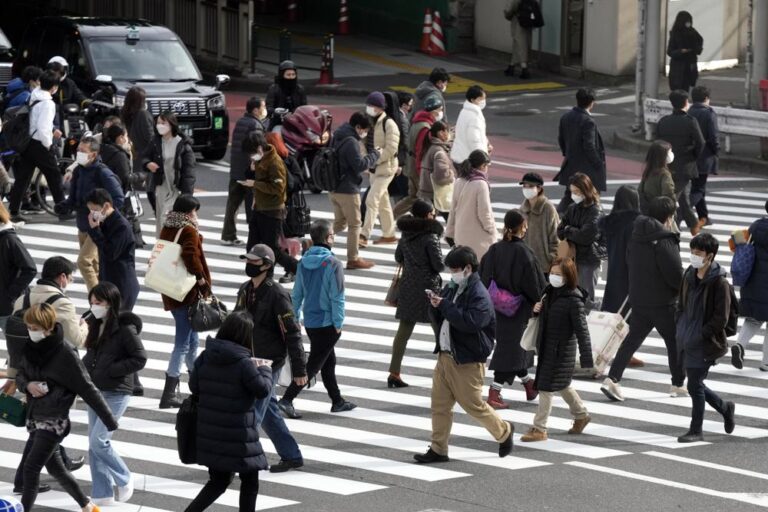
Japan’s government plans to put the majority of the country under pre-emergency status and extend COVID-19 restrictions as omicron cases have surged and threatened to disrupt basic services like hospitals and schools.

So far, hospitals are not overflowing as in earlier waves, but experts say the rapid upsurge of the cases could overwhelm the medical system once the infections spread among the elderly population who are more likely to become seriously ill.

While about 80% of Japanese have received their first two vaccine doses, the rollout of booster shots has been slow and has reached only 1.9 % of the population so far.

Tokyo logged 8,503 new cases Monday, double from a week ago. Nationwide, nearly 45,000 virus cases were reported for an accumulated total of about 2 million, with about 18,500 deaths, according to AP.

Prime Minister Fumio Kishida said Monday that he will tighten anti-virus measures in 18 more prefectures, including Hokkaido in the north to Osaka and Kyoto in western Japan, until Feb. 20. This will be in addition to areas where similar restrictions are already in place or to be further extended — including Tokyo, Okinawa, Yamaguchi and Hiroshima.

“Many people are feeling increasingly uneasy as the infections rapidly spread,” Kishida told reporters. “I want to obtain the people’s cooperation to overcome this crisis.”

Kishida said he will officially announce the measures Tuesday after consulting with a government panel that includes health experts.

Kishida added that the government has ordered COVID-19 test kit makers to boost production so that testing capacity can be increased to 800,000 per day, in the face of persistent shortages in Japan.

In some areas where test kits have run out, the health ministry said COVID-19 patients can be diagnosed based on symptoms, without tests.

Under the latest measures, most eateries are asked to close by latest 9 p.m. in exchange for government subsidies, with some restrictions on large public events.

Critics say the measures, which almost exclusively target bars and restaurants, make little sense and are unfair.

Japan has resisted the use of lockdowns to limit the spread of the virus as the government seeks to minimize damage to the economy. Even so, Japanese are increasingly becoming less cooperative to social distancing and other restrictions.

Tough border controls that are scheduled to last through the end of February have also triggered criticism from foreign students and scholars who say the measures are not scientific.

Surging infections have already begun to paralyze hospitals, schools and other sectors in some areas.

The health ministry said more than 300 nursery schools had to be closed because of the high number of children, as well as staff infected or their colleagues who were forced into self-isolation after close contact with confirmed cases.

South Korea to expand testing, shorten quarantine for omicron

0

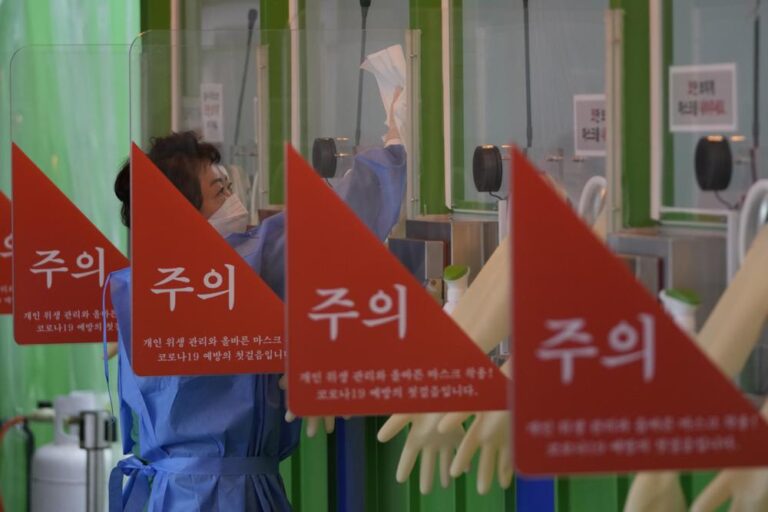
South Korea will expand rapid testing and shorten quarantines as it reshapes its pandemic response to deal with a faster-than-expected surge in coronavirus infections driven by the highly contagious omicron variant.

The plans were announced as the country reported 7,513 new cases of infection on Monday, the third straight day exceeding 7,000 and nearing a one-day high of 7,848 reported in December, when a devastating delta-driven spread spiked hospitalizations and deaths.

The new testing process will be enforced from Wednesday at three cities near capital Seoul and the southern South Jeolla province — regions where the levels of omicron infections have been highest — before being expanded nationwide at the end of this month or early February, Jeong said.

“While the omicron variant leads to less serious cases (compared to delta), it’s highly contagious and could cause a huge strain on our epidemiological and medical response if it leads to huge number of infections over a short period of time,” she said.

Starting Wednesday, the quarantine for people who test positive after being fully vaccinated will be reduced from the current 10 days to seven days, KDCA Commissioner Jeong Eun-kyeong said during a briefing.

Fully vaccinated people who come in close contact with virus carriers will no longer be placed under quarantine, but they will be required to report their daily health conditions to officials before receiving a test within six or seven days.

Officials say the easing of quarantine restrictions is inevitable as they try to prevent an explosion in omicron cases from causing major disruption at workplaces and public services by putting huge numbers of people under quarantine.

The new rules will require people who aren’t fully vaccinated to quarantine for seven days if they come in close contact with a virus carrier and 10 days if they test positive themselves. As of Monday, more than 85% of a population of more than 51 million were fully vaccinated and around 49% have gotten booster shots.

Officials also plan to rewire the country’s testing regime that’s currently centered around PCR tests and expand the use of rapid antigen tests to detect a larger number of infections sooner.

According to the plans, PCR tests will be mostly saved for high-risk groups, including people in their 60s and older or those with pre-existing medical conditions. Most people will be asked to first use rapid test kits available at public health offices and pharmacies and receive PCR when those tests are positive.

While PCR tests have been described by medical experts as the “gold standard” for their accuracy and reliability, such tests require large numbers of health professionals administrating nasal and throat swabs and high-tech laboratory machines analyzing samples.

Graduation rates dip across US as pandemic stalls progress

0

High school graduation rates dipped in at least 20 states after the first full school year disrupted by the pandemic, suggesting the coronavirus may have ended nearly two decades of nationwide progress toward getting more students diplomas, an analysis shows.

The drops came despite at least some states and educators loosening standards to help struggling students.

The results, according to data obtained from 26 states and analyzed by Chalkbeat, are the latest concerning trend in American education, which has been rocked by a pandemic that left many students learning remotely last year and continues to complicate teaching and learning. Some fear that the next several graduating classes could be even more affected.

“It does concern me,” said Chris Reykdal, the schools superintendent in Washington state, where the graduation rate fell by about half a point. “I don’t ever want to see a decline. We’ve made such steady progress.”

According to AP, in 2020, when schools shuttered for the final months of the school year, most states waived outstanding graduation requirements and saw graduation rates tick up. But the picture was different for the class of 2021. In 20 of 26 states that have released their data, graduation rates fell. Comprehensive national data will likely not be available until 2023.

Those declines were less than a percentage point in some states, like Colorado, Georgia and Kansas. Elsewhere, they were larger. Illinois, Oregon, and North Dakota saw graduation rates drop 2 points, and Indiana, Maine, Nevada, South Dakota, and West Virginia saw declines of at least 1 point.

Where rates increased, growth was modest. Florida had seen graduation rates jump by more than 2 points every year for a decade but gained just a tenth of a point in 2021, even as state officials waived certain diploma requirements.

“We do have to be concerned that grad rates are down and that some number of kids that earned a diploma, they’ve learned less than prior years,” said Robert Balfanz, a professor at the Johns Hopkins School of Education and director of a research center focused on high school graduation. “What we’re going to have to learn in the future is, how great is the concern?”

Last year’s senior class saw school disrupted in distinct ways. In Nevada’s Washoe County schools, for example, the graduation rate tumbled by 2.6 points as many teens worked longer hours or spent more time caring for siblings.

Carly Lott, a counselor at Hug High School in Reno, grew concerned last year as the hours on her students’ pay stubs, which the school collects to offer elective credits, rose from 20 to 30 a week to 40 to 50. Some students worked during remote school days, while others took late-night shifts that left them too tired to concentrate on schoolwork.

In 2001, an estimated 71% of U.S. students who started ninth grade at a public high school graduated four years later. By 2019, that number had jumped to 86%, although the nation’s way of calculating that has changed slightly.

On its face, that increase is one of the biggest recent success stories in American education. A recent Brookings Institution study concluded that the gains were a result of new federal pressure on states and schools and found little evidence that the long-term improvements were due to lower standards.

The causes are much debated, though. A 2015 NPR investigation found that many students graduated with the help of hasty, low-quality credit recovery courses. Some of the states with the nation’s top graduation rates, like Alabama and West Virginia, also have very low test scores.

Some fear that cumulative effects of the pandemic stand to hit future graduating classes hardest. In both Oregon and Nevada, the share of high school freshmen who finished last school year on track to graduate was about 10 percentage points lower than before the pandemic. This school year, attendance has also been unusually low.

Lott worries many seniors won’t graduate on time this year, either.

“​We have a significant group of kids on our campus who failed an entire year of high school,” she said. Those students get extra check-ins with Lott, who says it will be hard but not impossible to make up those classes through online credit recovery.

“I tell them, there will be a time that you’re going to want to give up,” she said. “That’s when we need to talk with you, because we can help you through that motivational slump.”

Schools have received large sums of federal aid that could be used to help students to graduate, but Washington’s Reykdal said schools have recently been focused on staffing and safety.

“If I had talked to my districts a year ago, they all would have said graduation and recovery, and right now they’re saying more PPE, finding substitutes,” he said.

Still, some educators are hopeful last year’s dip represents an anomaly. In Peoria, Illinois, where the graduation rate fell 4 points after climbing steadily for years, Superintendent Sharon Desmoulin-Kherat thinks the district’s expanded “safety net” for struggling students will help.

Every week, a team of educators identifies students with failing grades for extra support. The district has also added ways for working students to earn credits in the evenings or on weekends, and has hired three “navigators” to help students who are in the juvenile justice system to finish school.

“It is not easy,” Desmoulin-Kherat said. “It’s definitely a marathon, not a sprint.”

China tests 2M in Beijing ahead of the Winter Olympics

0

The announcement of the end of the lockdown in Xi’an followed the restart of commercial flights from the city over the weekend. The major tourism center and former imperial capital, famed as the home of the Terracotta Warrior statue army, struggled to get food to some residents in the early days of the lockdown, after people were confined to their homes.

Access to Xi’an was suspended Dec. 22 following a delta outbreak. More than 2,000 people were infected in the city, which is about 1,000 kilometers (600 miles) southwest of Beijing.

Other outbreaks prompted the government to impose travel bans on a number of cities, including the port of Tianjin, about an hour from Beijing. The stiff regulations are credited with preventing major nationwide outbreaks and China has reported relatively few cases of the highly infectious omicron variant.

A cluster of COVID-19 cases in Beijing has prompted authorities to test millions and impose new measures two weeks ahead of the opening of the Winter Olympics, even as the city of Xi’an in north-central China lifted on Monday a monthlong lockdown that had isolated its 13 million residents.

According to AP, officials in Beijing said they would conduct a second round of mass testing of the Fengtai district’s 2 million residents, where the majority of the capital’s 40 coronavirus cases since Jan. 15 have been found. That came a day after authorities announced that anyone who buys or who has bought fever, cough or certain other medicines in the past two weeks would be required to take a COVID-19 test within 72 hours.

The severe measures, despite a relatively low number of cases, illustrate the acute concern of government officials in the run-up to the Olympics, which open in Beijing on Feb. 4.

“The current epidemic prevention situation is still grim and complicated and all departments across the city must act proactively and swiftly,” Beijing city spokesperson Xu Hejian said.

“The overall situation is controllable,” he added.

The ruling Communist Party’s “zero tolerance” COVID-19 policy has brought with it drastic efforts to stamp out any signs of new outbreaks — including last month’s lockdowns of Xi’an and two other cities, and the partial suspension of train and plane routes to Beijing to isolate it from outbreak areas.

Overall, the number of reported new cases has been falling in China from more than 100 a day at the peak of the Xi’an outbreak to 18 on Sunday, six of which were in Beijing. Despite the drop, pandemic controls remain stepped-up ahead of the Games, where all participants will be tested every day and be completely isolated from the general public.

Visiting Olympic athletes are required to be vaccinated or undergo a quarantine after arriving in China.

Ben Cowling, a public health expert at Hong Kong University, said that COVID-19 infections still could leak out of the Olympic bubble.

“I would estimate there is a good chance of at least one lockdown being implemented in Beijing in the coming month,” he said.

On top of the first round of mass testing in the capital’s Fengtai area, targeted testing was conducted Sunday at residential communities in six other districts, the Beijing Daily reported. It wasn’t fully clear who was being tested. The newspaper said that in one community, an official said that if a resident had been to a high-risk area in Fengtai or Fangshan, another affected district, occupants of the entire building would have to be tested twice.

The government told people in areas of Beijing deemed at high risk for infection not to leave the city. A number of nearby provinces reported cases linked to the outbreaks in the capital, including Shandong and Hebei provinces.

Beijing officials said an omicron cluster that infected six people had been brought under control. The Fengtai outbreak is delta-driven and Chinese health officials have alleged it is linked to imported frozen food.

Pang Xinghuo, deputy director of the Beijing Center for Disease Control, said that gene sequencing of virus samples from the frozen food was consistent with that in 28 infected people. Foreign experts are skeptical that COVID-19 can spread easily from packaging.

More than 3,000 people have arrived for the Games from Jan. 4 through Sunday, including more than 300 athletes and team officials, organizers said Monday. The rest are media and other participants. So far, 78 people have tested positive, including one who was an athlete or team official. China has waived the usual 21 days of hotel quarantine for those coming for the Olympics.

The IOC announced Monday some changes in the COVID-19 policy for the Games, including a reduction in the period an infected person is considered a close contact from 14 to 7 days.