South Korea reached a new pandemic high of 20,270 coronavirus cases on Tuesday as the nation wrapped up the Lunar New Year holiday, three days typically marked by widespread travel on the peninsula, according to Stripes.
Tuesday’s count was 1,928 cases higher than the previous record of 18,342 infections logged the day before, according to the Korea Disease Control and Prevention Center. Over 6,000 cases were reported in Gyeonggi province, where Camp Humphreys, the largest U.S. military base overseas, is located.
Meanwhile, U.S. Forces Korea reported 196 new COVID-19 cases for the week ending Monday, its third consecutive week of declining numbers. USFK confirmed 379 new infections the previous week and a pandemic high of 1,599 between Jan. 4 and 10.
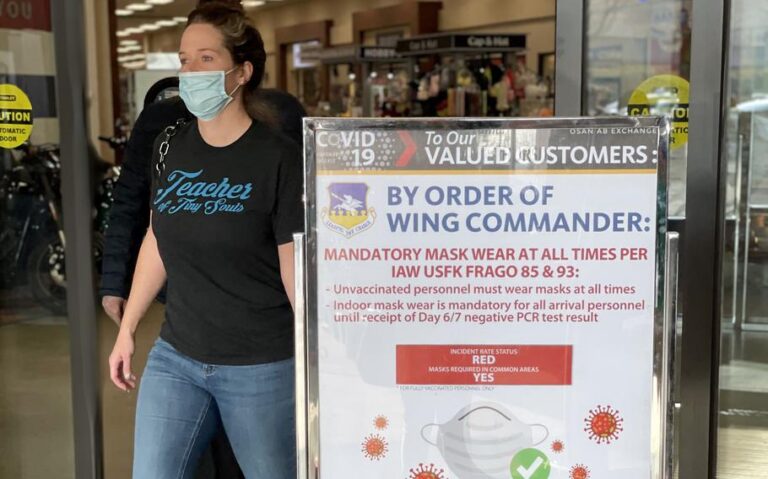
The U.S. military population in South Korea is subject to strict social distancing and mask policies but has not been confined to their homes and installations as those in Japan were for three weeks in January.
One month after South Korea confirmed its first COVID-19 case on Jan. 20, 2020, USFK elevated its health-risk level to condition Charlie and Charlie-plus, which prompted mandatory health checks at base entrances and curtailed many activities.
“We are very proud of the USFK-affiliated community … for their continued efforts in adhering to our [health protection condition] mitigation measures and USFK core tenets,” command spokesman Army Col. Lee Peters said in a statement to Stars and Stripes on Wednesday. “Their actions are reflected in our numbers and they speak for themselves: we’ve seen a continued downward trend over the last three weeks and expect to continue this trend.”
The capital city of Seoul, which routinely counted more COVID-19 cases than any other province last year, reported 4,209 new infections on Tuesday.
Prime Minister Kim Boo-kyum, in a speech to the National Assembly on Jan. 27, implored the country to refrain from long-distance travel during the three-day holiday. With a “heavy heart,” and concern for people’s lives, Kim said, he could not fulfill their expectations of a normal holiday.
South Korean President Moon Jae-in on Jan. 21 asked his countrymen and women to consider their health during the holiday.
“The COVID-19 pandemic is still ongoing, and many people will not be able to return home even though the Lunar New Year holiday is only a few days away,” he said. “Amid this situation, I ask you to do all you can and take good care of your health.”
USFK is at health protection condition Bravo-plus, which indicates a heightened risk for the coronavirus spreading and brings increased health protection measures.
Piccoma, a digital manga subscription service, pulled in more revenue in 2021 than any other non-gaming app except TikTok and YouTube, according to market intelligence company Sensor Tower, whose estimates exclude spending on mobile commerce such as Amazon purchase and food deliveries.
In October, less than six years after its launch in 2016, the app passed $1bn in accumulated transactions – a feat achieved by only 15-non gaming apps worldwide, according to Aljazeera.com.
Piccoma’s success is all the more extraordinary as the service is only available in Japan.
Yet the world’s most popular manga app doesn’t hail from the art form’s homeland but South Korea, the cultural powerhouse behind global phenomena such as “Squid Game” and “Parasite”.
Kakao Piccoma, the developer, is a subsidiary of South Korean tech juggernaut Kakao, the company behind the country’s most popular messaging app.
While Japan’s manga market is by far the world’s biggest, it is South Korean companies that are leading the industry’s digital transformation.
South Korean tech companies, including Kakao and Naver, controlled more than 70 percent of the Japanese digital manga market in 2021, according to a Korea Creative Content Agency (KOCCA) white paper released that year.
While paper manga comics remain popular, digital sales took over the biggest slice of the market last year, and are estimated to grow more than 80 percent by 2025, according to the KOCCA.
South Korea’s webtoon market grew more than 64 percent in 2020 compared with the previous year, surpassing the one trillion won milestone ($840m), according to the KOCCA.
But like South Korea’s other cultural industries, webtoons are increasingly looking overseas to find success.
Lee, the head of C&C Revolution, said about 65 percent of his company’s revenue now comes from overseas markets. While the industry average is less than 30 percent, according to the KOCCA, revenues from overseas are increasing and are likely to continue doing so.
The global comics market in 2020 was estimated to be worth $11bn, about one-quarter of the value of the film or music industry in the pre-pandemic era, according to the KOCCA.
Some industry insiders argue webtoons have the potential to grow far beyond anything achieved by the market for traditional comics.
“A common mistake is to consider printed comics and webtoons as the same,” Seo said. “It’s true that webtoons are derived from printed comics but what we’re seeing in the industry now shows that the webtoon industry has a completely different character and purpose than the printed comic industry.”
Lee said he believed the buzz around webtoons was only just getting started.
“In the old days, we were busy trying to attract other countries’ attention but now they are looking to us,” he said.
“In this market condition, the cycle won’t end anytime soon.”
Comic book industry veterans like Lee Jae-sik believe the buzz around webtoons is just getting started [Courtesy of Subin Kim]
The seeds of South Korea’s digital revolution of the industry can be found in the collapse of its own comic book industry in the late 90s.
The 1997 Asian financial crisis dealt a severe blow to the sector as sales plummeted amid mass unemployment. Some publishers churned out rip-offs of Japanese comics to stay afloat, while others were forced to shut down.
“After we fell apart all at once, we were busy looking for an exit,” Lee Jae-sik, an industry veteran and the founder of Korean webtoon production company C&C Revolution, told Al Jazeera.
For many industry figures, including Lee, the dot-com boom of the late 1990s appeared to be a golden opportunity. It was, however, not easy for the tottering industry to stand on its own feet when the country had yet to fully recover from the economic crisis.
The big breakthrough came when burgeoning search engines, mainly Daum, began seeking new ways to keep users coming to their sites.
Beginning in the early 2000s, South Korean Internet portals started offering digitised comic books and original comics made for the web for free.
Search engines’ embrace of the medium enabled webtoons to expand their readership beyond typical comic book readers and evolve during the coming mobile era.
As most Internet users viewed the comics on their smartphones, webtoons adopted a distinctive, vertical scroll-to-read style.
“The very act of scrolling to read gives it a kind of feeling of movement, such as the movement of a gaze or flow of time,” Seo Bum-gang, the head of the Korea Webtoon Industry Association, told Al Jazeera.
“For those who work in the film, it strikingly resembles storyboards used in their industry. When the audience reads a webtoon, they can easily associate it with a motion picture.”
Since the late 2000s, the South Korean film and TV industry has been busy adapting webtoons. Since the runaway success of office drama series Misaeng in 2014, webtoons have been a major source of inspiration for the Korean entertainment scene.
Netflix has been especially enthusiastic about adapting the medium.
Following the international success of Kingdom, Sweet Home and Hellbound, the entertainment company is planning the release of five webtoon-based series this year.
The global success of webtoon-inspired TV series has, in turn, fuelled the popularity of South Korean comics in foreign markets. After the TV series Itaewon Class became a smash hit in Japan, the webtoon on which it was based became took off helped Piccoma overtake rival app Line Manga, developed by Naver.
It’ll be a fake winter wonderland in Beijing come Feb. 4 for the 2022 Winter Olympics, accordig to NYPOST.
The international sports games will be blanketed almost entirely in artificial snow due to climate change.
“It can be really rock hard out there and falling can feel like falling on concrete, and so it does make it a little bit more dangerous than if it was natural snow conditions,” explained Chris Grover, the head cross country coach for the US ski team.
Kellison recommended in his report that athletes, scientists as well as the Olympic planning committees research environmental concerns and locations more when choosing future cities to host the Olympics.
The Olympics are set to be held from Friday until Sunday, Feb. 20.
According to a report co-authored by Georgia State University, shorter winter seasons, less snowfall and melting ice caused by the weather phenomenon has resulted in the games using fake snow.
Because the weather varies in different host cities and snow is not always readily available, scientists have figured out a way to create artificial particles to give the illusion of a wintery climate.
But the illusion comes at a cost.
The report indicates that the games will need about 49 million gallons of water, 130 fan-operated snow generators and 300 snow-making guns to create the 1.2 million cubic meters of phony snowflakes.
Georgia State associate professor Tim Kellison, who co-wrote the study, told Futurity, “For everything to work, event organizers need to be able to access a huge supply of water and to power all that equipment. And even still, they need favorable weather conditions to keep the artificial snow in optimal conditions — after all, even fake snow melts.”
“The process of artificial snow-making itself can come at a heavy environmental cost, especially because of all the water that’s used,” he said. “But all of this infrastructure also costs a lot of money, something an Olympic host city might be able to absorb, but less possible at lower levels of these winter sports.”
The impact is being felt by athletes, too, who are worried about the dangers of man-made snow.
Johanna Talihärm, an Estonian Olympic biathlete, recently told NBC News that racing on fake snow is very risky.
“Artificial snow is icier, therefore faster and more dangerous,” she said. “It also hurts more if you fall outside of the course when there is no fluffy snowbank, but a rocky and muddy hard ground,” she said.
According to the outlet, artificial ice has a higher moisture content, which makes the material freeze up quicker. Going downhill is also an issue, as the knockoff flakes make racing down much faster and can induce more harmful accidents.
According to AJC, at least nine state employees— from professors and coaches to pension fund investors — made more than $1 million during fiscal 2021, according to the state’s Open Georgia salary website.
That came in a fiscal year — which ended June 30 — during which most state employees didn’t get a pay raise.
The public is used to football coaches earning big money — University of Georgia head coach Kirby Smart made $6.9 million in fiscal 2021, according to Open Georgia, and Georgia Tech head coach Geoff Collins $3.5 million.
Charles Cary, longtime chief investment officer at the Teachers Retirement System, was paid $1,018,238, up from $980,000 the previous year. The TRS had a big year in fiscal 2021 because the stock market skyrocketed, topping $100 billion in assets.
Other $1 million noncoaches, according to Open Georgia, were James D. St. Louis, chief of pediatric and congenital heart surgery at Augusta University, $1.35 million; and Richard Lee, chief of cardiothoracic surgery at Augusta University, $1.2 million.
Two others came close: Fernando Vale Diaz, neurosurgery chairman at Augusta University, $985,500; and Georgia Tech President Angel Cabrera, $975,000.
Two top 10 names traditionally on the annual Atlanta Journal-Constitution list are no longer in their jobs. University System of Georgia Chancellor Steve Wrigley, who was paid $524,000 in fiscal 2021, retired. And the Gwinnett County school board decided not to renew the contract of Superintendent Alvin Wilbanks, who led the largest school system in the state for 25 years. Wilbanks was the highest-paid local superintendent in the state, earning $642,000 in fiscal 2021, according to Open Georgia.
The FDA authorized the companies’ vaccine for children aged 5 through 11 years old last October, but use among children remains significantly lowerthan the overall population. According to data from the Centers for Disease Control and Prevention, only 21.6% of children 5-11 are fully vaccinated.
The last age group of the population unable to get a Covid-19 vaccine may soon be able to do so — and much earlier than anticipated.
According to NPR, Pfizer-BioNTech is expected to file a submission for emergency use to the Food and Drug Administration for a vaccine regimen designed for use in children aged six months to five years, according to a person familiar with the plan. The companies could file for the authorization as early as Tuesday.
“The key question is whether the parents of younger children will get their kids vaccinated,” Dr. Celine Gounder, a clinical assistant professor at NYU Langone Health, said . “Parents are relatively more hesitant to get their young children vaccinated than themselves.”
Dr. Gounder predicted vaccination rates for the younger group of children would mirror that of the group already authorized for the doses.
Clinical trials last fall showed that the low doses of the vaccine generated protection in children up to 2 years old but failed to do so in kids aged 2-5. The companies announced in December they’d add a third dose to its trials, which would delay the submission to the FDA.
Emergency use authorization could allow children to begin a two-dose regimen, which would prepare children between 2-5 years old to receive a third shot when the data demonstrates its effective.
“By now they probably have more information on whether the two shots provided any protection at all,” Dr. Bob Wachter, chair of the University of California San Francisco Department of Medicine, said .
“It seems likely the third shot will be necessary … but you can’t get shot #3 until you’ve [had] shots 1 and 2,” he wrote in an email Monday night.
A spokesperson for Pfizer emailed a written statement that says “At this time, we have not filed a submission, and we’re continuing to collect and analyze data from both two and three doses in our younger age cohort.”
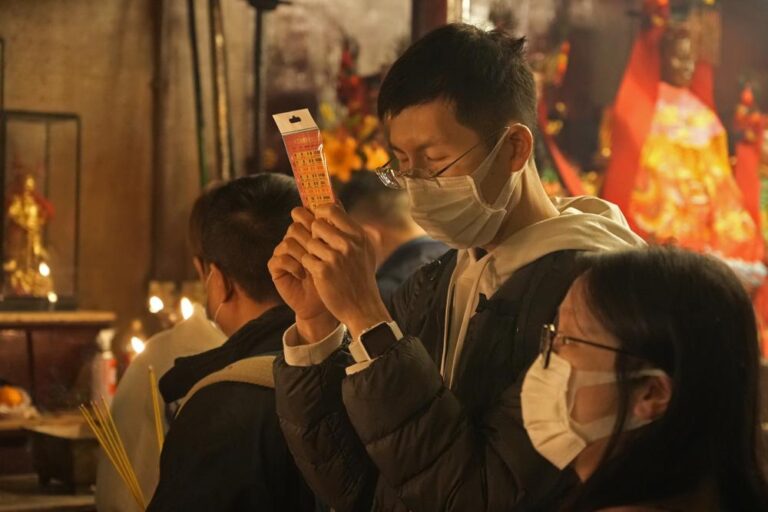
Chinese people rang in the Lunar New Year on Tuesday despite pandemic restrictions, as small crowds gathered at temples to offer traditional prayers for the Year of the Tiger, according to AP.
At the Lama Temple in Beijing, dozens of people bowed in prayer before the ornate west gate of the Tibetan Buddhist site that was shut because of pandemic restrictions.
As of the end of Monday, 272 people had tested positive among more than 10,000 who had arrived for the Games, Beijing organizers said. Of the positive cases, 67 were athletes or team officials. Those who test positive are taken to a designated hotel or hospital.
Zhao Weidong, a spokesperson for the organizing committee, said that COVID-19 prevention remains a priority.
“Everything is under control,” he said at a news conference. “Without a safe Games, there would be no Games.”
The Lunar New Year, also known as the Spring Festival, is the most important annual holiday in China. Each year is named after one of the twelve signs of the Chinese zodiac, with this year being the Year of the Tiger.
This year’s holiday has seen fewer people return to their hometowns for traditional family gatherings. China’s strict pandemic policies can lead to the swift lockdown of towns and cities, as well as suspension of travel wherever clusters of coronavirus cases are identified.
Wang Ying, who works at an accounting firm, said praying outside the temple was better than burning incense at home.
“I think sincerity is more important than burning incense sticks,” she said, after finishing her devotions.
Wang also said she is looking forward to the opening ceremony of the Beijing Winter Olympics on Friday. Marking the holiday, Beijing residents also took photos outside displays for the Games in the city’s central Tiananmen Square.
China has doubled down on its pandemic restrictions ahead of the Olympics. The National Health Commission on Tuesday reported 27 new local cases in the latest 24-hour period, including two in Beijing and seven in neighboring Hebei province.
Liu Yuetong stayed in Beijing in case her hometown had a sudden outbreak and her return to work at an ad agency was delayed.
“This is the first time I celebrate the Spring Festival in Beijing alone,” she said after her prayers outside the Lama Temple. “I feel a bit lonely. But thanks to technology, I had video calls with my family almost every day.”
In Hong Kong, the city’s largest Taoist temple, Wong Tai Sin Temple, was closed because of the pandemic, but people gathered to burn incense sticks and offer prayers at smaller temples that remained open.
“I hope that this year is like a tiger, very energetic,” said Eric Lee, a visitor to the popular Man Mo Temple. “I hope the economy and everyone’s career will be better in the Year of Tiger.”
Hong Kong had a surge of coronavirus cases in January and city officials have urged the public to avoid large gatherings. Authorities have also closed schools and banned restaurant dining after 6 p.m.
The number of worshippers at the historic Longshan Temple in Taipei, the capital of Taiwan, was significantly lower as the pandemic enters its third year. Settlers from southern China built the temple in the eighteenth century to honor Buddha. It also has altars dedicated to Taoist deities.
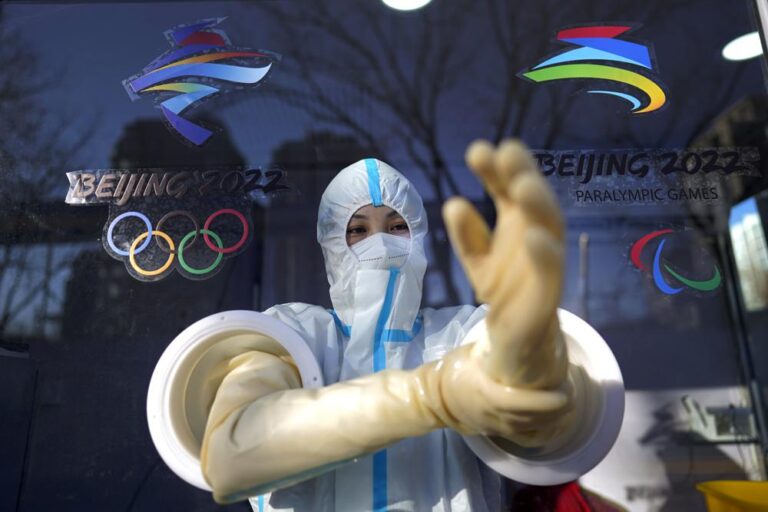
According to AP, athletes and team officials are testing positive for COVID-19 at much higher rates than other people arriving in China for the Beijing Olympics, organizers said Tuesday.
On Monday, the rate of infection from tests of those already inside the Olympic bubbles was 100 times higher for athletes and officials compared to workers. Five of 3,103 tests from the athletes-officials group were positive compared to only one of more than 60,000 daily tests from “stakeholders.”
A total of 200 positive tests for COVID-19 have now been recorded at the Olympics since Jan. 23. Of those 200, 67 were athletes and officials. “Stakeholders” accounted for the other 133.
Among the athletes testing positive in Beijing is Hong Kong skier Audrey King, who arrived from a training camp in Bosnia-Herzegovina. King told the South China Morning Post she had no symptoms and was optimistic of skiing in the women’s slalom on Feb. 9.
The most senior athlete representative at the International Olympic Committee, two-time Olympic hockey medalist Emma Terho, also is in an isolation hotel after testing positive on arrival.
“Even though this is not the start I envisaged, I was happy to see the protocols that Beijing 2022 has put in place are working well,” Terho, an IOC member from Finland who sits on the Olympic body’s executive board, wrote on her Instagram account.
Figures released by local organizers showed 11 positive tests for COVID-19 among 379 athletes and officials arriving Monday. They have been taken into isolation hotels to limit the spread of the infection and could miss their events.
The positive test rate of 2.9% for athletes and officials compared to 0.66% for Olympic “stakeholders,” a group which includes workers and media, in the same period. There were 1,059 people in that category.
Over a three-day period from Saturday through Monday, the positivity rate for athletes and officials was 40% higher than other Olympic arrivals.
The rates were confirmed in PCR and other follow-up tests for tens of thousands of people at the Beijing Olympics who will live, work and train in closed-off communities separated from the general public. The Chinese government is pursuing a zero-tolerance public health strategy.
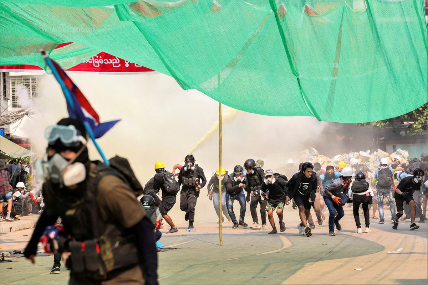
At least 1,500 people are known to have been killed in year-long protests against the coup in Myanmar, with thousands more possibly killed in the armed conflict, the United Nations human rights office said on Tuesday.
According to Reuters, at least 11,787 people were unlawfully detained in Myanmar in that period, including 8,792 who remain in custody, U.N. human rights spokesperson Ravina Shamdasani said.
Shamdasani announced the figures for arbitrary detentions at a U.N. briefing in Geneva, adding: “This is for voicing their opposition to the military, whether in peaceful protests or through online activities even.”
“We have documented 1,500 people who have been killed, but this is in only in context of protests,” she said, adding that they included 200 “killed due to torture in military custody.”
“This 1,500 does not include people who were killed due to the armed conflict…We do understand that they are in the thousands,” Shamdasani said.
Myanmar’s ruling junta has disputed past estimates of the death toll made by rights groups.
Facing a shortage of workers, Domino’s Pizza is hoping to incentivize its customers to choose carryout over delivery, according to CNN.
Beginning Monday through May 22, Domino’s will be “tipping” customers $3 if they order online and choose carryout. The credit can be used on a future online carryout order.
The promotion could help alleviate stress on its limited number of workers right before the Super Bowl, which is one of the company’s biggest pizza sales days.
Domino’s said in a statement that the carryout credit can be combined with other offers “making for a tasty deal.” It also could help retain customers. Pizza customers are notoriously fickle and tend to choose the chain that offers the better deal.
The labor shortage has plagued Corporate America — particularly companies that pay low wages. The percentage of Americans who are in the job market, either as workers or as active job seekers, is measured by the labor force participation rate. And that rate is nowhere near its pre-pandemic level. As of December, the measure stood at 61.9%, having recovered about half of what was lost at height of the pandemic compared with the February 2020 rate of 63.3%.
Inflation is also biting Domino’s. The chain recently announced changes to its chicken wings deal, including cutting the number from 10 pieces to just eight as costs soar. Domino’s also made the deal an online exclusive, meaning fewer workers are needed to answer the phones.
Domino’s CEO Richard Allison recently said at an industry conference that the company expects to deal with “unprecedented increases” in food prices, explaining that the costs of its ingredients are increasing 8% to 10% compared to last year. That is substantially higher than the usual hike of 3% to 4% the chain normally forecasts.
Although pizza sales have exploded during the pandemic, Domino’s (DPZ) hit a rocky patch in its most recent earnings as same-store sales fell for the first time since 2011. Its next earnings will be released on March 1.
Jimin of the South Korean boy band BTS has been hospitalized with acute appendicitis, his management company said Monday.
The 26-year-old singer and dancer was taken in for emergency surgery Sunday after experiencing sudden abdominal pain.
He also had a mild sore throat and tested positive for COVID-19 while in the hospital.
“The surgery was successful, and Jimin is currently recuperating after his procedure,” BTS’ agency, Big Hit Music, said in a statement, noting that Jimin was already making a “speedy recovery” from the novel coronavirus.
Jimin, whose full name is Park Ji-min, will receive several days of postoperative care as well as inpatient treatment for COVID-19, Big Hit added.