Home Blog Page 74

N. Korea confirms spy satellite tests

0

North Korean state media said on Sunday that the country performed tests that would be necessary to create a spy satellite, signaling that the pariah state could soon launch a long-range rocket despite a United Nations ban. 

The report comes after North Korea fired a ballistic missile test into the sea on Saturday. 

After that launch was detected by the South Korean military, the South Korean Joint Chiefs of Staff said U.S. and South Korean intelligence officials were analyzing the situation.

Following several launches in January, North Korean officials warned that it might resume nuclear tests because of what they have referred to as the hostility of the U.S.

The Korean Central News Agency said on Sunday North Korea had conducted “another important test” to test a reconnaissance satellite’s data transmission and reception as well as control systems, according to The Associated Press.

However, it remains unclear if North Korea has a camera that would be able to produce images in a high enough resolution to have spying capabilities. The country would need to launch a long-range rocket to put such a satellite into orbit. 

“While it may succeed in what it calls ‘a reconnaissance satellite launch,’ it would still likely take a very long time for North Korea to obtain militarily meaningful reconnaissance technology because of powerful international sanctions that restrict its import of high-tech equipment and its poor civilian technology,” Cheong Seong-Chang, an analyst at the Sejong Institute in South Korea, told the AP.

Sunday’s announcement marked the second tests of this kind in roughly a week, marking the increased possibility of a long-range rocket launch.

China, N. Korea, and the U.S. are closely watching S. Korea’s election

0

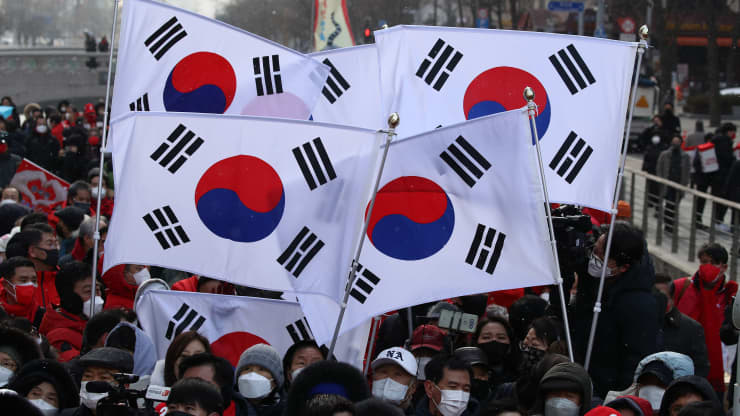
A conservative victory for South Korea’s upcoming presidential election could see the country adopt a rigid stance on North Korea and China, potentially igniting fresh tensions in the Asia-Pacific.

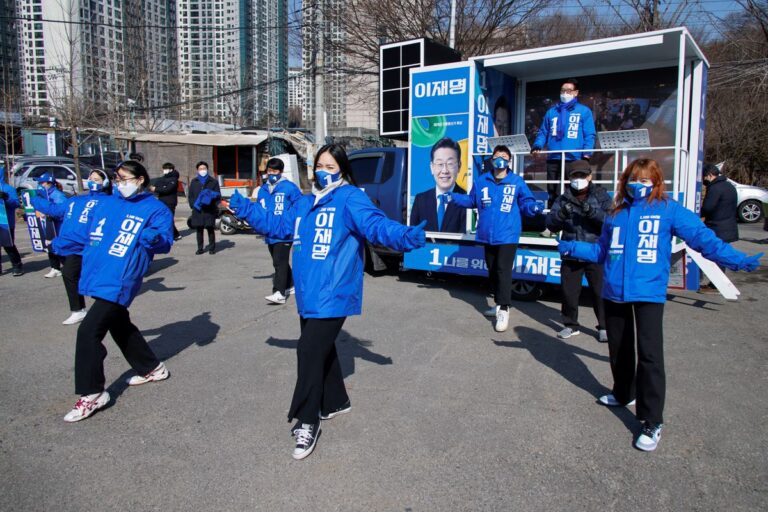
According to CNBC, Yoon Seok-youl of the conservative People Power Party and Lee Jae-myung of the ruling Democratic Party (DP) are the front-runners for the March 9 vote. A string of opinion polls conducted by Gallup Korea, a research company, show Yoon and Lee running neck and neck, indicating a tight race ahead. In one survey of 1,000 adults on Feb. 25, Lee’s public approval rating stood at 38%, compared with Yoon’s 37%. Another poll in early February showed the two tied at 35%. 

Economic issues, particularly housing, are at the forefront of this election. But given North Korea’s ongoing missile activity and anti-China sentiment at home, foreign policy matters are also expected to weigh on public sentiment. With each candidate holding diverging views on relations with North Korea, China and the United States, there’s a lot at stake for South Korea’s geopolitical fate.

A wave of anti-China uproar has been sweeping across South Korean media in recent weeks following controversies surrounding the Winter Olympics in Beijing. Combined with broader concerns about Beijing’s aggressive stance toward its neighbors in the South China Sea and the Indo-Pacific, the Asian giant has become a central talking point in this election. South Korea’s position on China is also closely linked to its relationship with the United States, given Beijing and Washington’s historical rivalry, meaning Seoul often finds itself in a position of prioritizing one of the two superpowers. 

“Lee is expected to adhere to a relationship of strategic ambiguity with China, wanting to balance security and economic relations,” said Town. Like Moon, Lee understands that he needs Chinese support on both the North Korea issue as well as on the economic front. “Lee Jae-myung is more concerned about China’s economic influence on South Korea, and will therefore adopt a more neutral stance,” echoed Xue. “However, the intensifying tensions between the US and China will make this approach increasingly difficult to hold,” Xue added.

Yoon, meanwhile, seeks stronger security cooperation with the U.S., specifically calling for additional Terminal High Altitude Area Defense deployments, which is sure to spark economic punishment from China. The installation of the U.S. anti-missile system in South Korea led to a year-long standoff between Beijing and Seoul from 2016 to 2017, with South Korea’s tourism, cosmetics and entertainment industries reeling from Chinese backlash. Yoon also wants to apply for membership of the Quadrilateral Security Dialogue as well as participate in the Five Eyes intelligence sharing program “despite possible China’s opposition to such moves,” said Xue. Yoon’s willingness to overtly side with the U.S. will be questioned, however, “if or when China starts to apply pressure on Seoul,” Town said.

Kim Jong Un’s government has been ramping up missile tests as diplomatic talks with the United States and its allies remain at a standstill. This isn’t a novel development, but against the backdrop of Russia’s invasion of Ukraine, it adds to rising fears of regional unrest. Most recently, on Feb. 27, Pyongyang fired what likely was a medium-range ballistic missile, according to officials in South Korea and Japan.

In line with his conservative predecessors, Yoon demands North Korea first denuclearize before the two Koreas agree on peace pacts and economic assistance. In late November, he told the South Korean newspaper Kookmin Ilbo that he would consider canceling the 2018 Comprehensive Military Agreement, a diplomatic milestone of President Moon Jae-in’s reign, if North Korea doesn’t change its attitude.

In contrast, DP’s Lee supports Moon’s approach of diplomatic engagement and economic cooperation with North Korea as a means of initiating denuclearization. He also supports easing existing sanctions if North Korea complies. Unlike Yoon, Lee is also open to declaring an end to the Korean war in order to bring Pyongyang back to the negotiating table.

However, despite sharing similar perspectives, analysts said, Lee is unlikely to copy Moon’s policies. “While Moon was personally heavily invested in engineering an inter-Korean summit, and trying to build sustainable, cooperative relations with North Korea, Lee is more likely to uphold the principle of peaceful coexistence while being reluctant to expend too much political capital on trying to achieve it, especially if Pyongyang is uncooperative,” Jenny Town, a senior fellow at independent think tank Stimson Center, told CNBC. Town is also the director of the Center’s North Korea-focused research arm, 38 North.

Further complicating matters is Yoon’s emphasis on resuming joint military exercises with the United States. These have been scaled down since 2018, “owing to North Korea’s perception of these manoeuvres as preparation for war,” Fei Xue, Asia analyst at the Economist Intelligence Unit, told CNBC. A revival is thus likely to anger Kim Jong Un. Yoon’s position is “harsh enough to make North Korea abandon diplomacy altogether, as it was the case during the tenures of Lee and Park,” Khang X. Vu, a doctoral student and East Asian politics specialist at Boston College, wrote in a note published by the Lowy Institute.

While each candidate offers fundamentally different views on inter-Korean relations and U.S.-China rivalry, several analysts said the dynamics of Asia-Pacific security and politics don’t allow for great shifts in foreign policy. 

“An increase in regional tension brought about by China’s assertiveness, US efforts to contain China, or North Korea’s long-range missile and nuclear tests, will shrink the number of policy options that the next South Korean president can pursue,” Vu wrote in his note. “Unfortunately, such a deterioration in regional dynamics is increasingly likely.”

Stimson Center’s Town said: “Even in trying to cultivate deeper relations with other middle powers, as South Korea is currently trying to do to create some buffer for itself amid rising US-China rivalry, this is a long term process.” She added: “In the near- to mid-term, South Korea will continue to find itself in a strategic dilemma as it works to navigate US-China competition while bolstering its own defences against significant improvements in North Korea’s weapons capabilities.”

Athletes force a change in ban of Russians at Paralympics

0

Athletes around the world cheered when leaders of the Paralympics booted Russia from the Games. The move, in many eyes, marked the high point of a growing movement by the people who actually deliver the show to find a greater voice in the Olympic world, according to Reuters.

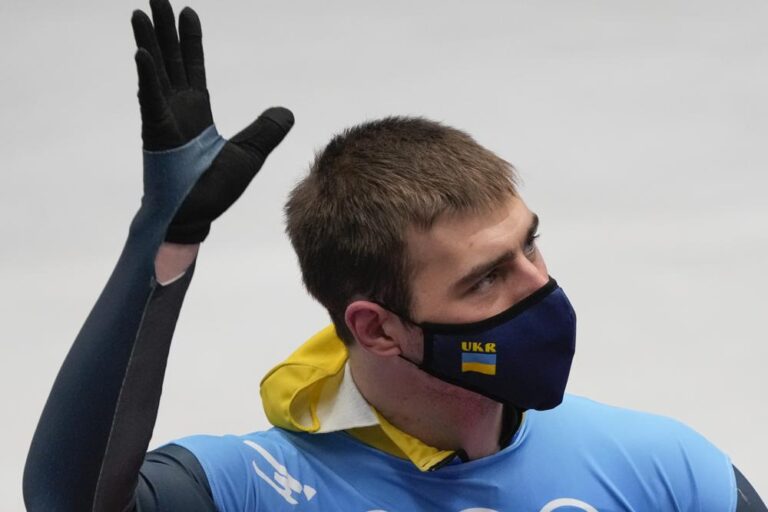
“It is because of the athletes,” said Ukrainian skeleton athlete Vladyslav Heraskevych, who has been living about 100 miles from Ukraine’s capital of Kyiv, fearful of an attack by Russian troops who invaded the country earlier this week.

The tipping point to the rapid turn of events Thursday was “a very, very volatile environment” in the athletes village in Beijing at the Paralympics, according to the head of that organization.

The International Paralympic Committee was faced with the very real possibility that athletes might simply pick up and go home before their Games start Friday. To prevent that, it made an abrupt about-face and chose to ban the Russian and Belarusian Paralympic teams that, previously, were being allowed to compete under a neutral flag.

Russia is likely to take this case to the Court of Arbitration for Sport. CAS, the IOC, World Athletics, the World Anti-Doping Agency and dozens more in this long “alphabet soup” of sports organizations have a long history of contorting the rulebooks of international sports to make them say whatever they want.

One example: While, before the war broke out, Russia remained largely eligible in most sports despite eight years of rule-breaking and cover-ups, it was still considered a rogue state in track and field.

It is also, for the time being, persona non grata at the Paralympics. The credit for that goes to a growing group of athletes who wouldn’t accept any other option.

“We did not think that entire delegations, or even teams within delegations, will withdraw, will boycott, will not participate,” IPC president Andrew Parsons said.

Rob Koehler, the head of the advocacy group Global Athlete, called the moment “a clear message to every single athlete about how valuable and important their voices are for change.”

Early in the week, a cadre of Ukrainian athletes aligned with Koehler’s group to put out a statement condemning Russia’s invasion and asking for an immediate ban of Russian and Belarusian athletes from the Olympics and Paralympics. The list of signers to this letter grew by the hour. It encompassed several hundred athletes, when adding the individuals who put their names on the letter to those who were members of the federations and athlete committees that signed on, as well.

It could have been more, but as the letter poignantly stated, “it has been a challenge to speak with all athletes from Ukraine as they are seeking safety in bomb shelters.”

The International Olympic Committee signaled that it heard the message. It urged all federations to prohibit athletes from those countries from competing. Many took heed of that advice — including ice skating, skiing, soccer, hockey, basketball and others.

But the Paralympics didn’t do a ban, explaining it would never hold up in court because of the rulebook. The IOC, with the Olympics in the rearview mirror, also passed on a ban itself.

That decision cast a different light on a New York Times report that China had specifically asked Russia to hold off on any invasion until the Olympics were over. The countries are allies — their presidents held a summit the day after the opening ceremony and declared their strategic partnership had “no limits.” It was no shock that China didn’t want the start of a war to tarnish its massive sports spectacle.

But the Paralympics bring another 600-plus athletes to Beijing to compete over 10 days of skiing, skating and sledding. It is one of the largest gathering of international athletes this side of the Olympics. The removal of Russia’s flag, without the removal of the country’s athletes was, Parsons said, the “harshest possible punishment we can hand down within our constitution and the current IPC rules.”

Those rules, however, took a backseat to reality.

The Latvian and South Korean curling teams said they wouldn’t take the ice against Russia for an early round match. Other athletes were considering leaving. The IPC could no longer ignore that possibility.

“It is abundantly clear that athletes forced this decision, not sport leaders,” said Ali Jawad, a four-time Paralympian who is on the board of Global Athlete.

The thought of walking away is the most drastic possible option for athletes who spend their lives training for a day or two of glory at the biggest spectacle in sports. For decades, none have willingly made that choice.

The thought of competing in China, with its record of human-rights abuses, was stomach-turning to many Olympians. But they all chose to go, in large part because they knew there was no groundswell that would follow them out the door. Boycotting by themselves, they said, would grab headlines for a day or two, but then the world would simply move on.

Athletes posed a bigger threat than that at the Paras. It was the latest, most striking show of power in a movement that has included victories in the fight over Olympic rules on marketing and demonstrations, a flap over women wearing bikini bottoms for beach handball, pay for women’s soccer players and more.

“The list goes on and on, and it shows that when athletes say ‘Things are changing, and they’re changing today,’ that it really can happen,” Koehler said.

South Korea reports record daily COVID-19 cases and deaths amid Omicron surge

0

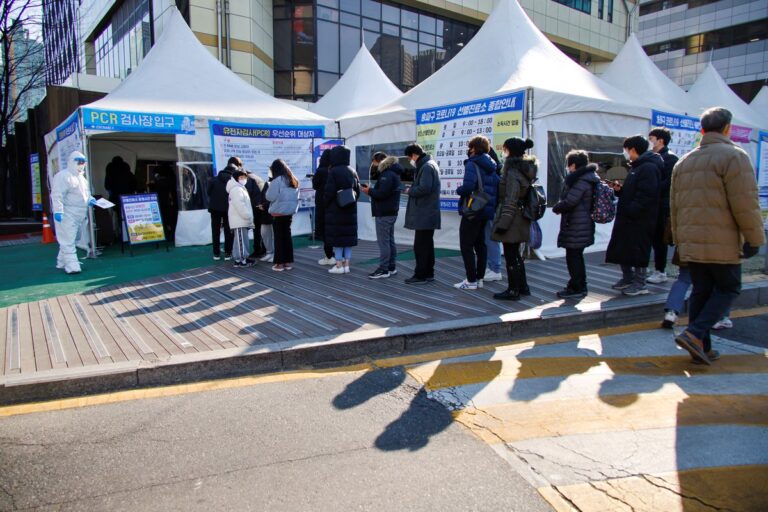
South Korea reported a daily record 266,853 new COVID-19 cases, and record daily 186 deaths, the Korea Disease Control and Prevention Agency said on Friday, according to Reuters.

The country moved forward with easing some social distancing restrictions, however, as authorities announced on Friday they would be pushing a curfew on restaurants and cafes back one hour to 11 p.m.

Meanwhile, South Korea began early voting on Friday for a presidential election in the shadow of the pandemic, as up to a million people with COVID-19 are expected to cast ballots during a spike driving one of the world’s highest caseloads.


Election workers have been deployed in protective equipment including full-body suits and safety glasses, and voters with COVID or exposed to the virus will spray hand sanitisers and wear gloves before casting ballots, according to the national election commission.

China: report alleging it asked Russia to delay Ukraine invasion until after Olympics is ‘fake news’

0

The information, compiled by a Western intelligence service, was deemed credible by officials and has been shared amongst the U.S. and allied governments, according to The New York Times.

The report alleged that Chinese officials told their Russian counterparts not to invade Ukraine before the end of the Games. The communication reportedly took place in “early February.”

In response, China on Thursday denounced the report and slammed it as “pure fake news.”

“The report by the New York Times is pure fake news. Such practice of diverting attention and blameshifting is despicable. The ins and outs of the developments of the Ukraine issue are very clear. The crux of the issue is known to all,” Chinese Foreign Ministry spokesperson Wang Wenbin told reporters.

Liu Pengyu, a spokesman for the Chinese Embassy in Washington, echoed the sentiment, saying, “The claims mentioned in the relevant reports are speculations without any basis, and are intended to blame-shift and smear China.”

China was one of 35 countries that abstained from voting on the demand that Russia end its invasion of Ukraine at the United Nations General Assembly (UNGA) on Wednesday. Five states voted to oppose the move, including Russia, Belarus, Syria, Eritrea and North Korea.

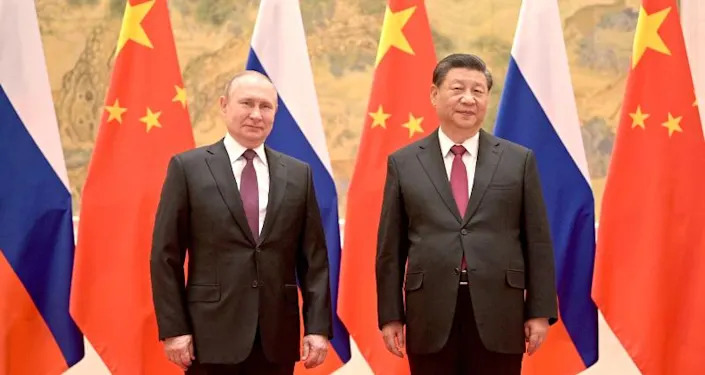
Chinese President Xi Jinping and Russian President Vladimir Putin met before the opening of the Olympics on Feb. 4, jointly condemning NATO and declaring that their “friendship” has “no limits” and “no ‘forbidden’ areas of cooperation.” At the time, Putin also expressed opposition to Taiwan’s independence.

The day after the Olympics, which ended on Feb. 20, Putin deployed Russian troops to two breakaway regions in eastern Ukraine, which he declared independent, under the pretext of “peacekeeping duties.”

The full-scale invasion of Ukraine began three days later, on Feb. 24. On Wednesday, the country’s State Emergency Service reported at least 2,000 civilian deaths, but an independent verification is impossible at this time.

NextShark also reported about a leaked Weibo post from the Chinese state-run Horizon News, which contained censorship instructions for Ukraine crisis coverage. The post, however, was published on Feb. 22, two days ahead of the full-scale invasion.

Officials reportedly had varying interpretations of the intelligence report, which remains classified. One said the material “did not necessarily indicate the conversations about an invasion took place between Mr. Xi and Mr. Putin,” while others simply declined to provide further details, according to the Times.

South Korea candidates woo young voters with hair insurance

0

South Korean presidential candidate Yoon Suk-yeol got a boost on Thursday when a rival dropped out, but if the conservative former prosecutor wins next week, it may also be thanks to “deepfake” avatars and viral short videos.

Opposition leader Yoon and the top liberal contender have gone to unusual lengths in the nation’s tradition-bound politics to shed the image of grumpy old men, courting young voters who could prove decisive in what has been a close race.

The candidates are vying to replace liberal President Moon Jae-in, who came to power five years ago with help from voters in their 20s and 30s. They have since deserted his party in droves, according to Reuters.

Yoon, 61, who has been narrowly ahead of Lee Jae-myung, 57, from Moon’s governing party, won the backing on Thursday of a fellow conservative running a distant third, who joined with Yoon in a combined ticket. Moon is barred by terms limits from seeking reelection.

A former top prosecutor, Yoon has enjoyed steadfast support from people over 60, while Lee leads with those in their 40s and 50s, leaving a battleground for younger voters. Their support has swung dramatically toward some conservative challengers, but disapproval ratings are high for both top contenders amid scandal and mud-slinging. 

Yoon and Lee both established campaign task forces aimed at capturing or winning back young voters.

A digital avatar of Yoon, his campaign says, is the world’s first “deepfake candidate”, explaining policy ideas and taking digs at his rival. Lee’s team responded with its own AI-powered character.

Yoon’s slogan “OK, Let’s go!” – shouted at rallies with his signature uppercut gesture – has gone went viral on social media, creating endless memes and video spoofs.

Liberal contender Lee, after meeting with young men and mothers, proposed allowing public healthcare insurance to cover hair loss treatment.

In an appearance-obsessed country where plastic surgery is common, many young men believe baldness can harm career and marriage prospects, but uninsured treatments are expensive.

A 15-second video clip in which Lee did a spoof of a hair-loss commercial sparked explosive reaction on social media as well as complaints from some experts and rival candidates that he was pushing a populist agenda. read more

He courted younger voters in January by calling for legalising the estimated $1 billion tattoo industry, which operates underground because South Korean law allows only doctors to perform the procedure. read more

Lee is especially targeting young people who joined candlelight vigils leading up to the 2017 impeachment and ouster of conservative then-president Park Geun-hye.

Lee Jung-in, 19, a candlelight protester who now heads a group of some 30 youth campaigners for candidate Lee, steered a successful movement to lower South Korea’s voting age by a year to 18 in 2019.

“It is extremely rare that teenagers would have a chance to speak at rallies during any presidential elections, and political parties are generally not good at embracing young people,” said Lee, who is not related to the candidate.

“We’re aiming to persuade other young voters to join us, which I believe would bring a big change in further democratising the country’s politics.”

Zelensky urges european leaders to “wake up now before this becomes a nuclear disaster.” 

0

“We don’t know how it is going to end with the fire at the station, if there might be an explosion, God forbid,” Zelensky said, adding “our guys are keeping the atomic power station secure.”

“No country besides Russia has ever fired upon an atomic power plant’s reactors. The first time, the first time in history,” he said, urging European leaders to “wake up now” and stop Russian forces “before this becomes a nuclear disaster.” 

In a Facebook post early Friday, Ukrainian President Volodymyr Zelensky accused Russia of intentionally firing at the Zaporizhzhia nuclear power plant, after a fire broke out at the facility following heavy shelling from Russian forces, according to CNN.

Ukrainian authorities say the power plant has not sustained any critical damage, and that radiation levels are currently normal, though the situation remains fluid and firefighters continue to battle the blaze.

“Russian tanks are shooting at the atomic blocks equipped with thermal imagers. They know what they are shooting at. They’ve been preparing for this (attack),” he said in the post.

Zelensky also referred to the Chernobyl tragedy and its victims in the post. “For all Ukrainians, for all Europeans, for all people who know the word ‘Chernobyl,’ how many victims there were.”

The 1986 Chernobyl disaster, which took place in Soviet Ukraine, is considered the worst nuclear accident in history. It was a “global catastrophe that affected the lives of hundreds of thousands of people,” and had a lasting impact on the country, Zelensky said.

But the very fact Russia launched an attack at the plant is itself an extremely dangerous act and could cause a potential catastrophe, he said. “There are 15 nuclear reactors in Ukraine. If one of them blows, that’s the end for everyone, that’s the end of Europe,” he added.

Russian soprano, Anna Netrebko, out at the Metropolitan Opera

0

Famed Russian soprano Anna Netrebko will no longer perform at the Metropolitan Opera in New York City this season or next after she refused to publicly distance herself from Russian President Vladimir Putin, according to a statement from the Met, according to CNN.

In 2014, Netrebko made a large donation to an opera house in Donetsk, a city in Ukraine controlled by pro-Russian separatists, according to a report by the New York Times. After she made the donation, she was pictured holding a Novorossiyan flag, which is used by separatist groups.

“It is a great artistic loss for the Met and for opera,” the company’s general manager, Peter Gelb, said in a statement to CNN. “Anna is one of the greatest singers in Met history, but with Putin killing innocent victims in Ukraine there was no way forward.”

Netrebko was scheduled to perform in Puccini’s “Turandot” this spring, as well as Verdi’s “Don Carlo” next season.

Ukranian soprano Liudmyla Monastyrska will replace her in “Turandot” and her replacement in “Don Carlo” will be announced at a later date, according to the Met.

Netrebko had issued statements critical of the war, but has not publicly commented on Putin.

500,000 Australians face flood evacuation orders

0

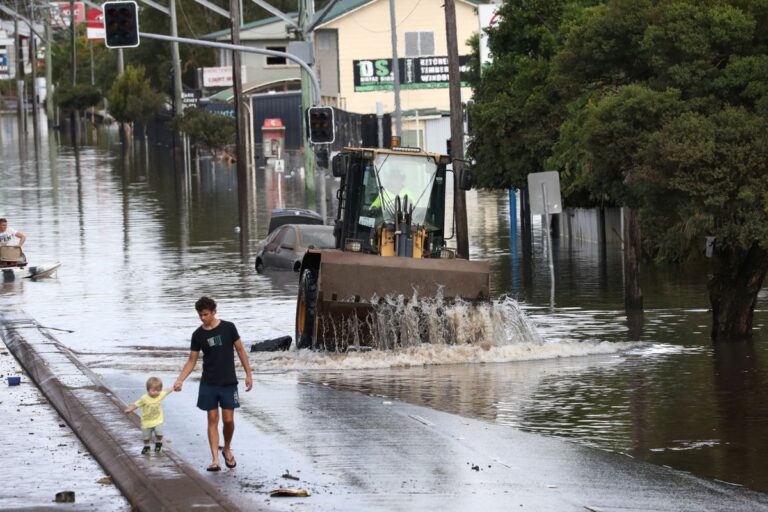
Authorities in Australia issued more orders for people to leave their homes on Thursday after heavy rain triggered flash floods in its largest city, with officials warning of worse to come and some 500,000 people likely to face orders to evacuate, reported by Reuters.

Satellite images showed the storm drifting away from Sydney but several suburbs in the city’s west are still battling rising waters. Tens of thousands of residents were ordered to evacuate in the middle of the night on Wednesday.

In Lismore, the north New South Wales town worst hit by the floods, business owners began taking stock of the damage as waters receded.

“We are shattered and my heart is aching. Not sure when roads will be clear … what a week!,” the owner of a cloth store wrote in a Facebook post and posted pictures of a pile of debris in her flood-hit store.

Heavy rainfall and wild winds, meanwhile, returned to southeast Queensland, already devastated by record flooding in recent days, hampering relief efforts with the weather bureau predicting “incredibly intense rain” there on Thursday.

“Conditions are going to be unstable for the next 24 to 48 hours,” Queensland Premier Annastacia Palaszczuk told reporters. “I haven’t seen storms and floods like this, all being thrown at us at once.”

Australia’s east coast has been battered by a severe weather system that has cut off entire towns and submerged hundreds of homes and farms as it has moved south from Queensland state over the past week.

Thirteen people have been killed since the deluge began a week ago.

“We do believe that things will get worse before they get better in the state,” New South Wales state Premier Dominic Perrottet told reporters, adding that some half a million people would be affected by evacuation orders and warnings.

Perrottet said the floods would likely be worse in some places than floods last year, which were the worst in 60 years.

The second year of flooding comes as the La Nina weather pattern, typically associated with increased rainfall, has dominated Australia’s east coast over the summer. Rivers and catchments were already near capacity before the latest drenching after steady rains over the last few weeks.

Authorities said not as much water was expected to overflow from the Warragamba Dam, Sydney’s major water supply, as earlier feared as rains slightly eased.

Some Sydney suburbs got more than 100 mm (4 inches) of rain over the past 24 hours and the weather bureau said more was on the way with some places to get up to 150 mm on Thursday.

March’s mean rainfall in Sydney, home to more than 5 million people, is around 140 mm.

South Korea presidential candidate backs conservative, may tip tight race

0

A South Korean presidential candidate dropped out on Thursday, throwing his support to conservative Yoon Suk-yeol in a surprise move that could tip the balance of next week’s closely fought election, according to Reuters.

Yoon, standard bearer of the People Power Party, the main opposition to the liberal governing party, was joined by fellow conservative Ahn Cheol-soo of the People Party, who had been running a distant third.

A survey by Realmeter on Wednesday, the last day for publication of polls under election rules, put Yoon ahead of Lee 46.3% to 43.1%, while an Embrain Public poll showed Yoon before the merger with less than a percentage-point lead.

Given the tight race, the swing by Ahn, whose support was around 7%, could mean a decisive conservative win, although it was unclear how many of Ahn’s supporters would vote for the combined ticket.

Embrain Public estimated the merger could give Yoon 47.4% to Lee’s 41.5%, while an Ipsos survey tipped the margin with Ahn at a slightly wider 48.9% to 41.9% for the conservatives. The Smarkets betting exchange gives Yoon a commanding 69%-26% lead.

“We have no doubt that today’s announcement would bring a perfect government change,” Ahn, a physician and software mogul, told a news conference with Yoon, announcing the merger. “We’re one team.”

The shake-up days before Wednesday’s election is bad news for Lee Jae-myung, representing President Moon Jae-in’s Democratic Party. Moon is barred by term limits from seeking reelection. 

“We can say that Yoon now has some edge, being able to fetch more ballots from centrists and moderate conservatives who had supported Ahn,” said Kim Hyung-joon, a political science professor at Myongji University in Seoul.

“Of course some of them won’t necessarily end up voting for Yoon, but an extra 3% to 4% could make a big difference in such a close race.”

Voters want a president who can clean up polarised politics and corruption, and tackle the runaway housing prices and deepening inequality that have dogged Asia’s fourth-largest economy, polls show. 

A former prosecutor general, Yoon has promised to stamp out corruption, foster justice and create a more level playing field, while seeking a “reset” with China and a tougher stance toward North Korea. 

He wants to buy an additional U.S. missile system, a move his top foreign policy adviser has said would risk economic retaliation from China but provide a chance to improve testy diplomatic ties.

Yoon thanked Ahn, pledging to win the election and realise their shared vision for national integration through a joint government.

Lee’s party derided the merger as “collusion” and “fraud”, while the candidate pressed ahead, telling a rally in downtown Seoul, “The people’s collective wisdom, not the actions of politicians, will determine our future.”

Ahn, who lost to the incumbent Moon in 2017, initially had double-digit support on promises to make South Korea a technology and economic powerhouse and for volunteering at COVID-19 clinics with his wife. But his popularity waned even as voters soured on corruption scandals, gaffes and mud-slinging by the two main contenders. read more

He first made an overture to Yoon in mid-February, saying a merger would bring a “overwhelming victory” and national unity, but earlier negotiations foundered over how to consolidate the campaigns.