Home Blog Page 67

China Eastern Airlines crashes in mountains with 132 on board, no sign of survivors

0

A China Eastern Airlines (600115.SS) Boeing 737-800 with 132 people on board crashed in mountains in southern China on a domestic flight on Monday after a sudden descent from cruising altitude. Media said there were no signs of survivors.

The airline said it deeply mourned the loss of passengers and crew, without specifying how many people had been killed.

Chinese media showed brief highway video footage from a vehicle’s dashcam apparently showing a jet diving to the ground behind trees at an angle of about 35 degrees off vertical. Reuters could not immediately verify the footage.

The plane was en route from the southwestern city of Kunming, capital of Yunnan province, to Guangzhou, capital of Guangdong, bordering Hong Kong, when it crashed.

China Eastern said the cause of the crash, in which the plane descended at 31,000 feet a minute according to flight tracking website FlightRadar24, was under investigation.

The airline said it had provided a hotline for relatives of those on board and sent a working group to the site. There were no foreigners on the flight, Chinese state television reported, citing China Eastern.

Media cited a rescue official as saying the plane had disintegrated and caused a fire destroying bamboo trees. The People’s Daily quoted a provincial firefighting department official as saying there was no sign of life among the debris.

State media showed a piece of the plane on a scarred, earthen hillside. There was no sign of a fire or personal belongings.

According to Reuters, the aircraft, with 123 passengers and nine crew on board, lost contact over the city of Wuzhou, China’s Civil Aviation Administration of China (CAAC) and the airline said.

The flight left Kunming at 1:11 p.m. (0511 GMT), FlightRadar24 data showed, and had been due to land in Guangzhou at 3:05 p.m. (0705 GMT).

The plane, which Flightradar24 said was six years old, had been cruising at 29,100 feet at 0620 GMT. Just over two minutes and 15 seconds later, data showed it had descended to 9,075 feet.

Twenty seconds later, its last tracked altitude was 3,225 feet.

Crashes during the cruise phase of flights are relatively rare even though this phase accounts for the majority of flight time. Boeing said last year only 13% of fatal commercial accidents globally between 2011 and 2020 occurred during the cruise phase, whereas 28% occurred on final approach and 26% on landing.

“Usually the plane is on auto-pilot during cruise stage. So it is very hard to fathom what happened,” said Li Xiaojin, a Chinese aviation expert.

Online weather data showed partly cloudy conditions with good visibility in Wuzhou at the time of the crash.

President Xi Jinping called for investigators to determine the cause of the crash as soon as possible, state broadcaster CCTV reported.

A Boeing spokesperson said: “We are aware of the initial media reports and are working to gather more information.”

Shares of Boeing Co (BA.N) were down 6.4% at $180.44 in premarket trade.

Shares in China Eastern Airlines in Hong Kong closed down 6.5% after news of the crash emerged, while its U.S.-listed shares slumped 17% in premarket trading.

China Eastern grounded its fleet of 737-800 planes after the crash, state media reported. China Eastern has 109 of the aircraft in its fleet, according to FlightRadar24.

According to Aviation Safety Network, China’s last fatal jet accident was in 2010, when 44 of 96 people on board were killed when an Embraer E-190 regional jet flown by Henan Airlines crashed on approach to Yichun airport.

In 1994 a China Northwest Airlines Tupolev Tu-154 flying from Xian to Guangzhou crashed, killing all 160 on board in China’s worst-ever air disaster, according to Aviation Safety Network.

Moderna asks FDA authorization for 4th dose of COVID shot

0

Drugmaker Moderna asked the Food and Drug Administration on Thursday to authorize a fourth shot of its COVID-19 vaccine as a booster dose for all adults.

According to AP, the request is broader than rival pharmaceutical company Pfizer’s request earlier this week for the regulator to approve a booster shot for all seniors.

U.S. health officials currently recommend a primary series of two doses of the Moderna vaccine and a booster dose months later.

Moderna said its request for an additional dose was based on “recently published data generated in the United States and Israel following the emergence of Omicron.”

On Tuesday, Pfizer and its partner BioNTech asked U.S. regulators to authorize an additional booster dose of their COVID-19 vaccine for seniors, saying data from Israel suggests older adults would benefit.

In a press release, the company said its request for approval for all adults was made “to provide flexibility” to the Centers for Disease Control and Prevention and medical providers to determine the “appropriate use” of a second booster dose of the mRNA vaccine, “including for those at higher risk of COVID-19 due to age or comorbidities.”

U.S. officials have been laying the groundwork to deliver additional booster doses to shore up the vaccines’ protection against serious disease and death from COVID-19. The White House has been sounding the alarm that it needs Congress to “urgently” approve more funding for the federal government to secure more doses of the COVID-19 vaccines, either for additional booster shots or variant-specific immunizations.

Russian model who called Putin ‘psychopath’ on social media found dead

0

A Russian model who called Vladimir Putin a “psychopath” has been found dead and stuffed inside a suitcase, a report says. 

Gretta Vedler, 23, went missing a year ago after her anti-Putin social media rant, but the two events do not appear to be connected, according to NYPOST.

“Vedler’s ex-boyfriend Dmitry Korovin, 23, has now confessed to strangling her to death before driving her 300 miles to the Lipetsk region and abandoning the body in the boot of a car,” the Daily Star reports.

“I can only assume, in my opinion, clear psychopathy or sociopathy is seen in him. For psychopaths, it is important to constantly experience a sense of fullness and sharpness of life, so they love risk, intense experiences, intense communication, intense activity – an intense and dynamic life,” she wrote, according to the Mirror.

Korovin told authorities he slept in a hotel room for three nights with her dead body, which was stuffed in a newly bought suitcase. The man then left her body in the trunk for a year but kept posting to her social media pages to make it look like she was still alive. 

In January 2021, Vedler had raised concerns over Putin’s crackdown on protests and desire to enhance the integrity of Russia.

Hong Kong’s COVID infections exceed 1 million

0

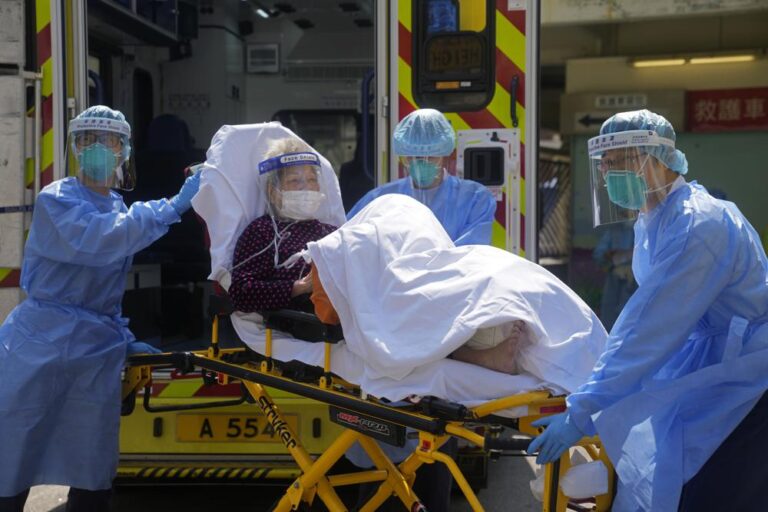
Hong Kong’s cumulative coronavirus infections have exceeded 1 million as the city grapples with a widespread outbreak that has killed more people than the reported COVID-19 deaths in all of mainland China.

For most of the pandemic, Hong Kong was able to stamp out earlier outbreaks with tough “zero COVID” restrictions that temporarily shuttered businesses, limited public gatherings and imposed entry curbs such as lengthy quarantines for arrivals and flight bans from countries deemed high-risk.

That changed with the highly transmissible omicron variant. Officials have sought assistance from mainland China, which has sent experts and medical resources to help Hong Kong combat the pandemic.

According to AP, health officials reported 20,079 confirmed infections on Friday, taking the total since the start of the pandemic to 1,016,944.

Nearly 97% of those came from Hong Kong’s current wave, which began in December. Since Feb. 9, nearly 5,200 people have died from the virus.

The total number of deaths in Hong Kong — 5,401 — has exceeded the 4,636 fatalities recorded in mainland China. Mainland authorities have reported 126,234 confirmed cases, but unlike most countries, China does not include asymptomatic cases in its confirmed total.

The city of 7.4 million is in the grip of an omicron surge that has strained its health care system as hospitals reached maximum capacity. Coffins are running out and mortuaries are so full that bodies have to be temporarily stored in refrigerated containers.

Most of the deceased were elderly patients, a majority of whom are not fully vaccinated.

South Korean president’s home stirs feng shui furore

0

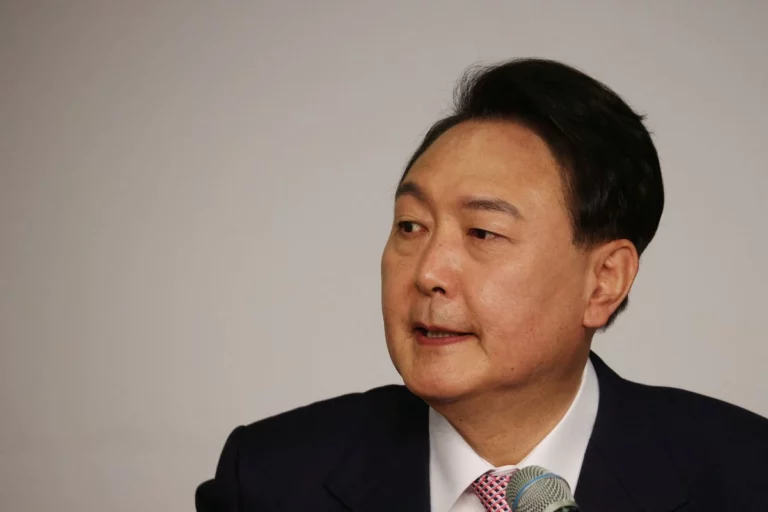
South Korea’s President-elect Yoon Suk-yeol’s plan to break with decades of tradition to move his future office and residence beyond Seoul’s Blue House compound has whipped up a fierce debate involving experts in the ancient practice of feng shui.

Yoon, who won a tight March 9 election, has pledged to relocate his office to a more accessible location, and open the Blue House to the public.

Ordinary South Koreans expressed mixed views. Park Kwang-il, 50, said Yoon should foster consensus with reasonable grounds as a sudden move could cause traffic jams or other inconvenience.

Kim Hee-young, 21, said she welcomed Yoon’s intention to boost public access, unless the relocation was driven by shamanist belief.

“I hope he would come up with policy solutions by communicating with the people, but he also needs to console and embrace others who could suffer damage from his decision,” she said.

According to Reuters, Yoon’s transition committee conducted on-site surveys on Friday after drawing up a shortlist of two possible locations: a foreign ministry building in the downtown district of Gwanghwamun and the defence ministry complex in nearby Yongsan.

After initially favouring Gwanghwamun, he was leaning towards the military compound chiefly because of security concerns, campaign officials said. With less than two months before Yoon’s swearing-in, a formal announcement is expected as early as this weekend.

Yoon’s team said the move would improve public access, communications with aides, and that the Blue House executive mansion had become a “royal palace,” isolated and enclosed by forests and tight security.

“We are looking to move out of the Blue House, which had been a symbol of absolute power in our history, and return that power to the people,” Yoon’s spokeswoman Kim Eun-hye told a briefing on Friday.

Only a limited part of the Blue House is open to the public, and any vehicle passing the area is subject to security checks. Last remodelled in the 1970s, the main presidential office inside the compound is far from where secretaries work, which some officials have said hampers interaction.

Outgoing President Moon Jae-in had also said he would find a new office, but abandoned the plan for security and logistical reasons.

Some Democratic Party officials have said other considerations could be in play, and have accused Yoon of being influenced by masters of feng shui, a form of geomancy that originated in China. They have said the Blue House was inauspicious.

The Democrats alleged in the run-up to the election that a shaman was closely involved in Yoon’s campaign. He denied any influence, saying only that he knew the man as a Buddhist priest.

Jee Jong-hag, head of a major feng shui society, said the Blue House is badly located, which could explain why dozens of ancient kings worked and lived elsewhere. More recently, four out of the six presidents in the country’s 25-year democratic history have been imprisoned or committed suicide after leaving office.

“I do see the link between the site and the ill-fated presidents,” Jee told Reuters. “But Yongsan is a blessed spot, open and surrounded by gentle mountains. It’s an incomparably humble yet auspicious piece of land compared to the Blue House location.”

Some Democrats called the planned move a waste of resources that could cost up to 1 trillion won ($822.7 million).

Yoon’s spokeswoman dismissed that projection as “gone too far,” and said his team would make a decision based on public consensus but not waste taxpayers’ money.

The Yonhap news agency reported that the interior ministry estimated the cost of moving into the defence ministry at around 50 billion won ($41.14 million).

Porsche increases its EV sales targets, confirms 911 hybrid sports car

0

As the all-electric Porsche Taycan sedan outsells the German carmaker’s iconic 911 sports car, the company is increasing its EV sales targets. It also plans to roll out a hybrid version of the 911.

According to CNBC, Porsche on Friday announced it expects 80% of its global sales to be all-electric vehicles by 2030. That compares with previous plans for that amount of sales to be a mix of all-electric and plug-in hybrid electric vehicles, which include internal combustion engines with battery technologies.

Porsche announced a roughly $24 million investment in the development of “e-fuels,” which officials say is a climate-neutral fuel to replace gasoline in nonelectric vehicles.

Blume described e-fuels as “an ideal complement” to EVs.

The new EV plans were announced in connection to Porsche, which announced a preliminary agreement last month to be spun off from VW into a public company, announcing its 2021 financial results.

Porsche reported new records in both sales revenue and operating profit. Sales in 2021 were 33.1 billion euros ($36.7 billion), up 4.4 billion euros ($4.9 billion) from 2020. Porsche’s operating profit last year increased by 27% to 5.3 billion euros ($5.9 billion) compared to 2020.

“The future of Porsche is electric,” Porsche CEO Oliver Blume told media during a roundtable.

Blume declined to predict the breakdown of the non-all-electric vehicles, citing a “flexible engine strategy” that could include internal combustion engines, hybrids and plug-in hybrids.

The Taycan is Porsche’s first and only all-electric car so far. It represented about 14% of the company’s 301,915 vehicles sold in 2021. Taycan sales were 41,296, topping record sales of the 911 at 38,464 units.

The company’s next two EVs are expected to be the Macan SUV in 2023, followed by the 718 sports car by 2025. Blume also confirmed a hybrid version of its 911 sports car is coming, but he did not disclose a timeframe for its release.

Porsche reports nearly 40% of Porsche vehicles sold in Europe were all-electric or plug-in hybrids vehicles, or PHEVs. Porsche currently offers two PHEVs, which are viewed by many as a short-term, transitional technology before all-electric vehicles.

Porsche’s plans are unique among global carmakers in the fact that it doesn’t plan to completely give up on vehicles with traditional internal combustion engines. Specifically, for its 911 sports car, which is considered among the best “driver’s cars” in the world.

Biden and Xi Jinping spoke, aims to press him on Russia war

0

Two key figures in determining the course of a war half a world away, President Joe Biden and China’s Xi Jinping spoke Friday as the White House looks to deter Beijing from providing military or economic assistance for Russia’s invasion of Ukraine.

According to AP, planning for the call has been in the works since Biden and Xi held a virtual summit in November, but differences between Washington and Beijing over Russian President Vladimir Putin’s prosecution of his three-week-old war against Ukraine are expected to be at the center of the call. The two leaders began the secure video call at 9:03 a.m. EDT.

White House press secretary Jen Psaki said Biden would question Xi about Beijing’s “rhetorical support” of Putin and an “absence of denunciation” of Russia’s brutal invasion of Ukraine.

“This is an opportunity to assess where President Xi stands,” Psaki said.

Though seen as siding with Russia, China has also reached out to Ukraine, with its ambassador to the country on Monday quoted as saying: “China is a friendly country for the Ukrainian people. As an ambassador, I can responsibly say that China will forever be a good force for Ukraine, both economically and politically.”

“We have seen how great the unity of the Ukrainian people is, and that means its strength,” Fan Xianrong was quoted by Ukraine’s state news service Ukrinform as telling regional authorities in the western city of Lviv, where the Chinese Embassy has relocated to.

In a reminder of China’s threat to assert its claim to Taiwan by force, the Chinese aircraft carrier Shandong sailed through the Taiwan Strait on Friday, just hours before the Biden-Xi call, Taiwan’s Defense Ministry said.

Any conflict over the self-governing island democracy stands to involve the U.S., which is legally obligated to ensure Taiwan can defend itself and treats threats to the island as matters of “grave concern.”

“The national army’s intelligence, surveillance and reconnaissance systems are in complete possession of the movements of Chinese ships in the sea and planes in the airspace around the Taiwan Strait to safeguard national security,” the ministry said in a statement.

Zhao said he had no details about the ship’s passage through the strait, but added that “I believe the carrier has its routine training schedule, and it should not be linked with the communication between Chinese and American leaders.”

China on Friday again sought to highlight its calls for negotiations and donations of humanitarian aid, while accusing the U.S. of provoking Russia and fueling the conflict by shipping arms to Ukraine.

“China has called for every effort to avoid civilian casualties all the time,” Foreign Ministry spokesperson Zhao Lijian told reporters at a daily briefing. “Which do the civilians in Ukraine need more: food and sleeping bags or machine guns and artillery? It’s easy to answer.”

In an attempt to show international support for China’s position, state broadcaster CCTV said Xi discussed Ukraine in phone calls with South African President Cyril Ramaphosa and Cambodian Prime Minister Hun Sen, adding that the leaders’ views were “extremely close.”

The U.S.-China relationship, long fraught, has only become more strained since the start of Biden’s presidency. Biden has repeatedly criticized China for military provocations against Taiwan, human rights abuses against ethnic minorities and efforts to squelch pro-democracy advocates in Hong Kong.

But the relationship may have reached a new low with the Russian invasion.

In the days after Putin deployed Russian forces in Ukraine, Xi’s government tried to distance itself from Russia’s offensive but avoided criticizing Moscow. At other moments, Beijing’s actions have been provocative and have included amplifying unverified Russian claims that Ukraine ran chemical and biological weapons labs with U.S. support.

Earlier this week, the U.S. informed Asian and European allies that American intelligence had determined that China had signaled to Russia that it would be willing to provide both military support for the campaign in Ukraine and financial backing to help stave off the impact of severe sanctions imposed by the West.

Secretary of State Antony Blinken on Thursday reiterated that the Biden administration remains concerned that China is considering providing military equipment to Russia. He said Biden would make clear to Xi “that China will bear responsibility for any actions it takes to support Russia’s aggression, and we will not hesitate to impose costs.”

Ahead of the call, a senior administration official said that China has been sending mixed messages about its support for Russia. There were initial signs that Chinese state owned banks were pulling back from financing Russian activities, according to a senior Biden administration official who insisted on anonymity to discuss internal analyses. But there have also been public comments by Chinese officials who expressed support for Russia being a strategic partner.

White House national security adviser Jake Sullivan and senior Chinese foreign policy adviser Yang Jiechi met in Rome earlier this week for an intense, seven-hour talk about the Russian invasion and other issues.

Ahead of the Rome talks, Sullivan said the U.S. wouldn’t abide China or any other country helping Russia work around economy-jarring sanctions inflicted by the U.S. and other allies since the Feb. 24 invasion.

Sullivan also said the administration determined China knew that Putin “was planning something” before the invasion of Ukraine, but the Chinese government “may not have understood the full extent” of what Putin had in mind.

Xi and Putin met in early February, weeks before the invasion, with the Russian leader traveling to Beijing for the start of the Winter Olympics. During Putin’s visit, the two leaders issued a 5,000-word statement declaring limitless “friendship.”

Beijing’s leadership would like to be supportive of Russia but also recognizes how badly the Russian military action is going as an overmatched Ukrainian military has put up stiff resistance, according to a Western official familiar with current intelligence assessments.

The official, who was not authorized to comment and spoke on the condition of anonymity, said Beijing is weighing the potential “reputational blowback” of being associated with the Russian camp. The Chinese response to Russia’s request for help “is in the process of being formulated,” the official added.
The world’s happiest countries, 2022 edition

0

For the fifth year in a row, Finland is the world’s happiest country, according to World Happiness Report rankings based largely on life evaluations from the Gallup World Poll.

According to CNN, the Nordic country and its neighbors Denmark, Norway, Sweden and Iceland all score very well on the measures the report uses to explain its findings: healthy life expectancy, GDP per capita, social support in times of trouble, low corruption and high social trust, generosity in a community where people look after each other and freedom to make key life decisions.

Denmark comes in at No. 2 in this year’s rankings, followed by Iceland at No. 3. Sweden and Norway are seventh and eighth, respectively.

Switzerland, the Netherlands and Luxembourg take places 4 through 6, with Israel coming in at No. 9 and New Zealand rounding out the top 10.

Canada (No. 15), the United States (No. 16) and the United Kingdom (No. 17) all made it into the top 20.

Another bright spot in this year’s report: Worry and stress dipped in the pandemic’s second year. While they were still up 4% in 2021 versus pre-pandemic, worry and stress in 2020 were up by 8%.

“I think part of that is people knew a little more what they were dealing with in the second year, even if there were new surprises,” Helliwell said.

Average life evaluations “have remained remarkably resilient” during the pandemic, with negative and positive influences offsetting each other, the report says.

“For the young, life satisfaction has fallen, while for those over 60, it has risen — with little overall change,” according to the report.

Helliwell acknowledges that there’s a sense that crises bring out either the best or the worst in societies.

“But in general, people are too pessimistic about the goodwill in the societies they live in, so then when the actual disaster happens and they see other people responding positively to help others, it raises their opinion both of themselves and of their fellow citizens,” Helliwell said.

“And so you find both trust in others and general life evaluations often rise in times when you think ‘these are bad times,’ but what’s happening is people are working together to deal with them.”

This interplay of negative and positive very much applies to the situation in Ukraine, although how the scales will ultimately tip remains to be seen. Working together will certainly offset, to some degree, the tragedies affecting Ukrainians, Helliwell said.

“Their heartland is being attacked, so they’ll be getting some coming-together effect, but of course the actual damage is terrible.”

The effects the war will have on overall happiness in Russia are especially murky because government censorship distorts information that could inform life evaluations.

The surveys this year’s happiness rankings were based on were conducted well before the invasion. Ukraine and Russia both fall into the bottom half of world rankings for happiness in the 2022 report, with Ukraine at No. 98 and Russia at No. 80.

The world’s happiest countries, 2022 edition

1. Finland

2. Denmark

3. Iceland

4. Switzerland

5. Netherlands

6. Luxembourg

7. Sweden

8. Norway

9. Israel

10. New Zealand

11. Austria

12. Australia

13. Ireland

14. Germany

15. Canada

16. United States

17. United Kingdom

18. Czechia (Czech Republic)

19. Belgium

20. France

Largest Apple store in S. Korea coming soon

0

Apple has announced that the largest Apple Store in South Korea will soon be opening, in the capital Seoul. The store will be located in the city’s historical center of Jung-gu.

Apple has not yet announced an opening date for the new store.

The Cupertino company says that the Center Point Myeong-dong store will offer a source of inspiration..

Apple made the announcement on its Korean website.

Apple Myeongdong. See you soon.

The largest Apple Store in Korea is coming soon to the heart of Myeong-dong, where people from all over the world continue to visit, in the heart of splendid Seoul.

Through this store, we aim to provide a source of inspiration that is open to all, where imagination and creativity are constantly springing up. Apple Myeong-dong, a place where you and us can communicate and inspire each other. A place that will shine brightly with everyone’s sparkling ideas
awaits you.

Jung is the historical city center of Seoul with a variety of old and new, including modern facilities such as high rise office buildings, department stores and shopping malls clustered together, and also a center of tradition where historic sites such as Deoksugung and Namdaemun can be found.

Jung is home to cultural sites such as the landmark N Seoul Tower on Namsan Mountain, the Myeongdong Cathedral, the Bank of Korea Museum, and the Gwangtonggwan, the oldest continuously-operating bank building in Korea and one of city’s protected monuments since March 5, 2001.

The Myeongdong neighborhood is one of the most famous shopping areas and popular tourist destinations in South Korea. The district has undergone significant redevelopment in the recent decades, especially with the remodeling of Seoul Plaza and the opening up of Cheonggyecheon, previously covered by an elevated highway.

Jung-gu is known for its mix of historical buildings, traditional markets, and upscale retail stores. It is also home to the iconic Dongdaemun Desing Plaza Wall, seen above.

U.S. Olympian Alysa Liu, father targeted in Chinese spy case

0

U.S. Olympic figure skater Alysa Liu and her father Arthur Liu – a former political refugee – were among those targeted in a spying operation that the Justice Department alleges was ordered by the Chinese government, the elder Liu said late Wednesday.

Arthur Liu told The Associated Press he had been contacted by the FBI last October, and warned about the scheme just as his 16-year-old daughter was preparing for the Winter Olympics that took place in Beijing in February. The father said he did not tell his daughter about the issue so as not to scare her or distract her from the competition.

“We believed Alysa had a very good chance of making the Olympic Team and truly were very scared,” Arthur Liu said.

The Justice Department earlier Wednesday announced charges against five men accused of acting on behalf of the Chinese government for a series of brazen and wide-ranging schemes to stalk and harass Chinese dissidents in the United States.

The elder Liu said he left China in his 20s as a political refugee because he had protested the Communist government following the 1989 Tiananmen Square massacre. Arthur Liu eventually settled in the Bay Area, put himself through law school and nurtured one of America’s most promising athletes.

His daughter visited their ancestral homeland for the first time while at the Olympics. Arthur Liu said his daughter has generally been warmly embraced by Chinese fans and media, who considered Alysa Liu to be one of their own.

But through the spying investigation, he learned that China was aware of an Instagram message about human rights violations against the ethnic minority Uyghurs that his daughter once posted. During the Games, Alysa Liu also told her father that she was approached by a stranger late one night at a cafeteria after the free skate event, and that the man followed her and asked her to come to his apartment.

“I’ve kind of accepted my life to be like this because of what I chose to do in 1989, to speak up against the government. And I know the Chinese government will extend their long hands into any corner in the world,” Arthur Liu said. “I’m going to continue to enjoy life and live life as I want to live. I’m not going to let this push me down and I’m not going to let them succeed.”

Arthur Liu said he and his daughter were included in the criminal complaint as “Dissident 3” and “family member,” respectively.

Chinese Foreign Ministry spokesperson Zhao Lijian said he was “not aware of the specifics” surrounding the allegations, but said China is “firmly opposed to the U.S. slandering by making an issue of this out of thin air.”

“China always asks Chinese citizens to abide by the laws and regulations of host countries, and we would never ask our citizens to engage in activities that violate local laws,” Zhao told reporters at a daily briefing Thursday. “The so-called transnational harassment schemes are just trumped up.”

Liu said he took a stand against China’s bullying by allowing his daughter to compete at the recent Olympic Winter Games, where she placed 7th in the women’s event.

“This is her moment. This is her once-in-a-lifetime opportunity to compete at the Olympic Games. I’m not going to let them stop her from going and I’ll do whatever I can to make sure she’s safe and I’m willing to make sacrifices so she can enjoy the moment,” Arthur Liu said. “I’m not going to let them win — to stop me — to silence me from expressing my opinions anywhere.”

The father said he agreed to let his daughter compete with assurances from the State Department and U.S. Olympic Committee that Alysa Liu would be closely protected and kept safe while competing in China. They said she would have at least two people escorting her at all times.

“They are probably just trying to intimidate us, to … in a way threaten us not to say anything, to cause trouble to them and say anything political or related to human rights violations in China,” Arthur Liu said. “I had concerns about her safety. The U.S. government did a good job protecting her.”

Arthur Liu said a man called him in November claiming to be an official with the U.S. Olympic & Paralympic Committee, and asked for his and his daughters’ passport numbers. Arthur Liu refused to provide them and said he would call his contact at Team USA the next day.

“I didn’t feel good about it. I felt something fishy was going on,” Arthur Liu said. “From my dealings with the U.S. Figure Skating association, they would never call me on the phone to get copies of our passports. I really cut it short once I realized what he was asking for.”

The U.S. Olympic & Paralympic Committee couldn’t immediately be reached for comment. A spokesman for U.S. Figure Skating deferred comment to Team USA.

Arthur Liu does not remember being approached in person by Matthew Ziburis, who was arrested Tuesday on charges that include conspiring to commit interstate harassment and criminal use of a means of identification. Ziburis was released on a $500,000 bond.

Prosecutors allege that Ziburis was hired to perform surveillance on the family and pose as a member of an international sports committee to ask Arthur Liu for a copy of his and Alysa Liu’s passports by claiming it was a travel “preparedness check” related to COVID-19. The complaint said when Arthur Liu refused, Ziburis threatened to delay or deny them international travel.