Home Blog Page 66

Telemedicine booms in South Korea amid COVID, President-elect Yoon backs practice

0

Kim Jin-woo, a 27-year old resident of Seoul battling COVID-19 and recovering at home under a new government policy, needed to see a doctor when his symptoms did not improve, but the nearest designated hospital was fully booked. So he picked up his phone.

Like Kim, many have turned to telemedicine in South Korea in recent weeks as access to in-person options have been hit after authorities said they would only provide care to COVID patients aged 60 and above amid record high Omicron cases and prescribed home care for those with mild symptoms. 

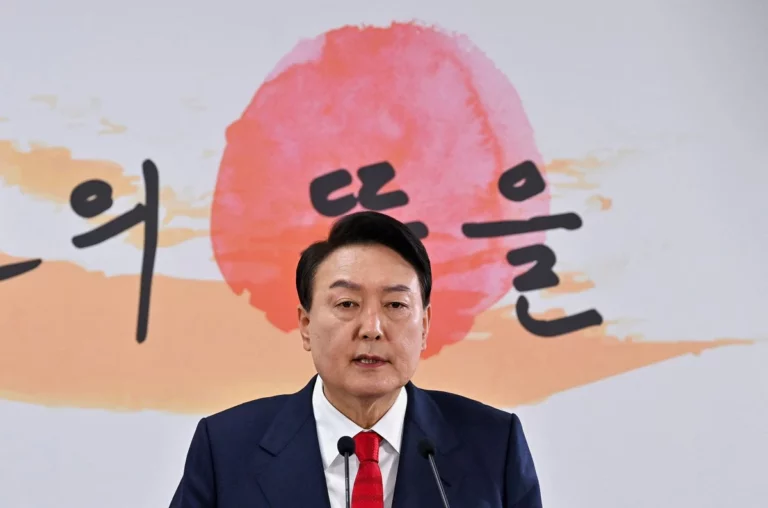
While telemedicine is technically illegal in South Korea and has only been allowed under emergency COVID measures since 2020, the increase in its users and support from President-elect Yoon Suk-yeol who sees it as an “inevitable reality” suggest it may remain part of the healthcare system, reported by Reuters.

For decades, the Korean Medical Association has opposed telemedicine on worries about misdiagnosis and misuse of drugs.

But the medical community is gradually embracing the trend given evidence that telemedicine can help reduce medical service gaps between urban and rural areas.

“At first, I thought it would be a bit awkward and difficult … but it turns out to be more satisfying to both the doctor and the patient,” said Han Jae-hyuk, a paediatrician at The Bareun Yonsei Clinic in Seoul.

“Telemedicine is essential in many ways, especially for those who are not in a position to visit hospitals or need to get a prescription refilled for chronic diseases.”

“It was really convenient to get treatment via a phone call and have drugs delivered through a single process. I wish this can be expanded even after COVID ends,” Kim said. “Making a trip to the hospital can be burdensome when you’re ill.”

The closest hospital designated for COVID home care patients that Kim can go to is an hour away by foot, but it only provides such treatment on Monday and Tuesday and is currently fully booked for the week.

A total 2 million people are under home care for COVID in the country. While there are two doctors per 1,000 people on average in South Korea, only six of 17 cities and provinces meet the average, showing how health care is thinner in many parts.

This gap in traditional in-person services has driven up business for local telemedicine players, like Doctor Now, Ollacare, Soldoc and Dr.Call, that help connect hospitals to patients located tens and hundreds of kilometres away.

Doctor Now, a SoftBank Ventures-backed startup, said it has seen a surge in users, mostly in their 20s and 30s, with COVID consultations now making up above half of total cases.

Of its cumulative 2.3 million users since December 2020, nearly a million patients have signed up for treatment in February this year, a 40-fold jump from a year earlier.

Other players have also seen a pick up in users.

But telemedicine providers are few in South Korea, leading to long virtual queues. Kim, for example, had to wait three hours to get a phone call from a doctor.

“Although I had to wait hours in the virtual queue, still that’s better than not being able to receive any treatment … and I’ve got tonnes of work to do, which means I still wouldn’t have made it to the hospital,” Kim told Reuters.

President-elect Yoon, who takes office in May, has vowed to “make sure all Korean citizens can enjoy telemedicine”, fuelling hopes that the practice may become a permanent part of South Korea’s $203 billion health industry.

For now, telemedicine is in its infancy, providing only about 58 billion won ($48 million) worth of treatments over the past two years, health ministry data showed.

In North America, a global frontrunner in the industry, the telemedicine market stood at $57.26 billion in 2020 alone, according to data from Fortune Business Insights.

It expects the global telemedicine market to reach about $264 billion by 2028, from about $127 billion in 2020.

Russia purported it fired hypersonic missiles in Ukraine

0

Russia’s purported use of hypersonic missiles in Ukraine in recent days is not only a sign that the military could be resorting to using more destructive weaponry, but also an opportunity for Russia to flaunt weapons it says it’s been developing for several years.

Russia’s Defense Ministry said on Friday that it had deployed “Kinzhal” (meaning “Dagger” in Russian) hypersonic aeroballistic missiles to destroy a large underground warehouse of Ukrainian missiles and aviation ammunition in Delyatin, in the Ivano-Frankivsk region of western Ukraine.

According to CNN, the Kh-47M2 Kinzhal hypersonic missile is an aeroballistic air-to-surface missile that Russia claims has a range of more than 2,000 kilometers, or 1,200 miles, and a speed of Mach 10 — that is, that they can travel ten times faster than the speed of sound.

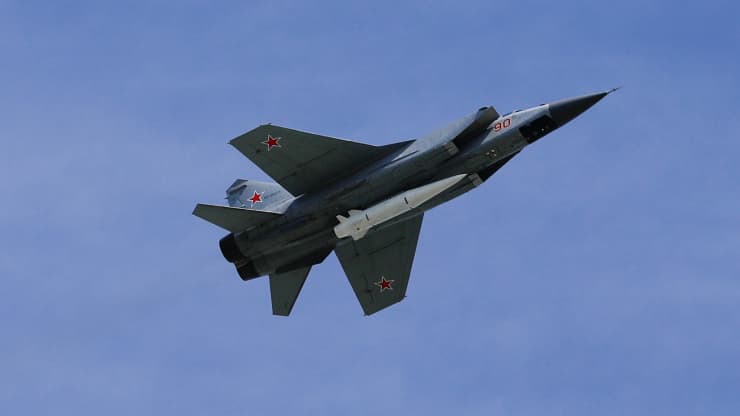
The Kinzhal hypersonic missile is designed to be carried by MiG fighter jets, as seen in the image below, which shows MiG-31K supersonic interceptor aircraft designed to carry Kh-47M2 Kinzhal missiles

Then on Saturday, the ministry said it had used Kinzhal hypersonic aeroballistic missiles again to destroy a large Ukrainian storage base for fuels and lubricants in the Mykolaiv region; Russia’s Defense Ministry said in a statement it was the main fuel supply base for Ukrainian armored vehicles in combat areas in southern Ukraine.

Russian news agencies said the reported use of hypersonic missiles was the first time Russia’s military had used them in its invasion of Ukraine, which began on Feb.24.

CNBC was unable to immediately verify the claims of hypersonic weapon use. The Pentagon said it wasn’t able to either, but Russia has been flaunting the development of several types of hypersonic weapons for several years.

CNBC has a brief guide to hypersonic missiles and what Russia claims to have used:

A hypersonic weapon is classed as any missile that travels at least five times faster than the speed of sound, or Mach 5 (around 3836 miles per hour) or faster, meaning they can travel about one mile per second. They can also change direction mid-flight, making them a formidable strategic weapon and almost impossible to intercept, unlike conventional missiles.

Russia and China have been seen to be leading the way in the development of hypersonic missiles, much to the dismay of the U.S., a country arguably been behind the curve on this front.

In 2018, during his State of the Nation address, President Vladimir Putin bragged about Russia’s development of hypersonic missiles as he unveiled the Kinzhal and several other next-generation strategic weapons. Putin said at the time Russia had developed a new prototype missile that “can reach any point in the world” and a supersonic weapon that cannot be tracked by anti-missile systems.

The Center for Strategic and International Studies think tank noted in a February report that “hypersonic weapons combine the speed and range of ballistic missiles with the low-altitude and maneuverable flight profile of a cruise missile.”

A senior U.S. Defense official, who spoke on the condition of anonymity in order to share new details from the Pentagon’s ongoing assessment of the war, said it would be odd for the Kremlin to fire a hypersonic weapon.

“It’s a bit of a head-scratcher … Why you would need a hypersonic missile fired from not that far away to hit a building?” the official said. Since Russia’s Feb. 24 invasion of its ex-Soviet neighbor, the Pentagon has observed more than 1,100 Russian missile launches into Ukraine.

James Bosbotinis, a U.K.-based specialist in defense and international affairs, said on Twitter that “Russia’s reported use of a hypersonic air-launched Kinzhal against Ukraine is unsurprising,” adding it would act as both “a signal to Ukraine that Russia has options to escalate, and a message to NATO.”

The Center for Strategic and International Studies said in its February report that “defending against hypersonic missiles is strategically necessary, technologically possible, and fiscally affordable, but it will not be easy.”

“While traditional defenses can handle these challenges individually, their combination will require new capabilities, operational concepts, and defense design. The same characteristics that make hypersonic missiles attractive may also hold the key to defeating them. Instead of thinking about hypersonic defense as an adjunct to the legacy ballistic missile defense problem, it might be better understood as a form of complex air defense.”

New satellite images from Maxar Technologies show Damaged buildings

0

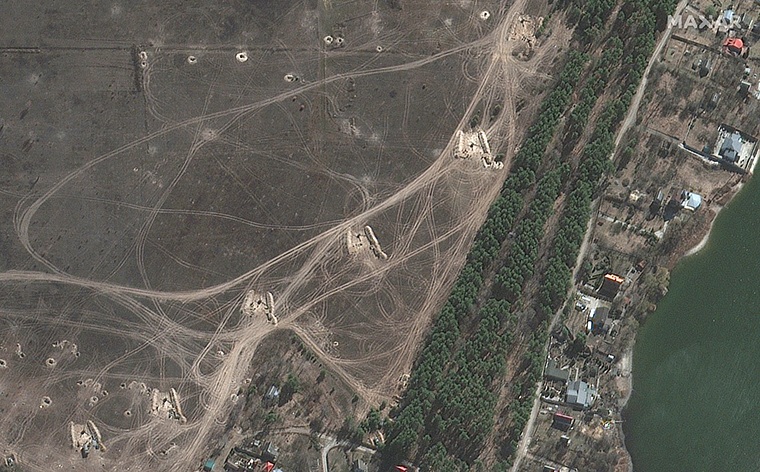
New satellite images from Maxar Technologies show fires from military strikes and growing flooding from the Irpin River.

The images, taken on Monday, also show Russian artillery positions west of the Russian-held Antonov Air Base northwest of the capital, Kyiv. Those positions match similar scenes at other Russian artillery positions — earthen berms have been constructed around them. 

Flooding from the Irpin River.
Flooding from the Irpin River. (Maxar Technologies)

An additional satellite image shows growing floodwaters from the Irpin River. 

CNN previously reported that a dam along the Dnieper River was flooding the Irpin River basin and its tributaries. The Irpin River is critical to the Russian advance toward Kyiv; if the Russians cannot cross it, they can’t take Kyiv from the west.

It’s unclear how the dam began flooding the Irpin River basin: whether the gates were opened on purpose by the Ukrainians to flood the area, or it was hit by a military strike. 

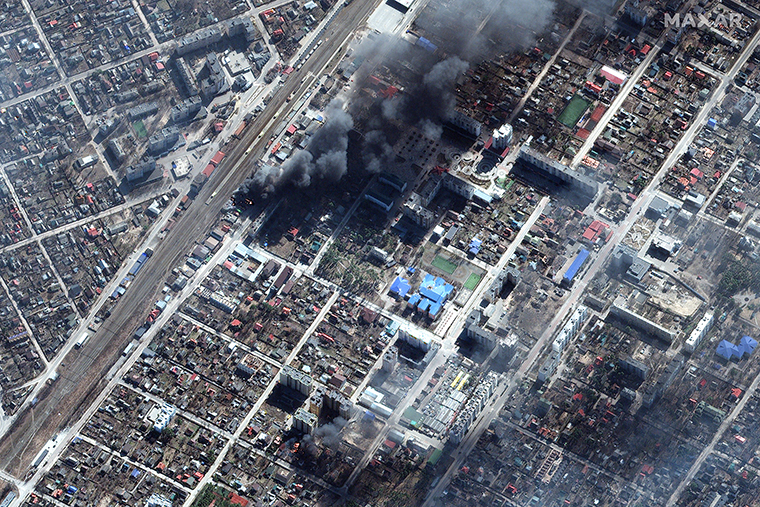
Damage from Russian military strikes in Irpin.
Damage from Russian military strikes in Irpin. (Maxar Technologies)

Damage from Russian military strikes are also seen across Irpin, northwest of Kyiv, in the satellite images. Two distinct fires are seen in central Irpin near a complex of city government and apartment buildings. 

Two other fires can also be seen in another satellite image among a group of buildings near a school in the city and a residential area near a lake. 

Philippines approved full foreign ownership in telecoms, airlines, shipping

0

Philippines President Rodrigo Duterte has approved an amendment to a law to allow full foreign ownership of firms in services like telecoms and shipping, amending archaic legislation that has long been blamed for stifling competition, reported by Reuters.

The Southeast Asian nation has been a regional laggard in attracting foreign investors, in part due to caps on ownership of firms in key sectors and its reputation for red tape.

“The entry of foreign investors will foster strong competition that will benefit the consumers, create more jobs, expand our economy, and boost our recovery from the disruptions caused by COVID-19,” the Management Association of the Philippines, a business group, said in a statement.

Lawmakers backing the bill have estimated it would boost foreign direct investment by around 299 billion pesos ($5.7 billion) over the next five years.

“By easing foreign equity restrictions in key industries, the law will spur critical investments to fast-track inclusive recovery and development,” said Senator Grace Poe, one of the bill’s principal authors.

Consumer groups have complained the lack of foreign competition has resulted in poor services and prohibitively high prices in the Philippines, where a handful of tycoons dominate multiple sectors.

The new law amends 1935 legislation to remove telecommunications, airlines, shipping, railways and irrigation from sectors in which foreign ownership of companies is restricted to 40%.

However, the cap will remain in place in areas like power transmission and distribution, water pipelines and sewerage, seaports, petroleum pipelines, and public utility vehicles.

The amendment was hailed as a positive step towards attracting new businesses.

Shooting at Arkansas car show kills and wounds 27 people

0

One man was killed and 27 people were wounded when two people got into a gunfight during a car show that’s part of an annual community event in a small southeast Arkansas town, authorities said Sunday.

The event, which helps raise funds for scholarships and school supplies, also included a bonfire, a basketball tournament, musical performances, a teen party and a balloon release.

“The purpose of Hood-Nic has always been to bring the community together,” the foundation said on its Facebook page. “This senseless violence needs to end.”

A person who left the scene of the Saturday evening shooting has been arrested on unrelated charges and is being questioned about the shooting in Dumas, a city of about 4,000 located about 90 miles (144 kilometers) southeast of Little Rock, Arkansas State Police Col. Bill Bryant said.

“All we know at this time, there was two individuals that got in a gunfight,” Bryant said at a Sunday afternoon news conference.

Russian Ministry of Defense calls on Mariupol to surrender by 5 a.m. Moscow time Monday

0

The Russian Ministry of Defense has called on Mariupol local authorities to surrender the city to Russian forces by 5 a.m. Moscow time Monday (4 a.m. Monday in Mariupol and 10 p.m. ET Sunday), according to Russian state-owned news agency, RIA Novosti.

The news agency said the Ministry of Defense would open humanitarian corridors to the city by 10 a.m. local time Monday (4 a.m. ET Monday) and “wants to receive a written response from Kiev to these proposals before 5:00.”, reported by CNN.

RIA Novosti attributed its reporting to comments made by the head of the National Center for Defense Management of the Russian Federation, Colonel-General Mikhail Mizintsev.

“From 10 a.m. to 12 o’clock — for all armed units of Ukraine and foreign mercenaries is a temporary suspension of fighting along the route agreed with Ukraine. From 12 o’clock, there will be a simultaneous passage of humanitarian convoys with food, medicine and basic necessities,” Mizintsev said.

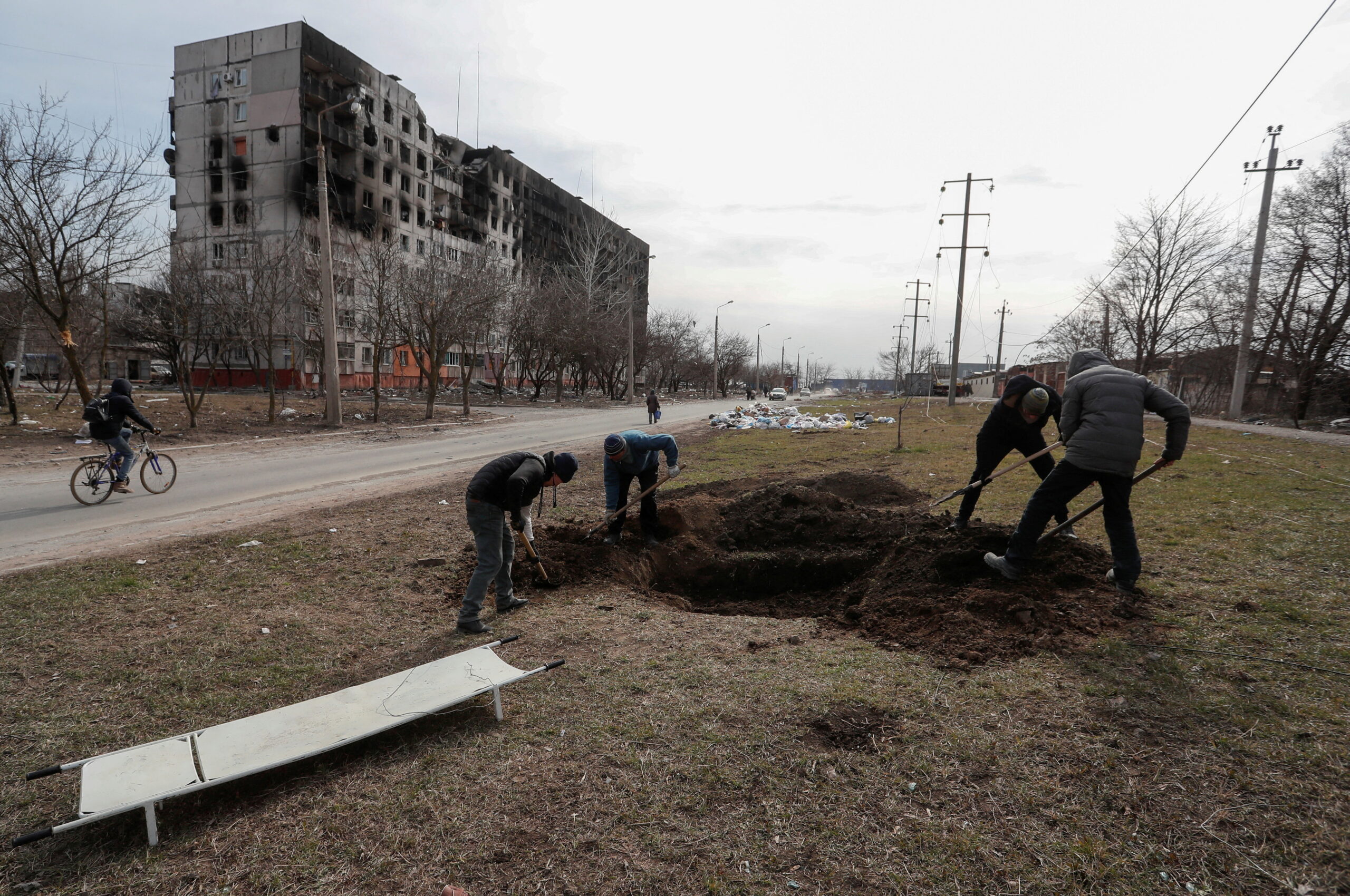
This latest demand comes as the Mariupol City Council said Saturday residents are being taken to Russia against their will by Russian forces.

In calling on city officials to surrender, RIA Novosti quoted Mizintsev saying “we appeal to the odious bandits, who are responsible for hundreds of lives of innocent people, and now call themselves representatives of the official local authorities, of this unique city Mariupol.”

“It is you who now have the right to a historic choice – either you are with your people, or you are with bandits, otherwise the military tribunal that awaits you is only a minor thing that you have already deserved because of the despicable attitude towards your own citizens, as well as the terrible crimes and provocations already arranged by you,” Mizintsev said, according to RIA Novosti.

RIA also reported Mizintsev said nearly 60,000 residents of Mariupol “found themselves in Russia in complete safety.”

“Over the past week, several thousand Mariupol residents have been taken to Russian territory,” the city said in a statement. “The occupiers illegally took people from the Livoberezhny district and from the shelter in the sports club building, where more than a thousand people (mostly women and children) were hiding from the constant bombing.”

Captured Mariupol residents were taken to camps where Russian forces checked their phones and documents, then redirected some of the residents to remote cities in Russia, the statement said, adding the “fate of the others is unknown.”

Rush to move South Korea presidential office risks security -outgoing government

0

Outgoing South Korean President Moon Jae-in’s administration said on Monday his successor’s rush to relocate the presidential office and official residence could “create a security vacuum and confusion” at a time of tensions with North Korea.

South Korean president-elect Yoon Suk-yeol, breaking with tradition, announced on Sunday he will move the presidential office from the Blue House to the defence ministry compound, a step estimated to cost $40 million. Elected in a tight vote on March 9, Yoon said he wanted to make the move immediately after his inauguration on May 10, according to Reuters.

Yoon’s team has said the Blue House is a symbol of South Korea’s “imperial presidency” and a move would improve public access and communications with aides. They have denied critics’ suggestion that Yoon was influenced by concerns that the Blue House is in an “inauspicious” location.

Moon’s press secretary Park Soo-hyun said it was “unfeasible” to relocate the defence ministry, the Joint Chiefs of Staff, the offices of the president and secretaries and the security service in the short period of time before Yoon takes office.

“The security crisis on the Korean peninsula is escalating, and a sudden and unprepared relocation… could create a security vacuum and confusion,” Park said at a briefing.

A Yoon spokeswoman expressed regret, saying there was no way to force the relocation if Moon refuses to cooperate, but that Yoon would keep his promise to open the Blue House to the public starting May 10 while carrying out his duties at his current office.

Yoon’s People Power Party accused the Moon administration of shifting its position after initially saying it hoped Yoon would implement the promise, which mirrored one made by Moon before he abandoned it for security and logistical reasons.

“The president-elect had already reviewed potential security issues that the Blue House raised,” the party said in a statement responding to Park’s comments, urging Moon’s office to help allocate a budget and cooperate on the plan.

Park said the move would be more reasonable if it was not rushed. Moon’s administration would share its concerns with Yoon’s transition team and make its official position after more consultations, he added.

A petition uploaded to the presidential office’s website on Thursday opposing Yoon’s plan to move had gathered more than 340,000 signatures as of Monday.

Conservative Yoon is expected to take a harder line against North Korea than Moon, a member of the liberal Democratic Party who had made engaging Pyongyang a major part of his agenda. South Korean presidents serve for a single five-year term.

Tensions have been rising after North Korea began the year with an unprecedented flurry of missile tests, and Pyongyang has suggested it could resume testing intercontinental ballistic missiles (ICBMs) or nuclear weapons for the first time since 2017.

South Korean slavery victim seeks UN justice as time runs out

0

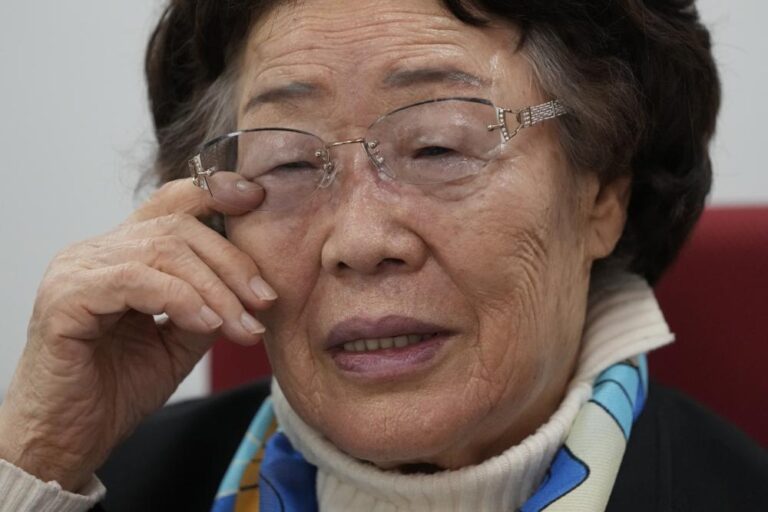
Thirty years after going public with her story of abduction, rape and forced prostitution by Japan’s wartime military, Lee Yong-soo fears she’s running out of time to get closure to her ordeal.

According to AP, the 93-year-old is the face of a dwindling group of South Korean sexual slavery survivors who have been demanding since the early 1990s that the Japanese government fully accept culpability and offer an unequivocal apology.

Her latest – and possibly final – push is to persuade the governments of South Korea and Japan to settle their decades-long impasse over sexual slavery by seeking judgement of the United Nations.

Lee leads an international group of sexual slavery survivors and advocates – including those from the Philippines, China, Indonesia, Australia and East Timor – who sent a petition U.N. human rights investigators last week to press Seoul and Tokyo to jointly refer the issue to U.N.’s International Court of Justice. The group wants Seoul to initiate arbitration proceedings against Japan with a U.N. panel on torture if Tokyo doesn’t agree to bring the case to the ICJ.

Japan’s Foreign Affairs Ministry now says its government has found no documents showing the use of coercion in the recruitment of the so-called “comfort women” and refuses to describe the system as sexual slavery. Tokyo has urged Seoul to abide by the 2015 agreement and described recent lawsuits filed by South Korean sexual slavery victims seeking compensation as “extremely regrettable and absolutely unacceptable.”

Lee began campaigning last year for Seoul and Tokyo to jointly refer their sexual slavery-related disputes to the ICJ in The Hague, the U.N.’s highest court. After a muted response from both governments, Lee is now demanding that South Korea call for a U.N. panel to examine whether Tokyo is failing to carry out its obligations under the 1984 Convention against Torture by denying or downplaying its past brutalities.

South Korea can either file a complaint against Japan with the convention’s committee against torture or sue Japan at the ICJ for violations of the convention, said Ethan Hee-Seok Shin, an international law expert who is helping with Lee’s efforts. In handling disputes between countries, the convention allows for any one party to refer the matter to the ICJ if the countries can’t agree within six months on an arbitration panel. ICJ decisions are binding upon U.N. member states.

“This issue doesn’t die with the survivors,” Lee said. “If I can’t take care of it, the problems get passed to our next generation.” __ AP writer Yuri Kageyama in Tokyo contributed to this report.

It’s unclear whether South Korea, which will swear in a new government in May, will consider bringing the matter to the U.N. when it faces pressure to improve relations with Japan amid a turbulent moment in global affairs. The country has never fought a case under such proceedings, and anything less than a lopsided victory might be seen at home as a defeat.

It’s hard for Lee to be patient when other survivors keep dying.

She worries about their plight being forgotten or distorted by Japan’s apparent efforts to downplay the coercive and violent nature of the World War II sexual slavery and exclude it from schoolbooks.

She cried as she described how she was dragged from home as a 16-year-old to serve as a sex slave for Japan’s Imperial Army, and the harsh abuse she endured at a Japanese military brothel in Taiwan until the end of the war — a story she first told the world in 1992.

“Both South Korea and Japan keep waiting for us to die, but I will fight until the very end,” Lee said in a recent interview at The Associated Press office in Seoul, across the street from the Japanese Embassy. She said her campaign is aimed at pressuring Japan to fully accept responsibility and acknowledge its past military sexual slavery as war crimes and properly educate its public about the abuses, through textbooks and memorials.

“I think time has so far waited for me so that I can clench my teeth and do everything that I can to resolve this issue,” Lee said.

Grievances over sexual slavery, forced labor and other abuses stemming from Japan’s brutal colonial rule of the Korean Peninsula before the end of World War II have strained Seoul-Tokyo relations in recent years as the animosities spilled over to trade and military cooperation issues. The disputes have frustrated Washington, which wants stronger three-way cooperation with its Asian allies to confront challenges posed by North Korea and China.

The upcoming government change in Seoul has inspired cautious hope in Japan about improved ties. After winning the election earlier this month, conservative South Korean President-elect Yoon Suk Yeol vowed “future-focused” cooperation with Japan.

Still, the countries may find it difficult to focus on the future if they can’t narrow their disagreements over the past.

Lee, who in 2007 testified at the U.S. House of Representatives before it passed a landmark resolution urging Japan to acknowledge the wartime sexual slavery, no longer believes Seoul and Tokyo can settle their history dispute without a U.N. process.

Years of bilateral diplomatic talks were largely fruitless. A haphazard settlement reached between the countries’ foreign ministers in 2015 — including Fumio Kishida, the current prime minister of Japan — never lived up to its goal of “finally and irreversibly” resolving the issue.

Lee and other survivors said Seoul officials didn’t consult them before making the deal, under which Japan agreed to contribute 1 billion yen ($8 million) to a South Korean fund to help support the victims. They questioned the sincerity of the Japanese government — then led by right-wing Prime Minster Shinzo Abe, who had long been accused by South Koreans of sanitizing Japan’s war crimes — because Japanese officials stressed the payments shouldn’t be considered as compensation.

South Korean court rulings in recent years calling for Japan’s government and companies to provide reparations to victims of sexual slavery and forced labor have been angrily rejected by Tokyo, which insists all wartime compensation issues were settled under a 1965 treaty normalizing relations between the two nations.

Historians say tens of thousands of women from around Asia, many of them Korean, were sent to front-line military brothels to provide sex to Japanese soldiers. At the time of the 2015 deal, 46 of the 239 women who registered with the Seoul government as victims were still alive in South Korea, but there are now only 12.

Japan has repeatedly expressed regret over its wartime actions. It conducted a study of the practice and established a fund from private contributions in 1995 to compensate victims in the Philippines, South Korea and Taiwan before it expired in 2007.

Many South Koreans believe Tokyo’s previous comments and actions lacked sincerity and fell short of legal reparations before they were further ruined by conservatives who’ve continued to downplay or question Japan’s wartime past. There’s also frustration over views that Japanese schoolbooks sugarcoat past brutalities.

A U.N. report from 1996 concluded that sex slaves were taken through “violence and outright coercion.” A statement from Japan in 1993 acknowledged that women were taken “against their own will, through coaxing, coercion,” but the nation’s leaders later denied it.

Oil prices jump again on Russia-Ukraine fears

0

The industry’s apparent inability to fill any potential gap has seen calls for consumption to be reduced.” Brian Martin and Daniel Hynes – ANZ RESEARCH

Oil prices jumped even higher on Monday after Russia-Ukraine talks appeared to yield no sign of progress, and markets continued to fret over tight supply — sparking a call by the International Energy Agency to reduce oil demand.

Crude futures were up more than 3% on Monday morning during Asia trading — international benchmark Brent crude was at  $111.46, and U.S. futures at $108.25.

According to CNBC, oil prices have been volatile in recent weeks – soaring to record highs in March before tumbling more than 20% last week to touch below $100. They jumped again in the latter half of last week to rise above that level.

In a note on Monday, Mizuho Bank said two factors were pushing oil prices higher: lingering Russia-Ukraine uncertainty as well as hopes that China’s latest Covid impact could be less dire than anticipated amid expectations of easing restrictions. The key hub of Shenzhen partially opened up Friday, as five districts were allowed to restart work and resume public transportation, Reuters reported.

Meanwhile, tight supply continued to worry markets, sparking a call by the International Energy Agency (IEA) on Friday for “emergency measures” to reduce oil usage.

The Russia-Ukraine war has led to worries over supply disruptions as a result of U.S. sanctions on Russian oil and gas. The U.K. and European Union also said they would phase out Russian fossil fuels. Russia supplied 11% of global oil consumption and 17% of global gas consumption in 2021, and as much as 40% of Western European gas consumption in the same period, according to statistics from Goldman Sachs.

European Union governments are set to meet U.S. President Joe Biden this week as the EU considers an oil embargo on Russia over the unprovoked invasion of Ukraine.

The Commonwealth Bank of Australia warned Monday that oil prices have fallen below recent peaks because markets are still largely pricing oil by “assessing the likelihood of a diplomatic solution to the Ukraine conflict.”

“Physical shortages, linked to current sanctions on Russia, though will eventually play a more dominant role in oil price determination,” said Vivek Dhar, the bank’s director of energy commodities research, in a note.

“The industry’s apparent inability to fill any potential gap has seen calls for consumption to be reduced,” the ANZ Research analysts said.

OPEC+ in its latest report showed some producers are still falling short of their supply quotas, with Reuters citing sources who said that the alliance missed its targets by more than 1 million barrels a day.

In a 10-point plan, the IEA’s suggestions to reduce oil demand included reducing speed limits for vehicles, working from home for up to three days a week, and avoiding air travel for business.

“We estimate that the full implementation of these measures in advanced economies alone can cut oil demand by 2.7 million barrels a day within the next four months, relative to current levels,” the IEA said Friday.

Ukrainian and Russian officials have met intermittently for peace talks, which have so far failed to progress to key concessions. Still, Ukrainian President Volodymyr Zelenksyy has called for another round of talks with Moscow.

“If these attempts fail, that would mean that this is a third world war,” Zelenskyy told CNN’s Fareed Zakaria in an interview that aired Sunday morning.

“The breakdown of peace talks between Russia and Ukraine saw crude oil prices extend their rebound on Friday,” ANZ Research analysts Brian Martin and Daniel Hynes wrote in a Monday note. “However, it failed to offset the losses earlier in the week, with Brent crude ending down more than 4%.”

Hong Kong to lift strict COVID curbs after business backlash

0

Hong Kong plans to relax some anti-COVID-19 measures next month, lifting a ban on flights from nine countries, reducing quarantine and reopening schools, after a backlash from business and residents.

According to Reuters, the moves, announced on Monday by Chief Executive Carrie Lam, come asmany countries shift to trying to living with the virus rather than trying to keep it out.

Residents in the Chinese-ruled territory have become increasingly frustrated with the stringent measures, many of which have been in place for over two years.

A ban on flights from Australia, Britain, Canada, France, India, Nepal, Pakistan, Philippines and the United States will be lifted from April 1.

“The flight ban is no longer timely and appropriate…it will bring huge disturbances to Hong Kong people who are stuck in these nine countries if we continue the ban,” Lam told a news briefing.

Hotel quarantine for Hong Kong residents arriving into the city could be cut to seven days from 14 if they tested negative, Lam said. She had previously said measures would be in place until April 20.

Schools would resume face to face classes from April 19 while public venues including sports facilities would also reopen from April 21, she said.

Hong Kong’s border has effectively been shut since 2020 with few flights able to land and hardly any passengers allowed to transit, isolating a city that had built a reputation as a global financial hub.

Hong Kong has registered the most deaths per million people globally in recent weeks – more than 24 times that of rival Singapore – due to a large proportion of elderly who were unvaccinated as the highly transmissible Omicron variant ripped through care homes.

The densely packed city has recorded more than a million infections since the pandemic started and about 6,000 deaths – most of them in the past month. Authorities reported 14,068 new cases on Monday and 223 deaths.

As many as 4 million people, out of a population of 7.4 million, could be infected according to estimates from health experts as many residents have contracted the virus and isolated at home without notifying authorities.

Businesses and the city’s economy are reeling from widespread closures, while doctors say many residents are grappling with rising mental health issues, particularly among low-income families.

Lam’s policy turnaround comes after her administration has been scolded repeatedly by politicians, pro-Beijing media and on Chinese social media, just weeks before the city is due to hold an election on May 8 to choose who will lead the territory for the next five years.

She declined to comment on whether she will run for a new term.

Nightclubs, pubs and beaches would be allowed to open in the second phase while people would be allowed to exercise outdoors without a mask. Masks are currently compulsory everywhere outside the home.

Until this year, Hong Kong had been far more successful at controlling the coronavirus than many other cities its size, but the latest wave of infections swamped its world class medical system, morgues are overflowing and public confidence in the city government is at an all-time low.