Home Blog Page 51

Israeli police storm a sensitive Jerusalem holy site after rock-throwing

0

 Israeli police in full riot gear stormed a sensitive Jerusalem holy site sacred to Jews and Muslims on Friday after Palestinian youths hurled stones at a gate where they were stationed.

The renewed violence at the site, which is sacred to Jews and Muslims, came despite Israel temporarily halting Jewish visits, which are seen by the Palestinians as a provocation. Medics said more than two dozen Palestinians were wounded before the clashes subsided hours later, according to AP.

Tens of thousands of Muslims took part in the main Friday prayers at midday, which were held as planned.

Israel says it remains committed to the status quo and blames the violence on incitement by Hamas. It says its security forces are acting to remove rock-throwers in order to ensure freedom of worship for Jews and Muslims.

Visits by Jewish groups were halted beginning Friday for the last 10 days of the Muslim holy month of Ramadan, as they have been in the past.

This year, Ramadan coincided with the week-long Jewish Passover and major Christian holidays, with tens of thousands of people from all three faiths flocking to the Old City after the lifting of most coronavirus restrictions.

The Old City is in east Jerusalem, which Israel captured along with the West Bank and Gaza in the 1967 Mideast war. Israel annexed east Jerusalem in a move not recognized internationally and considers the entire city its capital. The Palestinians seek an independent state in all three territories and view east Jerusalem as their capital.

Palestinians and Israeli police have regularly clashed at the site over the last week at a time of heightened tensions following a string of deadly attacks inside Israel and arrest raids in the occupied West Bank. Three rockets have been fired into Israel from the Gaza Strip, which is controlled by the Islamic militant group Hamas.

The string of events has raised fears of a repeat of last year, when protests and violence in Jerusalem eventually boiled over, helping to ignite an 11-day war between Israel and Hamas, and communal violence in Israel’s mixed cities.

Palestinian youths hurled stones toward police at a gate leading into the compound, according to two Palestinian witnesses who spoke on condition of anonymity out of security concerns. The police, in full riot gear, then entered the compound, firing rubber bullets and stun grenades.

Israeli police said the Palestinians, some carrying Hamas flags, had begun stockpiling stones and erecting crude fortifications before dawn. The police said that after the rock-throwing began, they waited until after early morning prayers had finished before entering the compound.

Video footage showed the police firing at a group of journalists holding cameras and loudly identifying themselves as members of the press. At least three Palestinian reporters were wounded by rubber bullets fired by police.

Some older Palestinians urged the youths to stop throwing rocks but were ignored, as dozens of young masked men hurled stones and fireworks at the police. A tree caught fire near the gate where the clashes began. Police said it was ignited by fireworks thrown by the Palestinians.

The Palestinian Red Crescent medical service said at least 31 Palestinians were wounded, including 14 who were taken to hospitals. A policewoman was hit in the face by a rock and taken for medical treatment, the police said.

The violence subsided later in the morning after another group of dozens of Palestinians said they wanted to clean the area ahead of the main weekly prayers midday. Those went ahead, with some 150,000 worshippers attending, according to the Islamic endowment that administers the site.

After prayers, a small group of Palestinians waving Hamas flags marched in protest and tried to break into an empty police post inside the compound. The police used a drone to drop tear gas on them, sending crowds of people scattering across the esplanade.

The Al-Aqsa Mosque in Jerusalem’s Old City is the third holiest site in Islam. The sprawling esplanade on which it is built is the holiest site for Jews, who refer to it as the Temple Mount because it was the location of two Jewish temples in antiquity. It lies at the heart of the Israeli-Palestinian conflict and clashes there have often ignited violence elsewhere.

Palestinians and neighboring Jordan, the custodian of the site, accuse Israel of violating longstanding arrangements by allowing increasingly large numbers of Jews to visit the site under police escort.

A longstanding prohibition on Jews praying at the site has eroded in recent years, fueling fears among Palestinians that Israel plans to take over the site or partition it.

Xi Jinping proposes ‘global security initiative’, without giving details

0

Chinese President Xi Jinping on Thursday proposed a “global security initiative” that upholds the principle of “indivisible security”, a concept also endorsed by Russia, although he gave no details of how it would be implemented.

During a video speech to the annual Boao Asia Forum, Xi said that the world should respect the sovereignty and territorial integrity of all countries, while paying attention to the “legitimate” security concerns of all, reported by Reuters.

“We should uphold the principle of indivisibility of security, build a balanced, effective and sustainable security architecture, and oppose the building of national security on the basis of insecurity in other countries,” Xi told the gathering on the southern Chinese island of Hainan.

China has repeatedly criticised Western sanctions, including those against Russia, but it has also been careful not to provide assistance to Moscow that could lead to sanctions being imposed on Beijing.

Xi said efforts are needed to stabilise global supply chains, but also said China’s economy is resilient and that its long-term trend had not changed.

In talks over Ukraine, Russia has insisted that Western governments respect a 1999 agreement based on the principle of “indivisible security” that no country can strengthen its own security at the expense of others. 

China and Russia have grown increasingly close, and China has refused to condemn Russia’s Feb. 24 invasion of Ukraine, which Moscow calls a “special operation” to demilitarise the country. China has blamed the Ukraine crisis on NATO’s eastward expansion.

Analysts note that this is the first time China has argued for “indivisible security” outside the context of the Russia-Ukraine crisis, with implications on U.S. actions in Asia.

“If China deems actions by U.S. and its allies on Taiwan or the South China Sea as disregarding its security concerns, it could evoke the concept of ‘indivisible security’ to claim the moral high ground in retaliation,” said Li Mingjiang, associate professor at the S. Rajaratnam School of International Studies in Singapore.

Wang Jiangyu, a law professor at the City University of Hong Kong, said by evoking the concept of “indivisible security”, which had originated from Europe, China could hope to make its actions in defence of its core interests appear more legitimate to other countries.

Xi also reiterated China’s opposition to unilateral sanctions and “long-arm jurisdiction”, without directly mentioning the West’s punitive actions against Russia for its invasion of Ukraine.

Germany says it is open to sending Ukraine heavy weapons

0

Germany is examining what extra maintenance and ammunition its stock of ageing Marder armoured infantry fighting vehicles will need for Ukraine to use them, Foreign Minister Annalena Baerbock said.

On the second day of a tour of Baltic states, Baerbock addressed criticism by allies and commentators of Germany’s apparent foot-dragging on delivering the weaponry Kyiv says it needs to fend off Russian attacks, according to Reuters.

“There are no taboos for us with regard to armoured vehicles and other weaponry that Ukraine needs,” she told a news conference with her Estonian counterpart on Thursday.

The German armed forces themselves faced equipment shortagers, she added, noting that German peacekeeping missions in Africa did not have all the helicopters they needed.

Pressed by journalists on whether Germany’s Leopard tank would be sent to Ukraine, she said troops would need training to use such advanced kit, and that Berlin would pay for that training.

“We are providing one billion euros because we should think not just for the coming days and months, but also the next years for the systems Ukraine needs for defence now, but also for a free Ukraine in the future,” she said.

“We know that every day counts.”

Earlier, Bild newspaper had accused Chancellor Olaf Scholz of blocking tank deliveries.

Many analysts say Ukraine urgently needs heavy weapons to drive back a Russian invasion that has now concentrated on taking ground in the eastern Donbass region.

While Ukraine’s light armaments and tactics have had some success in slowing Russia’s advance, stoping and reversing that incursion will need heavy battlefield weaponry like tanks and howitzers, they say.

Russia calls its incursion a “special military operation” to demilitarise and “denazify” Ukraine. Kyiv and its Western allies reject that as a false pretext for an illegal war of aggression.

But Baerbock said the priority was to ensure Ukraine quickly got older Soviet-designed kit that its military could use without extra training, and that it was doing this by backfilling the stocks of allied countries that had such weaponry to spare with modern German-made gear.

Macron tore into his far-right challenger Le Pen on Russia, Muslim headscarf ban pledge

0

French President Emmanuel Macron tore into his far-right challenger Marine Le Pen in a television debate Wednesday for her ties to Russia and for wanting to strip Muslim women of their right to cover their heads in public, as he seeks the votes he needs to win another 5-year term.

In their only head-to-head confrontation before the electorate has its say in Sunday’s winner-takes-all runoff vote for the presidency, Macron took the gloves off.

He argued that a loan that Le Pen’s party received in 2014 from a Czech-Russian bank made her unsuitable to deal with Moscow. He also said plans by the anti-immigration candidate to ban Muslim women in France from wearing headscarves in public would trigger “civil war” in the country that has the largest Muslim population in western Europe.

Macron appeared particularly self-assured in contrast, bordering at times on arrogance — a trait that his critics have highlighted. He sat with his arms crossed as he listened to Le Pen speak.

Macron emerged ahead from the April 10 first round. But Le Pen, who has gained ground this year by tapping anger over inflation, has significantly narrowed the gap in public support compared to 2017, when she lost with 34% of the vote to Macron’s 66%.

In 2017, a similar debate struck a damaging blow to her campaign, with a subpar performance from her.

Both candidates need to broaden support before Sunday’s vote. Many French, especially on the left, say they still don’t know whether they will even go to the polls.

Macron said the choice for voters between the two is clear.

“I fight your ideas,” he said. “I respect you as a person.”

Le Pen, in turn, sought to appeal to voters struggling with surging prices amid the fallout of Russia’s war in Ukraine. She said bringing down the cost of living would be her priority if elected as France’s first woman president and she portrayed herself as the candidate for voters unable to make ends meet.

She said Macron’s presidency had left the country deeply divided. She repeatedly referenced the so-called “yellow vest” protest movement that rocked his government before the COVID-19 pandemic, with months of violent demonstrations against his economic policies.

“France needs to be stitched back together,” she said.

The evening primetime debate drove home the yawning gulf in politics and character between the two candidates again vying for the presidency, five years after Macron handily beat Le Pen in 2017.

Polls suggest that Macron, a pro-European centrist, has a growing and significant lead over the nationalist firebrand. But the result is expected to be closer than five years ago and both candidates are angling for votes among electors who didn’t support them in the election’s first round on April 10.

“I am not like you,” Le Pen said as they clashed about France’s energy needs.

“You are not like me,” Macron said. “Thank you for the reminder.”

The French leader was particularly mordant in his criticism of the 9-million euro ($9.8 million) loan that Le Pen’s party received in 2014 from the First Czech-Russian Bank. Macron argued that because of the debt, Le Pen’s hands would be tied when dealing with Russian President Vladimir Putin, should she win on Sunday.

“You are speaking to your banker when you speak of Russia, that’s the problem,” Macron charged. “You cannot correctly defend France’s interests on this subject because your interests are linked to people close to Russian power.”

“You depend on Russian power and you depend on Mr. Putin,” he said.

Le Pen bristled at Macron’s suggestion that she is beholden to Russia. She described herself as “totally free” and said Macron “knows full well that what he says is false.”

She said her party is repaying the loan and called the president “dishonest” for raising the issue. Le Pen repeated what she has previously said: That her party went to the FCRB after French and European banks refused to lend it money. The loan has dogged her far-right party for years, along with her ties to Putin.

Just hours before Wednesday’s debate, imprisoned Russian opposition leader Alexei Navalny also raised the issue of the loan and stepped into the French presidential campaign, urging voters to back Macron and alleging that Le Pen is too closely linked to Russia.

In a long thread on Twitter, Navalny said the bank is tied to Putin and “is a well-known money-laundering agency.”

He did not cite any evidence other than his own investigations into corruption in Russia. But he argued the loan could be dangerous for France if Le Pen wins.

“This was not just a ‘shady deal,'” he tweeted. “How would you like it if a French politician took a loan from Cosa Nostra? Well, this here is the same thing.”

Because she is trailing in polls, Le Pen needed to land a knockout blow in the debate. But she made an inauspicious start: Having been picked to speak first, she started talking before the debate’s opening jingle had finished playing. Inaudible because of the music, she had to stop and start again. She apologized.

Once the verbal jousting began, Macron quickly put Le Pen on the defensive. He zeroed in on her voting record as a lawmaker and questioned her grasp of economic figures. Le Pen appeared most comfortable talking on topics that have long been centerpieces of her politics and her appeal to far-right voters: combatting what she called “anarchic and massive immigration” and crime.

Usually a powerful orator, Le Pen occasionally struggled for words and fluidity. She also at times lacked her characteristic pugnacity. She has sought in this campaign to soften her image and cast off the extremist label that critics have long assigned to Le Pen and her party.

Taiwan is investigating a local TV network after it aired false reports of a Chinese invasion

0

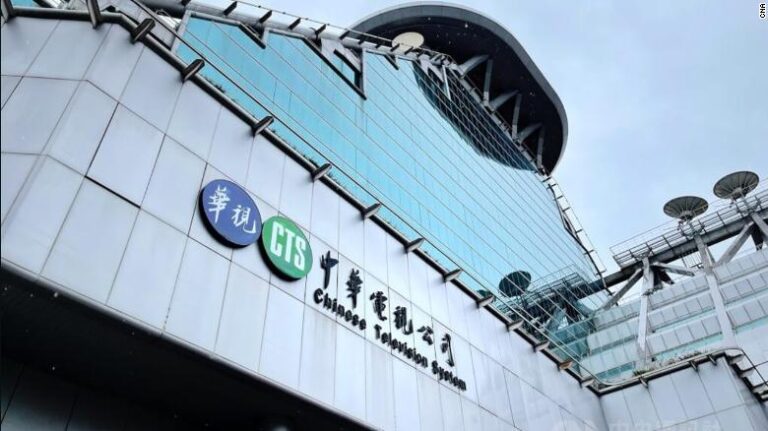
The Taiwanese government is investigating a local TV news station after it aired alarming false reports of a Chinese invasion against the self-ruled island.

During a Wednesday morning newscast on the government-affiliated Chinese Television System (CTS), part of the public Taiwan Broadcasting System, the network ran several fictional news tickers about China firing missiles toward the capital Taipei, according to CNN.

Taiwan’s National Communications Commission said in a statement that CTS is suspected of breaking laws on disturbing public order. It said it is launching an investigation into the incident.

The commission said it has received 10 complaints from viewers, adding the network could be fined up to 2 million NTD (US $68,530) for its violations.

Taiwan’s Defense Minister Chiu Kuo-cheng said in Parliament on Wednesday that he had been “surprised” by the incident and urged the public to verify information before making comments.

“This is a good lesson for our friends in the media industry,” he said.

“New Taipei City has been hit by missiles from the communist military; Taipei port has exploded, facilities and ships have been damaged,” one of the news tickers read. “It is suspected that enemy agents have arsonized and planted explosives at Banqiao train station.”

Another ticker said, “The Chinese communists have stepped up their preparations for a war, and (Taiwan’s) President has issued an emergency order.”

The erroneous reports come as Taipei expresses concerns over China’s potential military moves against the island following Russia’s unprovoked invasion of Ukraine. Communist-ruled China says Taiwan — a democratic island of 23 million people — is an inalienable part of its territory, despite never having ruled it.

Communist authorities in Beijing have refused to rule out the use of force to gain control of Taiwan and have been pressuring the island militarily, flying warplanes into its air defense identification zone, and staging naval drills around it.

Last week, China’s People’s Liberation Army (PLA) held joint combat readiness drills around Taiwan as a group of six bipartisan United States lawmakers met Taiwan President Tsai Ing-wen in Taipei.

US support for Taiwan, especially through weapons sales, has angered Beijing.

Taiwan maintains it is determined to defend itself from all forms of aggression. Last week, Taiwan’s Defense Ministry issued a civil defense handbook detailing how residents should react in the event of a military conflict.

On Wednesday, after the false reports flashed on screen, CTS issued a public apology and said the messages were created for use during fire service drills and were not meant to air to the public.

The network had also run news tickers falsely claiming that there had been panic buying across Taiwan due to the military conflict and that a magnitude 7 earthquake had taken place in New Taipei City.

In a public apology issued later on Wednesday, CTS said, “Besides urgently clarifying and apologizing to our audience through our anchors, CTS has also broadcast our apology on our different channels. We have also punished relevant personnel, supervisors and managers for dereliction of duty.”

The erroneous report was widely shared on social media platforms, with some calling for the TV station to be investigated.

Palestinian militants fired several rockets into southern Israel from the Gaza Strip

0

Palestinian militants fired several rockets into southern Israel from the Gaza Strip early Thursday and Israeli aircraft hit militant targets in Gaza, part of an escalation that was eerily similar to the run-up to last year’s Israel-Gaza war, according to AP.

The cross-border strikes came against the backdrop of Israeli-Palestinian tensions that have been boiling in Jerusalem.

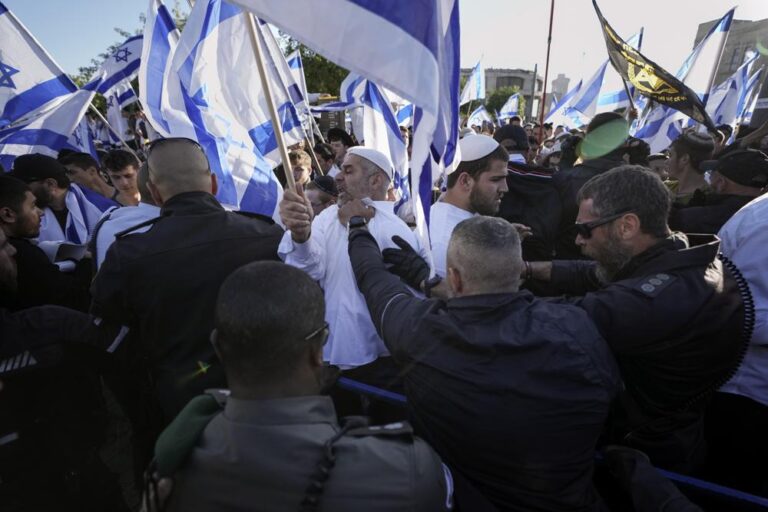
On Wednesday, hundreds of flag-waving Israeli ultra-nationalists marched toward predominantly Palestinian areas around Jerusalem’s Old City, a demonstrative display of Israeli control over the disputed city seen as a provocation by Palestinians.

Tensions have surged in recent weeks after a series of deadly attacks inside Israel, Israeli military operations in the occupied West Bank and repeated clashes between Israelis and Palestinians at the Al Aqsa compound.

Last May, Palestinian militants in Gaza fired rockets toward Jerusalem as a much larger group of thousands of Israelis held a flag march to the Old City following weeks of protests and clashes in and around Al-Aqsa. Those events led to an 11-day war between Israel and Hamas.

Israeli nationalists stage such marches to try to assert sovereignty over east Jerusalem, which Israel seized in 1967, along with the West Bank and Gaza, and annexed in a move not recognized internationally. The Palestinians seek an independent state in all three territories and consider east Jerusalem their capital.

Police closed the main road leading to the Damascus Gate of the Old City, the epicenter of last year’s unrest preceding an 11-day war between Israel and Hamas. After some pushing and shoving with police, the marchers rallied near the barricades, waving flags, singing and chanting.

A hilltop shrine in the Old City is the emotional ground zero of the Israeli-Palestinian conflict and a flashpoint for previous rounds of violence. Known to Muslims as the Al Aqsa Mosque compound, it is the third holiest site in Islam. It is also the holiest site in Judaism, revered by Jews as the Temple Mount, the site of their biblical temples.

For Palestinians, the mosque compound, administered by Muslim clerics, is also a rare place in Israeli-annexed east Jerusalem where they have a measure of control. Palestinians seek east Jerusalem, captured by Israel in the 1967 Mideast war, as a future capital.

Palestinian militant groups in Gaza — the ruling Hamas and the smaller Islamic Jihad — have positioned themselves as defenders of the Jerusalem holy site. On Wednesday, Hamas said Israel would bear “full responsibility for the repercussions” if it allowed the marchers “to approach our holy sites.”

Several rockets were fired from Gaza overnight. Four rockets fired early Thursday were intercepted by Israel, the military said. There were no immediate reports of casualties or damage, and no one claimed the rocket strikes. Israel holds Hamas responsible for all rocket fire.

Early Thursday, Israeli warplanes conducted a series of airstrikes in the central Gaza Strip, local media reported. Social media posts by activists showed smoke billowing in the air. The Israeli military said the airstrikes were aimed at a militant site and an entrance of a tunnel leading to an underground complex holding chemicals to make rockets.

The military later said its planes attacked another Hamas compound after an anti-aircraft missile was fired from Gaza during the initial airstrikes. It said the missile failed to hit its target and no injuries or damage were reported.

Apple workers in Atlanta file to unionize who become company’s 1st retail workers

0

Apple workers in Atlanta filed to unionize Wednesday, becoming the first retail employees for the tech giant to do so in the nation, according to Communications Workers of America, the union representing the employees.

Staff at the Apple store in Atlanta’s Cumberland Mall submitted their filing Monday. It included salespeople, technicians, creatives, and operations specialists, CWA said in a statement Wednesday.

Earlier this month, Amazon workers at a warehouse in Staten Island, New York, became the first group of Amazon employees to unionize. The historic vote was 2,654 for the union to 2,131 against.

The workers, who pick and package items for customer orders at the facility, will be represented by the Amazon Labor Union, an upstart group formed by Christian Smalls after he was fired from Amazon in March 2020. At the time a supervisor at the fulfillment center, he staged a walkout over the lack of worker protections against the coronavirus.

At Starbucks, a wave of union organizing that started in Buffalo, N.Y., has swept stores across the country. Close to 190 have petitioned for union elections, and 10 stores — half in Buffalo, and the others in New York City; Mesa, Ariz.; Knoxville, Tenn.; and in Starbucks’ hometown of Seattle — have voted to join Workers United.

“A number of us have been here for many years, and we don’t think you stick at a place unless you love it,” said Derrick Bowles, an Apple Genius worker who is a part of the organizing effort. “Apple is a profoundly positive place to work, but we know that the company can better live up to their ideals, and so we’re excited to be joining together with our coworkers to bring Apple to the negotiating table and make this an even better place to work.”

CWA said big tech companies like Google, Amazon and Apple fail to give employees who don’t work in an office equal standing and respect.

More than 100 employees are eligible to join the union effort, and at least 30% of workers must sign union authorization cards to show interest for the group to be registered with the National Labor Relations Board. 70% of the Cumberland Mall workers have shown interest, CWA said.

“We welcome the workers who are organizing at Apple and call on the company’s management to reject union busting tactics so that they can vote without interference or intimidation,” said Ed Barlow, President of CWA Local 3204 in Atlanta. “These workers have been indispensable during the pandemic and the high level of service and support they provide is critical to Apple’s success.”

Unionization movements have picked up steam at other large companies, such as Amazon and Starbucks.

Putin tries to claim Mariupol win

0

Russian President Vladimir Putin tried to claim victory in the strategic port of Mariupol on Thursday, even as he ordered his troops not to storm the last pocket of Ukrainian resistance in the war’s iconic battleground.

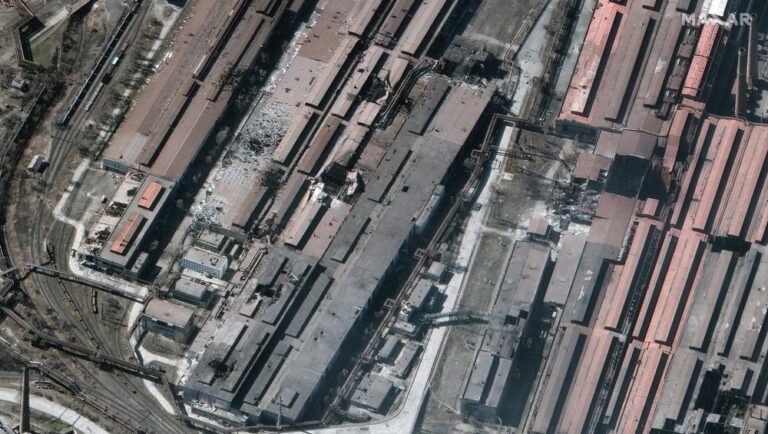
Russian troops have besieged the southeastern city since the early days of the conflict and largely pulverized it — and top officials have repeatedly indicated it was about to fall, but Ukrainian forces stubbornly held on. In recent weeks, they holed up in a sprawling steel plant, and Russian forces pounded the industrial site and repeatedly issued ultimatums ordering the defenders to surrender, according to AP.

On the battlefield, Ukraine said Moscow continued to mount assaults across the east, probing for weak points in Ukrainian defensive lines. Russia said it launched hundreds of missile and air attacks on targets that included concentrations of troops and vehicles.

The Kremlin’s stated goal is the capture of the Donbas, the mostly Russian-speaking eastern region that is home to coal mines, metal plants and heavy-equipment factories.

In a video address, Zelenskyy said the Russians were not “abandoning their attempts to score at least some victory by launching a new, large-scale offensive.”

The Luhansk governor said Russian forces control 80% of his region, which is one of two that make up the Donbas. Before Russia invaded on Feb. 24, the Kyiv government controlled 60% of the Luhansk region.

Analysts have said the offensive in the east could become a war of attrition as Russia faces Ukraine’s most experienced, battle-hardened troops, who have fought pro-Moscow separatists in the Donbas for eight years.

Russia said it presented Ukraine with a draft document outlining its demands for ending the conflict — days after Putin said the talks were at a “dead end.”

Moscow has long demanded Ukraine drop any bid to join NATO. Ukraine has said it would agree to that in return for security guarantees from other countries. Other sources of tension include the status of both the Crimean Peninsula, seized by Moscow in 2014, and eastern Ukraine, where the separatists have declared independent republics recognized by Russia.

Putin said that, for now, he would not risk sending troops into the warren of tunnels under the giant Azovstal plant, instead preferring to isolate the holdouts who have captivated the world’s attention “so that not even a fly comes through.” His defense minster said the plant was blocked off, while giving yet another prediction that the site could be taken in days.

Putin’s order may mean that Russian officials are hoping they can wait for the defenders to surrender after running out of food or ammunition. Bombings of the plant could well continue.

Even though Putin painted the mission to take Mariupol already a success and said the city had been “liberated,” until the plant falls, he cannot declare a complete victory.

Russian Defense Minister Sergei Shoigu said about 2,000 Ukrainian troops remained in the plant, which has a labyrinth of tunnels and bunkers that spread out across about 11 square kilometers (4 square miles). Ukrainian President Volodymyr Zelenskyy said that about 1,000 civilians were also trapped there.

Russian-backed separatists in the area previously seemed bent on taking every last inch of the city, which has seen some of the most dramatic fighting of the war and whose capture has both strategic and symbolic importance.

The scale of suffering in the city on the Azov Sea has made it a worldwide focal point, and its definitive fall would deprive Ukraine of a vital port, complete a land bridge between Russia and the Crimean Peninsula, which Moscow seized in 2014, and free up Russian troops to move elsewhere in the Donbas.

Russian officials now say capturing the Donbas, Ukraine’s eastern industrial heartland, is the war’s main goal. This week, Moscow’s forces opened a new phase of the war, in a deadly drive along a front from the northeastern city of Kharkiv to the Azov Sea. Detaching the region from the rest of Ukraine would give Putin a badly needed victory two months into the war, after the botched attempt to storm the capital, Kyiv, and amid mounting Russian losses.

Britain’s Defense Ministry said that Russia likely wants to demonstrate significant successes ahead of Victory Day on May 9, the proudest moment on the annual calendar marking its critical role in winning World War II.

“This could affect how quickly and forcefully they attempt to conduct operations in the run-up to this date,” the ministry said.

Retired British Rear Admiral Chris Parry described Putin’s remarks as reflecting a change in “operational approach” as Russia tries to learn from its failures in the eight-week conflict, which turned from initial hopes of a lightning fast invasion of a neighbor into a war of attrition with ever mounting casualties and costs.

“It seems to me that the Russian agenda now is not to capture these really difficult places where the Ukrainians can hold out in the urban centers, but to try and capture territory and also to encircle the Ukrainian forces and declare a huge victory,” Parry said.

In the meantime, Western powers are doubling down on their support of Ukraine, moving to push more military hardware in, heightening geopolitical stakes.

The latest in a long line of Western leaders venturing to Kyiv, Danish Prime Minister Mette Frederiksen said Thursday: “One of the most important messages today is that Denmark is considering sending more weapons. That is what is needed.”

Several Western officials have promised similar in recent days.

With global tensions running high, Russia reported the first successful test launch of a new type of intercontinental ballistic missile, the Sarmat, on Wednesday. Putin boasted that it can overcome any missile defense system and make those who threaten Russia “think twice.” The head of the Russian state aerospace agency called the launch out of northern Russia “a present to NATO.”

The Pentagon described the test as “routine” and said it wasn’t considered a threat.

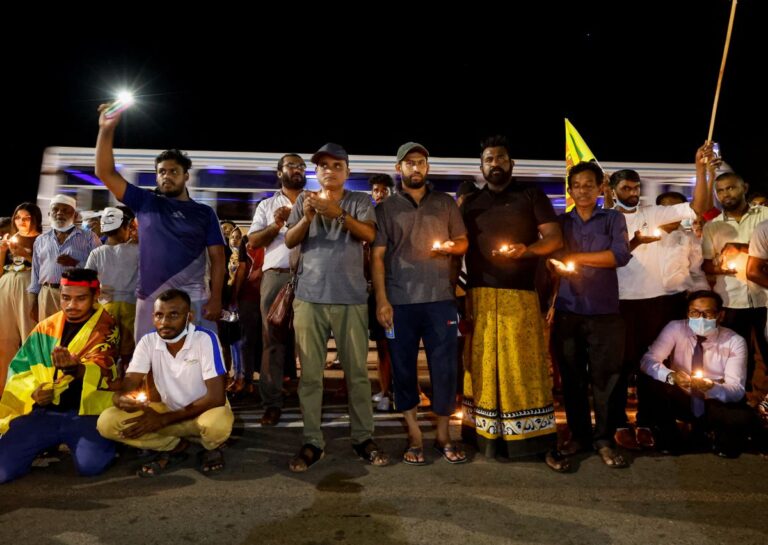
Sri Lanka promises impartial investigation after first death in weeks of protests

0

Sri Lankan police will launch an “impartial and transparent” investigation into clashes with protesters after the first death in weeks of unrest over the government’s handling of the economy, the president said on Wednesday, according to Reuters.

Police fired live ammunition to scatter protesters on Tuesday in the town of Rambukkana, northeast of the commercial capital Colombo, killing one person and wounding a dozen.

Demonstrations have roiled the South Asian island nation of 22 million people for weeks, with people protesting at shortages of fuel and other items and prolonged power cuts.

As the talks go on with the global lender, the country is getting billions of dollars in help from India and is in negotiations with China for more. It is also reaching out to Japan, the United Arab Emirates, Oman and Qatar, Sri Lankan Foreign Minister G. L. Peiris said.

“Assistance by the IMF will take about six months to come to us and it will come in tranches,” he told reporters. “During the intervening period, we need to find funds to keep our people supplied with essentials.”

Peiris said India had already committed about $2.5 billion in support and talks were ongoing for a further $500 million for fuel purchases. Bangladesh could also agree to postpone repayment on a $450 million swap, Peiris said.

The shooting broke out after protesters blocked a railway line and stopped a fuel tanker attempting to cross it, residents and a government minister said.

“Sri Lankan citizens’ right to peacefully protest won’t be hindered,” President Gotabaya Rajapaksa said on Twitter.

Police would “carry out an impartial and transparent inquiry regarding the incident at Rambukkana which led to the tragedy for which I’m deeply saddened. I urge all citizens to refrain from violence as they protest”.

Senior police spokesperson Ajith Rohana said a 20-member team had been formed to investigate the incident and one person had been arrested.

K.D. Chaminda Lakshan, 41, had gone to the petrol station at Rambukkana to fill his motorcycle when he got caught up in the clashes, his family said.

“I want justice for the crime committed against my father,” his daughter, Piumi Upekshika Lakshani, said as mourners sat around the family’s hillside home.

The first death in the largely peaceful protests came as Sri Lankan officials meet the International Monetary Fund (IMF) to discuss an emergency loan programme to tackle the shortages of fuel and other essentials.

The IMF said the discussions were at an early stage and any deal would require “adequate assurances” that Sri Lanka could resolve its unsustainable debt situation. 

Russia sets new deadline for Mariupol surrender

0

Russia has set a new ultimatum for surrender in the battered city of Mariupol, where Ukrainian forces and reportedly hundreds of civilians are holed up in the Azovstal steel plant potentially facing their “last days, if not hours,” one Ukrainian commander said. Vastly outnumbered, the Ukrainian troops have pledged to keep fighting.

According to CCN, officials in Ukraine continue to call for more weapons support and faster delivery as Russia intensifies its bombardment of the eastern Donbas region.

Meanwhile, the U.S. is preparing a massive new arms package for Ukraine, according to sources who spoke to NBC, and Chinese imports of Russian coal have plummeted.

The United Nations says it has confirmed 2,224 civilian deaths and 2,897 injuries in Ukraine since Russia invaded its ex-Soviet neighbor on Feb. 24.

Of those killed, the U.N. has identified at least 42 girls and 61 boys, as well as 70 children whose gender is unknown.