Home Blog Page 48

Trump election: downtown Atlanta road closures

0

The Fulton County Sheriff’s Office announced Wednesday the department will close some roads in downtown Atlanta next week ahead of major court proceedings.

The agency plans to close four roads starting Monday, which is when Fulton County District Attorney Fani Willis and her office begin to select members of a special grand jury who will investigate whether former President Donald Trump tried to illegally overturn Georgia’s 2020 election, according to AJC.

There are some other services changes to be aware of next week.

Any Fulton resident who receives a jury summons for May 2, should follow the instructions of that summons. Also note that the Fulton County Magistrate Court will be conducting first appearance hearings only on May 2; all other hearings will be rescheduled.

Those who need in-person access to Fulton justice agencies are encouraged to visit satellite locations outside of downtown. Learn more about that at www.fultoncountyga.gov/courts-and-justice-agencies.

Expect water blockades at the corners of the Fulton County Justice Center Complex. Transit buses will have access. Drivers will be allowed to access the Underground Atlanta parking decks via Martin Luther King Jr. Drive.

“The public is advised to avoid the area, unless they must conduct business in the vicinity,” according to the announcement.

Details of the closures are below:

  • Pryor Street between Martin Luther King Jr. Drive and Mitchell Street
  • Mitchell Street from Pryor Street to Central Avenue
  • Central Avenue between Mitchell Street and Martin Luther King Jr. Drive
  • On Martin Luther King Jr. Drive: the two lanes adjacent to the Fulton County Justice Center complex will be closed between Central Avenue and Pryor Street

Some North Koreans find ways around smartphone controls, report says

0

Despite North Korea intensifying efforts to stop citizens from seeing information coming from outside the country, a few tech savvy individuals are managing to circumvent tight government controls on smart phones, a U.S. based group said in a report.

“The scale of the hacking still appears to be minor, but recent changes to North Korean law indicate national authorities view it as a serious problem,” Lumen, a U.S.-based non-profit founded to provide North Koreans with access to uncensored information and media, said in report issued this week, according to Reuters.

The report said the resale value of a phone could also be increased by accessing and deleting screenshots automatically taken with the “Trace Viewer”, an application in each North Korean smartphone that takes random screenshots and locks them away from the user, to try and dissuade illicit activities.

The Lumen report said it is possible that state engineers responded to the techniques described by the hackers by disabling the USB interface used to access the phone.

North Korea also disabled Wi-Fi access on devices and only reintroduced it recently, once controls such as SIM cards, passwords, and supported devices had been designed to ensure Wi-Fi could only be used for approved purposes, the report said.

Most of the knowledge needed to hack the phones came from North Koreans who had been sent to China for work, often in software outsourcing businesses, the report said.

Smartphones have proliferated in North Korea, but very few people are allowed to access the global internet. Devices in the country are required to have government apps and other controls that monitor use and restrict access.

Working together with ERNW, a Germany-based independent IT Security service, the report’s authors examined North Korean smartphones and tablets for government controls, and interviewed two defectors who said they had been able to circumvent those restrictions before they fled the country.

The research overturns assumptions that, shut off from the internet, North Koreans lacked the knowledge and tools to be able to mount an effective attack on state information control mechanisms, the report concluded.

The goal of the hacking was to bypass phone security and be able to install different applications, photo filters and media files that would otherwise not be permitted.

Come on sponsorship night event for Judge Cason’s: in Koreatown on the 28th

0

04/27/2022

Sponsorship Night for Incumbent Judge Tracie Cason’s re-election will be held on Thursday, 28th at 6:30pm at Swanee Soon Bakery.

Judge Tracie Cason is a Gwinnett County Superior Judge who is aiming for re-election this year.

Judge Tracie Cason recently worked with Gwinnett County Attorneys, Prosecutors and Attorneys at a seminar hosted by the Korean American Crime Prevention Commission to deliver essential information on “Gye(Pyramid)” and “multilevel financial fraud”.

She has also served as a prosecutor and judge in Gwinnett County for nearly 20 years.

Judge Tracie Cason’s cases include criminal felonies, family and family law cases, and civil disputes.

She was elected in county-wide contested elections in 2018, and she said in an interview with Global News Today, “I am committed to providing fair and equitable justice for all.”

Meanwhile, before becoming a Gwinnett Superior Court Judge, Judge Tracie Cason worked as a profession prosecutor in the District Attorney’s Office.

Her work as a prosecutor in 2017 with the GBI, Gwinnett County Police and Sheriff, and more than a dozen other agencies in a massive prostitution crackdown that arrested 23 pimps of child prostitution. The arrest operation is considered one of the largest operations in Georgia.

The reason for wanting to become a judge also stemmed from her distinct judicial philosophy. Judge Cayson called it ‘compassion and responsibility’.

She stressed the need to keep communities safe for everyone, especially the most vulnerable, and to have everyone heard in court.

It also emphasizes that victims have rights, defendants have rights, and everyone’s rights must be protected and balanced to achieve justice for all. We are convinced that looking at the root causes of crime and preventing recurring crimes will keep everyone safer.

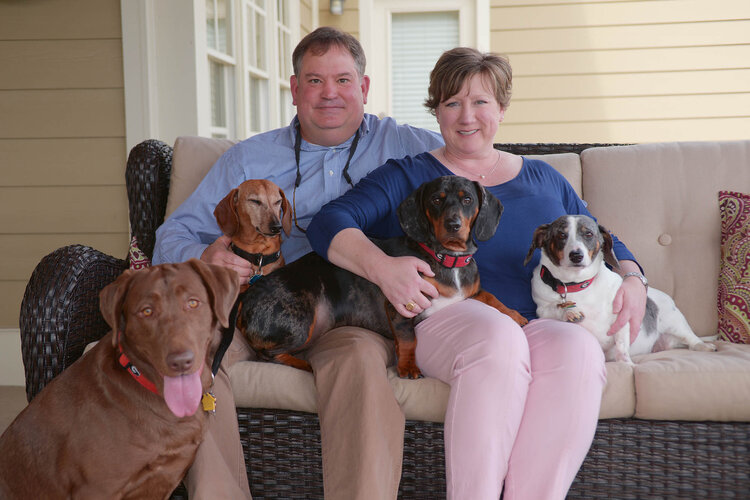
TC dog no banner.jpg

Judge Tracie Cason, who has been married for 14 years, lives with her husband and six dogs.

Judge Tracie was graduated from UGA and Baylor University Law Schools.

Judge Tracie Cason’s catchphrase is “I will be your judge, who listens humbly, speaks wisely, and judges with coolness”!

Below is the information on the sponsorship night event

  • Apr 28 6:30-8pm @ Soon Bakery & Cafe (2855 Lawrenceville-Suwanee Road • Suite 370 • Suwanee, GA 30024)
  • Donations – up to $3,000 – as low as $100
  • *Donations are appreciated but not required.
  • *If by mailed, Donations can be sent to: Committee to Elect Tracie Cason PO Box 754 Grayson, GA. 30017
  • *Donate online: TracieCason.com

<By Eugene Lee>

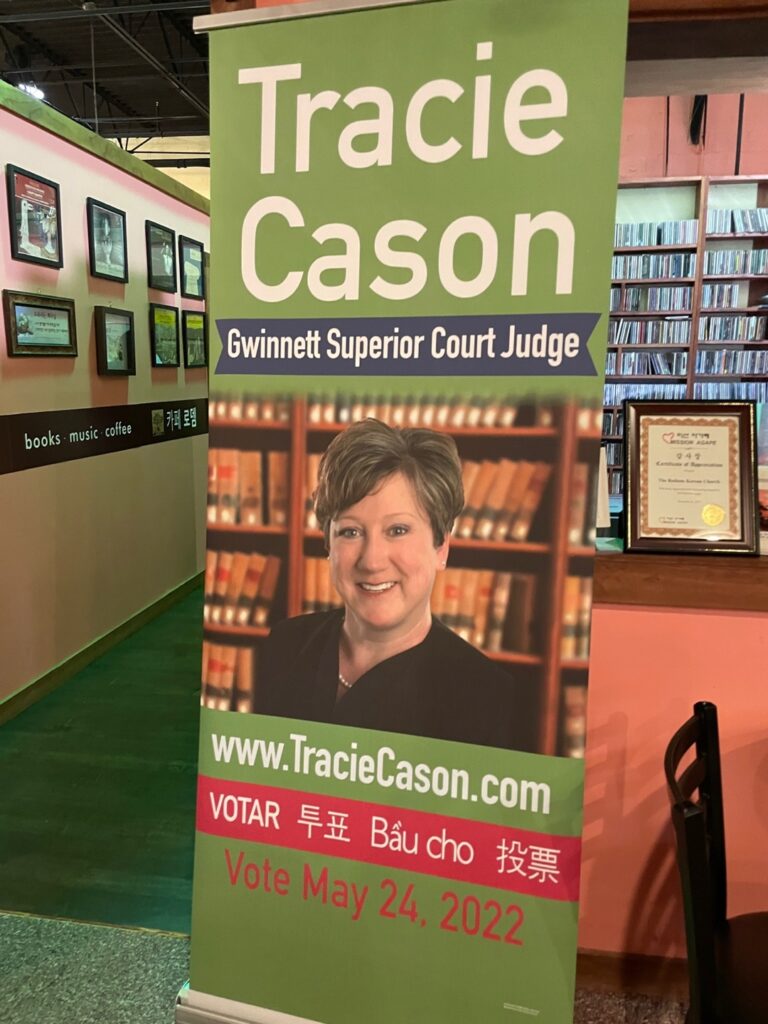
Election campaign banner. As a diverse Gwinnett County judge, it was produced in English, Korean, Chinese, and Vietnamese. photo by Global News Today.
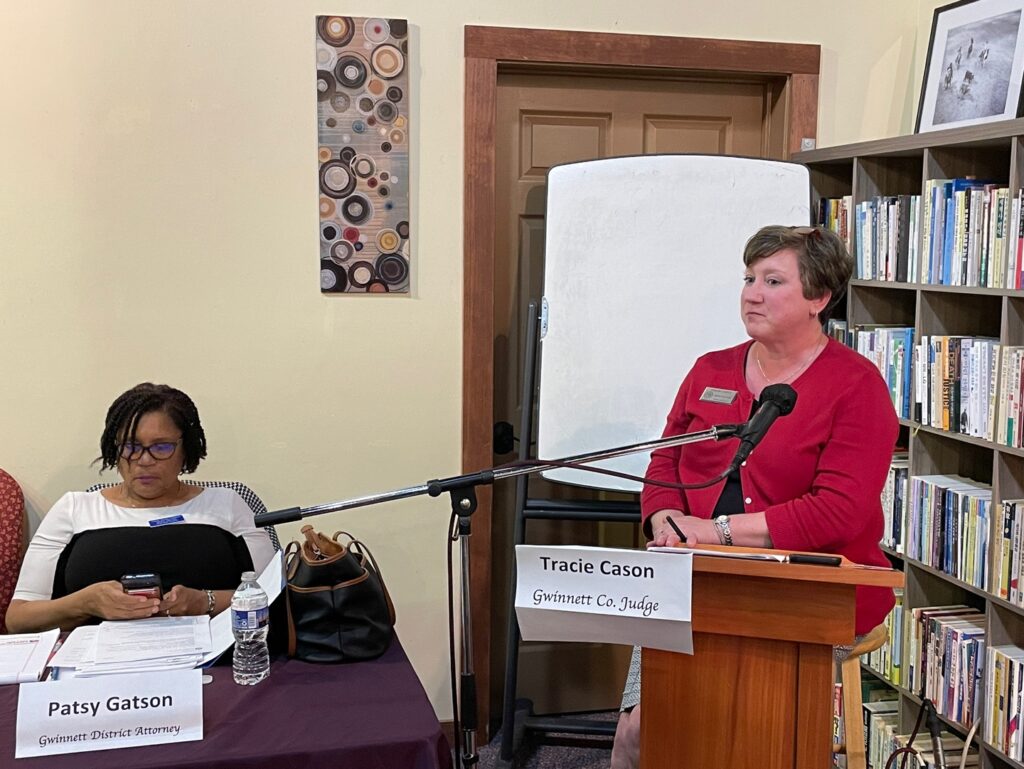
Judge Traceie Cason (far right) was the moderator of a seminar hosted by the Korean Crime Prevention Committee and answered questions from the panelists on ‘Gye’ and ‘Multilevel Financial Fraud’. (From left) Commissioner Lee Cho-won, Commissioner Hyung-kwon Park, candidate of House of Representatives Soo Hong, candidate of Solicitor-Genera Lisamarie Bristol, Candidate of House of Representatives Matt Reeves, and Gwinnett County Attorney General Patsy Austin-Gatson. photo by Global News Today.
Judge Tracie Cason. photo by Global News Today.

Venus and Jupiter will appear to touch each other in the sky at the end of the month

0

Venus and Jupiter will appear to touch each other in the sky at the end of the month, despite actually being millions of miles apart.

The two planets will appear closest together around 3 p.m. ET on April 30, with Venus 0.2 degrees south of Jupiter, according to EarthSky. The distance is less than the diameter of the moon, the space site added, reported by CNN.

By May 1, the planets will have continued on their paths and look as if they are spreadingfarther apart from Earth’s vantage point.

The early morning hours of April 30 and May 1 will provide great viewing opportunities, according to EarthSky, and you won’t need a telescope to view them.

In the Northern Hemisphere, viewers should look along the southeastern horizon just as dawn begins to break, but while it’s still dark enough to see some stars, Hartigan said.

Stargazers in the Southern Hemisphere will also be able to see the conjunction under the same conditions, except Venus and Jupiter will appear above the eastern horizon, EarthSky said.

Unlike in the Northern Hemisphere, Venus will appear above Jupiter on April 30 and below Jupiter on May 1 in the Southern Hemisphere, according to Hartigan.

Because the moon will not be illuminated, it will be easier to see the two planets nearly touch in the sky. That’s as long as the sky is clear, since inclement weather would block the conjunction from view.

The Venus-Jupiter conjunction happens about once a year, but this year the two planets will appear significantly closer than they usually do, said Patrick Hartigan, professor of physics and astronomy at Rice University in Houston.

A conjunction is when two planets appear to touch each other in the sky from Earth’s point of view, according to NASA.

The last time the two planets were closer than this year’s conjunction was August 2016, although it was more difficult to see since they were close to the sun, according to Hartigan.

In the nights leading up to the conjunction, the moon will slowly become less visible as it transitions to a new moon on April 30, according to NASA.

Although the conjunction takes place at the end of the month, viewers can already see the two planets slowly creeping toward each other. On April 27, they will be 3.2 degrees apart, EarthSky said.

Mars and Saturn will roughly align north of Venus and Jupiter, according to EarthSky, meaning astronomers will be able to see four planets while viewing the conjunction. Alignment means the planets form a line between them, but do not appear significantly close to each other like a conjunction.

“Venus and Jupiter are typically the two brightest planets in the sky, so they can put on quite a show when they are in close conjunction. It is a beautiful sight and easy for everyone to see,” Hartigan said.

Singapore executes Malaysian on drugs trafficking charges after rejecting mental disability appeal

0

Singapore executed a Malaysian man convicted of drug trafficking on Wednesday despite appeals for clemency on the grounds that he had an intellectual disability, his family said, in a case that has drawn international attention, according to Reuters.

Nagaenthran Dharmalingam, 34, had been on death row for more than a decade for trafficking 44 grams (1.5 oz) of heroin into Singapore, which has some of the world’s toughest narcotics laws. His lawyers had filed multiple appeals against his execution saying he was intellectually disabled.

The Malaysian government said in a statement it respected Singapore’s legal system, but noted it had sent another letter this week to ask the city-state’s government to reconsider and commute the sentence.

While Malaysia has similar penalties for drug trafficking, the country has imposed a moratorium on all executions since 2018, pending efforts to reform capital punishment laws.

“The Singapore authorities must immediately stop the current wave of executions and urgently review legislation on the use of the death penalty, with a view towards abolition, in light of this shocking case,” Amnesty International said in a statement.

The Singapore government says the death penalty is a deterrent against drug trafficking and most of its citizens support capital punishment.

His brother Navin Kumar, 22, said by telephone the execution had been carried out and said the body would be sent back to Malaysia where a funeral would be held in the town of Ipoh.

A Singapore court on Tuesday turned down a legal challenge put forward by Nagaenthran’s mother, clearing the way for the execution by hanging.

At the end of Tuesday’s hearing, Dharmalingam and his family reached through a gap in a glass screen to grasp each others’ hands tightly as they wept. His cries of “ma” could be heard around the courtroom.

Singapore authorities do not usually comment on executions.

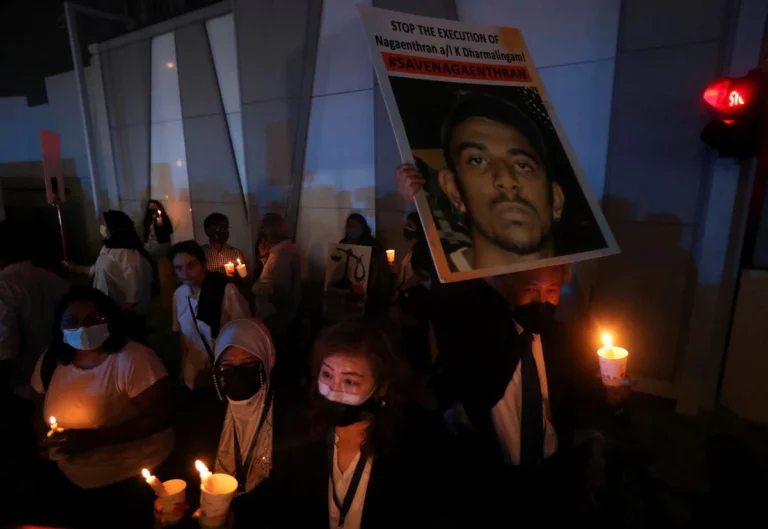
About 300 people held a candlelight vigil at a Singapore park on Monday to protest against the planned hanging.

Anti-death penalty group Reprieve in a statement described the execution as a “tragic miscarriage of justice”, but also said it felt it could be a “watershed moment” for opposition against the death penalty in Singapore.

A vigil was also held outside the Singapore High Commission in Kuala Lumpur on Tuesday evening appealing for clemency, with one protester carrying a placard reading “Singapore spare Nagaenthran the noose.”

Nagaenthran’s case attracted world attention, with a group of United Nations experts and British billionaire Richard Branson joining Malaysia’s prime minister and human rights activists to urge Singapore to commute his sentence.

His lawyers and activists have said Nagaenthran’s IQ was found to be 69, a level recognised as an intellectual disability. However, the courts determined he knew what he was doing at the time of his crime, and ruled there was no admissible evidence showing any decline in his mental condition.

U.N. takes a first step to put veto users under global spotlight

0

The U.N. General Assembly took a first step Tuesday to put the five permanent members of the Security Council under the spotlight whenever they use their veto power, a move highlighted by Russia’s veto threat paralyzing any action by the U.N.’s most powerful body on the Ukraine war, according to NPR.

A resolution adopted by consensus in the 193-member assembly amid a burst of applause does not eliminate or limit the veto power of the Security Council’s permanent members — the United States, Russia, China, Britain and France.

But for the first time, the General Assembly will be required “to hold a debate on the situation” that sparks a veto in the Security Council within 10 working days. Precedence will be given on the list of speakers to the permanent member who casts a veto.

India and Brazil, which have sought permanent seats on the Security Council for many years and are currently serving two-year terms on the body, both complained that the resolution doesn’t address the real issue of reforming the council.

“A representative council which reflects the current international system is central to the maintenance of international peace and security and to the future of this organization.” Brazilian Ambassador Ronaldo Costa Filho told members.

India’s deputy ambassador, Ravindra Raguttahalli, said that “a vocal minority of nay-sayers” who support the status quo in the Security Council have held reform efforts hostage. He said the veto resolution ignores the root cause of the problem — restructuring the council to reflect “contemporary geo-political realities.”

Ambassador Michel Biang of Gabon, which is also an elected council member, said Africa has the largest number of U.N. peacekeeping missions but has no permanent seat on the Security Council.

Approving the resolution “will not change the scope of the veto, nor its substance,” Biang said.

The assembly isn’t required to take or consider any action under the resolution, but the discussion could put veto-wielders on the spot and let a raft of other countries be heard.

Liechtenstein’s U.N. ambassador, Christian Wenaweser, who spearheaded the resolution, which had been in the works for two years, has said it aims “to promote the voice of all of us who are not veto-holders, and who are not on the Security Council, on matters of international peace and security because they affect all of us.”

In presenting the resolution to the assembly Tuesday morning, Wenaweser alluded to Russia’s invasion of Ukraine on Feb. 24 and the Security Council’s failure to take action: “There has never been a stronger need for effective multilateralism than today, and there has never been a stronger need for innovation in order to secure the central role and voice of the United Nations.”

Amnesty International’s secretary general, Agnes Callamard, called the resolution “a first step towards increasing the cost of using the veto — and it could not have come soon enough.”

The resolution had about 80 co-sponsors, including the United States and the United Kingdom. But it also had detractors even though they didn’t break consensus, including Russia and close ally Belarus as well as current elected council members Gabon and India and other U.N. member nations.

The reform of the Security Council, which is charged under the U.N. Charter with ensuring international peace and security, has been debated for more than 40 years, and was front and center in comments by countries before and after the resolution’s adoption.

There is widespread support for revamping the council to reflect current global realities rather than the international power structure after World War II in 1945 when the United Nations was created. But rivalries between countries and regions have blocked all attempts to reach agreement on the size, composition and powers of an expanded council.

The veto power of the five permanent members is one component on the reform agenda.

More than 200 different Security Council proposals have been vetoed, some by multiple countries, according to U.N. records. The subjects have ranged from the Korean War and the Israeli-Palestinian conflict to climate change, reporting on weapons stockpiles, and governance of a part of the Indian Ocean nation Comoros.

The former Soviet Union and its successor Russia have cast the most vetoes by far, followed by the United States. Far fewer have been cast by Britain, China and France.

U.S. deputy ambassador Richard Mills said after the vote that the United States is “extraordinarily troubled by Russia’s pattern of abusing its veto right over the past decade,” citing resolutions it vetoed ranging from referring Syria to the International Criminal Court, protesting Russia’s annexation of Ukraine’s Crimea peninsula and demanding Russia immediately halt its invasion of Ukraine.

British Ambassador Barbara Woodward, whose country has not used its veto since 1989, called the resolution “a step in pursuit of upholding international peace and security,” adding: “We prefer to win votes rather than use our veto to block council action.”

France didn’t co-sponsor the resolution and its deputy ambassador, Nathalie Broadhurst, said it does not believe the General Assembly can become the judge of the Security Council.

She said that is why France and Mexico have been promoting an initiative on the veto for several years. It would require the five permanent council members to voluntarily and collectively suspend the use of the veto in the event of mass atrocities. Saying the proposal is supported by 105 countries, she urged “all states, in particular the other four permanent members, to join it.”

Russia’s deputy ambassador, Gennady Kuzmin, called the veto “a cornerstone of the U.N. architecture” and warned that “without it the Security Council would become a rubber-stamping body, rubber-stamping questionable decisions imposed by the nominal majority whose implementation would be hardly possible.”

Chinese counselor Jiang Hua said the resolution’s automatic triggering of a General Assembly meeting on the vetoed resolution “in practice is likely to cause procedural confusion and inconsistency.”

Biden will make a highly effective COVID drug, available to more pharmacies

0

There is a new push from the White House to get Paxlovid, a drug which reduces the risk of COVID hospitalization by 90%, into the hands of more Americans.

The rollout of the medication has been slow since it was authorized for use in December, failing to reach many Americans eligible for treatment, according to NPR.

“It’s pretty clear from the uptake of Paxlovid, and the rate of hospitalizations and deaths over the months that Paxlovid has been available, that there are still some folks who could have benefitted from these medications,” a senior administration official acknowledged on a call with reporters on Monday ahead of Tuesday’s announcement.

“We can save more lives by getting this medication to more people,” the official said.’

Dr. Jerome Adams, who served as surgeon general during the Trump administration, worries that many people who are particularly vulnerable to COVID because of poor health or a lack of access to quality medical care, including many people of color and those living in rural areas, aren’t even aware that Paxlovid could be an option for them.

“The people who know about it are the people who know how to advocate for themselves, so we are seeing inequities actually expand,” Adams said in an interview in advance of the administration’s announcement. “One thing we need to do is have a massive patient education campaign.”

Now, the White House is set to begin that education push. But after limited success convincing the public to get vaccinated and boosted against the virus, it remains to be seen how effective the administration’s latest efforts will be.

The drug is authorized for use in patients 12 years of age and older who test positive for COVID and are at a high risk for developing a severe case. Because of the many possible risk factors for a severe case, including diabetes and obesity, tens of millions of Americans could be eligible to receive the drug if they receive a positive test.

The antiviral pills are a central component of President Biden’s strategy for helping Americans live with the pandemic, first detailed by the White House nearly two months ago. The government purchased 20 million doses of the drug from Pfizer and worked with the company to accelerate delivery of the pills.

Many pharmacies have not yet been able to stock the drug and some physicians have been hesitant to prescribe it over concerns about depleting the supply — which the White House now describes as “ample.”

The new campaign aims to double the number of places the pills are available in the coming weeks by allowing tens of thousands of pharmacy locations to order the treatment directly from the federal government.

There is also a plan to educate providers and the public about the drug and expand the administration’s “Test-to-Treat” program.

Dr. Ashish Jha, the White House COVID coordinator, told NPR on Monday that despite a considerable federal stockpile, there have been problems getting the drugs off the shelves and into the hands of patients.

“We’ve got to turn those pills into prescriptions and into things that patients can get so they can get better,” Jha said.’

Russia cutting off gas supplies to Poland, Bulgaria for refusing to pay in rubles

0

Polish and Bulgarian officials said Tuesday that Russian energy company Gazprom informed them it was suspending natural gas supplies to the two countries for their refusal to pay in Russian rubles

The suspensions, which would take effect Wednesday, would be the first since Russian President Vladimir Putin said last month that “unfriendly” foreign buyers would have to pay the state-owned Gazprom in rubles instead of dollars and euros, according to Fox Business.

Bulgaria said the new gas payment system created considerable risks for the country and that it was working with state gas companies to find alternative sources to replace the supplies it gets from Russia.

But the Bulgarian government said no restrictions on domestic gas consumption would be imposed for now even though the Balkan country of 6.5 million meets over 90% of its gas needs with Russian imports.

Gazprom suspending supplies to other countries would spell economic pain for Europe which heavily relies on Russian natural gas to heat homes, generate electricity and fuel industry. Still, any potential cutoffs are a two-way street, and Russian would likely be hurt as well given its reliance on European customers. 

European leaders said they would not comply with the rubles requirement, arguing that it violated the terms of contracts and their sanctions against Russia over its military aggression against Ukraine. Only Hungary has agreed to Putin’s demands.

Around 60% of imports are paid in euros, and the rest in dollars. Putin’s demand was apparently intended to help bolster the Russian currency amid the Western sanctions imposed over the war.

Poland’s state gas company, PGNiG, said it was informed by Gazprom that its deliveries through the Yamal-Europe pipeline would stop Wednesday morning.

The Yamal pipeline carries natural gas from Russia to Poland and Germany through Belarus. Poland has been receiving some 9 billion cubic meters of Russian gas annually, fulfilling some 45% of the country’s needs.

The Bulgarian Energy Ministry said it was also notified that Bulgaria’s supplies of Russian gas via the TurkStream pipeline would cease on Wednesday. 

Poland has been a strong supporter of neighboring Ukraine during the Russian invasion. It is a transit point for weapons the United States and other Western nations have provided Ukraine.

This week, the Polish government confirmed that it was sending tanks to Ukraine’s army. On Tuesday, it announced a sanctions list targeting 50 Russian oligarchs and companies – including Gazprom.

Bulgaria was once one of Moscow’s closest allies, but relations soured after a new liberal government took the reigns last fall and after Putin’s military invaded Ukraine in February. It has supported sanctions against Russia and provided humanitarian aid to Ukraine.

Poland’s gas company said it was considering legal action over the Russian payment demand. But Polish Climate Minister Anna Moskwa stressed that Poland was prepared for such a situation after working for years to reduce its reliance on Russian energy sources.

Several years ago it opened its first terminal for liquefied natural gas (LNG) in Swinoujscie, on the Baltic Sea coast, while later this year a pipeline bringing gas from Norway, called “Baltic Pipe,” is to become operational.

Harvard is vowing to spend $100M to research, atone for role in slavery

0

Harvard University is vowing to spend $100 million to study and atone for its extensive ties with slavery, the school’s president announced Tuesday, with plans to identify and support the descendants of enslaved people who labored at the Ivy League campus.

President Lawrence Bacow announced the funding as Harvard released a new report detailing the many ways the college benefited from slavery and perpetuated racial inequality. But the report stops short of recommending direct financial reparations, and officials have no immediate plans for that kind of support, according to AP.

Harvard formally began exploring its ties to slavery in 2016, when former President Drew Gilpin Faust acknowledged that the school was “directly complicit in America’s system of racial bondage.” Faust organized a committee to study the topic and had a plaque installed on campus honoring enslaved people who labored there.

Student activists had been shining a light on Harvard’s darker histories for years. In 2015, students demanded that Harvard Law School abandon its official crest, which was tied to an 18th century donor whose family enslaved dozens of people. Months later, the school retired the symbol.

Soon after becoming president, Bacow established a new Presidential Initiative on Harvard and the Legacy of Slavery to dig deeper into the university’s role. That effort led to the new report.

“The Harvard that I have known, while far from perfect, has always tried to be better — to bring our lived experience ever closer to our high ideals,” Bacow wrote. “In releasing this report and committing ourselves to following through on its recommendations, we continue a long tradition of embracing the challenges before us.”

Harvard, the nation’s oldest and wealthiest college, is the latest among a growing number of U.S. schools attempting to confront their involvement with slavery and also make amends for it.

The report, commissioned by Bacow, found that Harvard’s faculty, staff and leaders enslaved more than 70 Black and Native American people from the school’s founding in 1636 to 1783. It cautions that the figure is “almost certainly an undercount.” Using historical records, researchers were able to identify dozens of enslaved people by name, along with their connection to the university.

Most were identified only by a single name, such as Cesar, Dinah and Venus.

“Enslaved men and women served Harvard presidents and professors and fed and cared for Harvard students,” researchers found. “Moreover, throughout this period and well into the 19th century, the University and its donors benefited from extensive financial ties to slavery.”

The report says the university “should make a significant monetary commitment, and it should invest in remedies of equal or greater breadth than other universities.” Bacow said Harvard will attempt to redress its wrongs through “teaching, research and service.” He is creating a committee to implement the report’s suggestions.

Building on earlier research at Harvard, the report details how the university depended on the slave trade in its early years and profited from it for decades.

Harvard invested directly in the sugar and rum trades in the Caribbean, along with the U.S. cotton and railroad industries. The college’s early growth is credited to support from wealthy donors who accumulated their fortunes through the slave trade and industries that relied on it.

Along with the 70 people who were enslaved, the report also lists their enslavers — including several Harvard presidents and high-ranking officials — and the campus buildings, rooms and professorships that are still named after them.

Even after slavery was abolished, the report says, prominent scholars continued to promote concepts that fueled racist ideas.

It cites work by 19th century professor Louis Agassiz, who pushed discredited theories on “race science” and eugenics. Another scholar led a “physical education” program that collected students’ physical measurements to support research advancing eugenic theories.

In his message, Bacow called the findings “disturbing and shocking,” and he acknowledged that the school “perpetuated practices that were profoundly immoral.”

“Consequently, I believe we bear a moral responsibility to do what we can to address the persistent corrosive effects of those historical practices on individuals, on Harvard, and on our society,” he wrote.

The 130-page report included a series of recommendations that Bacow endorsed. The $100 million will be used to carry out the work, with some funding to be made available now and more to be held in an endowment. The university itself has an endowment of more than $50 billion, the largest in the nation.

The report says Harvard should identify the descendants of enslaved people and engage with them “through dialogue, programming, information sharing, relationship building and educational support.”

“Through such efforts, these descendants can recover their histories, tell their stories and pursue empowering knowledge,” the report said.

More broadly, it urges Harvard to fight racial inequality by expanding education options for descendants of enslaved people, especially in the South and the Caribbean. It calls on the university to work closely with historically Black colleges across the country, with new funding to bring students and scholars to Harvard for up to a year at a time.

And acknowledging the enslavement of Native Americans, it calls on Harvard to build closer ties with New England tribes. Harvard should recruit more students from tribal communities, the report says, and organize a national conference promoting research on the enslavement of Indigenous people.

In accepting the recommendations, Harvard joins an increasing number of colleges attempting to move from research to action as they reconcile with their histories.

Georgetown University in 2019 promised to raise $400,000 a year for the descendants of enslaved people sold by the school. The Princeton Theological Seminary created a $27.6 million reparative endowment. The University of Virginia established scholarships for the descendants of enslaved people.

Israeli air raids in Syria kills nine combatants

0

Israeli air raids near Syria’s capital, Damascus, have killed nine combatants, among them five Syrian soldiers, in the deadliest such raid since the start of 2022, a war monitor said.

According to Aljazeera, the Syrian Observatory for Human Rights said an ammunition depot and several positions linked to Iran’s military presence in Syria were among the targets on Wednesday.

Government media in Syria confirmed four of the nine reported casualties in the air raids. There was no comment from Israel.

Israel is believed to have staged hundreds of attacks on targets in Syria over the years, but it has rarely acknowledged or discussed such operations.

It has said, however, that it targets the bases of Iran-allied militias, such as Lebanon’s Hezbollah group, which has fighters in Syria backing the government of President Bashar al-Assad. It says it attacks arms shipments believed to be bound for the militias.

Israel also argues that any Iranian presence near its northern frontier is a red line.

“The Israeli enemy carried out an air assault at dawn … targeting several positions around Damascus,” a military source was quoted as saying by the state news agency SANA.

“The investigation indicated that four soldiers were killed, three others injured and material damage noted.”

The latest strike follows another near Damascus on April 14, without casualties, according to SANA.

The UK-based Observatory, which relies on a vast network of sources in every region of Syria, said eight people were also wounded in the attack.

Aside from the five Syrian soldiers, the other four killed were members of an Iran-backed militia, Observatory chief Rami Abdel Rahman said, adding he could not verify their nationalities.

He said at least five separate sites were targeted in the latest Israeli hits.