Home Blog Page 45

600 civilians died in March theater bombing in Mariupol

0

Evidence suggests close to 600 civilians died in the Russian airstrike on the Mariupol drama theater on March 16 that horrified the world and helped galvanize support for Ukraine’s effort to repel the invasion, according to an Associated Press investigation.

The theater had been used as a bomb shelter in the early days of Russia’s siege of the port city and had large warnings visible from the sky reading, “children.”

AP’s death total is twice the city government’s estimate and marks the deadliest single known attack against civilians in the war. AP said its journalists drew on accounts of 23 survivors, rescuers and people intimately familiar with the shelter operating at the Donetsk Academic Regional Drama Theater. It also used two sets of floor plans of the theater, photos and video taken inside before, during and after that day.

Most witnesses said around 1,000 people were in the theater at the time of the assault.

Dozens of nations have provided military and/or humanitarian aid to Ukraine. The U.S. has committed $3.7 billion in weapons and other aid and President Joe Biden is seeking an additional $33 billion from Congress.

Meanwhile, over 5 million refugees have fled Ukraine since Russia invaded. The United States in March pledged to accept 100,000 Ukrainians and individuals who have been displaced due to the war, and the Biden administration extended the eligibility for Ukrainians for temporary protected status in mid-April, which allows them to stay in the United States for 18 months and apply for work permits.

Elderly man taken to morgue in body bag while still alive

0

An elderly Shanghai resident was mistakenly declared dead and taken to a morgue in a body bag, in the latest sign of dysfunction in the Covid-stricken city where millions of people remain under government-enforced lockdown.

Video footage, shot by a bystander, shows the moment several workers dressed head-to-toe in protective gear recoil as they realize the man is still alive. The footage has since gone viral on Chinese social media, sparking horror and outrage, reported by CNN.

For weeks, the lockdown prohibited nearly all 25 million residents from leaving their homes or residential compounds — prompting logistical chaos, with many complaining they were unable to access basic goods like food, water, health products and even medical care for non-Covid emergencies.

Last week, authorities said some neighborhoods could start to ease lockdown measures if they have reported no cases in the past two weeks, allowing some neighborhoods a measure of freedom within their district.

As of Tuesday, more than 8.2 million Shanghai residents were still banned from leaving their residential compounds.

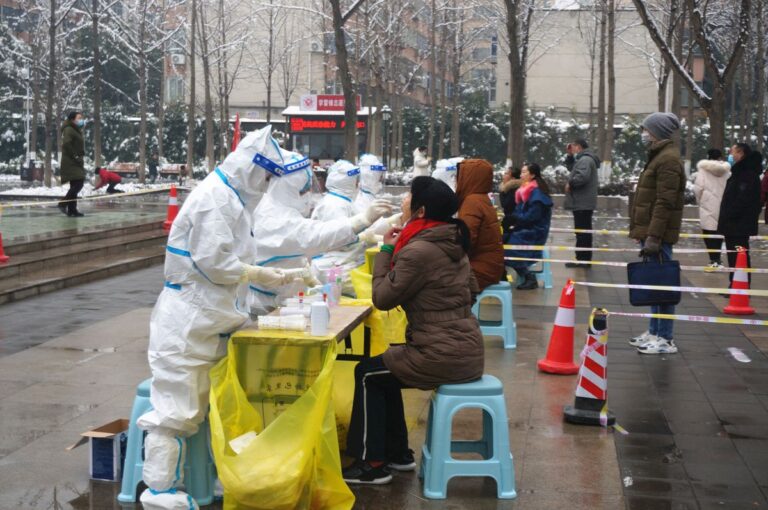
Meanwhile, cases are also rising in the national capital Beijing, where schools and other public spaces like libraries and shopping malls have been closed. More than 20 million residents will undergo three more rounds of mass testing this week, on top of several rounds implemented last week, authorities announced Monday.

The video, posted on Sunday, shows the head of the man — a nursing home resident — appearing from the yellow body bag as the workers lift it from a vehicle.

The person filming the video, apparently from a nearby building, can be heard saying, “The nursing home is such a mess. They sent a living person on a hearse and said they were dead. The undertaker staff said they were still moving … It is irresponsible, really irresponsible.”

On China’s Twitter-like platform Weibo, many expressed disbelief such a grave mistake could have happened — especially in Shanghai, which has long been seen as China’s most progressive and modern city.

“The problems in Shanghai are fully exposed this time,” read one popular comment on Weibo.

“This counts as intentional homicide,” wrote another user.

Many others pointed out the man could have been buried or cremated had he not been discovered alive. “The government doesn’t care … what is going on in Shanghai?” one comment read.

The district government responded to the incident on Monday, saying in a statement the elderly man was now in a stable condition.

Three officials have been removed from the district’s civil affairs bureau and social development office, and the head of the nursing home has also been removed, it said.

Authorities have also revoked the certification of a doctor who was involved, and who is now under investigation, according to the state-run Global Times.

The financial hub has been battling an outbreak of Covid-19 cases since early March, and has now been under citywide lockdown since March 31. It has become the center of China’s wider outbreak, with cases rising and lockdown measures being introduced in numerous cities.

Russia says it struck US and European weapons near Ukraine’s Odesa

0

According to Reuters, Russia has struck a military airfield near Ukraine’s southwestern city of Odesa with missiles, destroying drones, missiles and ammunition supplied to Ukraine by the United States and its European allies, the defence ministry said on Tuesday.

Russian missiles and artillery also struck various military targets across Ukraine, including command centres, arsenals, and an S-300 anti-aircraft missile system.

The governor of Odesa, Maksym Marchenko, said a rocket strike had hit the Black Sea port city on Monday evening, causing deaths and injuries

“High-precision Onyx missiles struck a logistics centre at a military airfield in the Odesa region through which foreign weapons were being delivered,” the defence ministry said.

“Hangars containing unmanned Bayraktar TB2 drones, as well as missiles and ammunition from the U.S. and European countries, were destroyed,” it said.

More survivors are found 3 days after China building collapse

0

Rescuers have found two more survivors in the rubble of a building in central China that collapsed more than three days ago, state media reported Tuesday.

The official Xinhua News Agency said a man and a woman were pulled out on Monday afternoon and early Tuesday morning.

The woman, whose rescue came after being buried for 88 hours, alerted workers using life detection equipment to her presence by knocking on objects. Xinhua said she was conscious, had normal vital signs and was able to communicate with her rescuers.

Following an increase in the number of collapses of self-built buildings in recent years, Chinese President Xi Jinping said Saturday that it was necessary to check such structures for any hidden dangers and fix them to prevent major accidents, Xinhua said.

Poor adherence to safety standards, including the illegal addition of extra floors and failure to use reinforcing iron bars, is often blamed for such disasters.

The collapse of the six-story building took place at 12:24 p.m. Friday in Changsha, the Hunan provincial capital south of Beijing.

Police have arrested nine people, including the building owner, on suspicion of ignoring building codes or committing other violations. Also held were three people in charge of design and construction and five others who allegedly gave a false safety assessment for a guest house on the building’s fourth to sixth floors.

The building also held a residence, a cafe and shops.

Muslims mark Eid al-Fitr holiday with joy, worry

0

For the Islamic holiday of Eid al-Fitr, the smell of freshly baked orange biscuits and powdered sugar-dusted cookies typically fills the air in Mona Abubakr’s home. But due to higher prices, the Egyptian housewife this year made smaller quantities of the sweet treats, some of which she gives as gifts to relatives and neighbors, reported by AP.

The mother of three has also tweaked another tradition this Eid, which began Monday in Egypt and many countries and marks the end of the Islamic holy month of Ramadan. She bought fewer outfits for her sons to wear during the three-day feast.

“I told them we have to compromise on some things in order to be able to afford other things,” she said.

Many in the capital flocked to shopping centers to buy clothes, shoes and sweets before the holiday despite pandemic warnings and food price surges.

Muslims in Malaysia were also in a celebratory mood after their country’s borders fully reopened and COVID-19 measures were further loosened. Ramadan bazaars and shopping malls have been filled with shoppers ahead of Eid and many traveled to their hometowns.

“It’s a blessing that we can now go back to celebrate,” said sales manager Fairuz Mohamad Talib, who works in Kuala Lumpur. His family will celebrate at his wife’s village, where they planned to visit neighbors.

“It’s not about feasting but about getting together,” he said ahead of the holiday. With COVID-19 still on his mind, the family will take precautions such as wearing masks during visits. “There will be no handshakes, just fist bumps.”

This year, Muslims around the world are observing Eid al-Fitr — typically marked with communal prayers, celebratory gatherings around festive meals and new clothes — in the shadow of a surge in global food prices exacerbated by the war in Ukraine. Against that backdrop, many are still determined to enjoy the holiday amid easing of coronavirus restrictions in their countries while, for others, the festivities are dampened by conflict and economic hardship.

At the largest mosque in Southeast Asia, tens of thousands of Muslims attended prayers Monday morning. The Istiqlal Grand Mosque in Indonesia’s capital Jakarta was shuttered when Islam’s holiest period coincided with the start of the coronavirus pandemic in 2020 and was closed to communal prayers last year.

“Words can’t describe how happy I am today after two years we were separated by pandemic. Today we can do Eid prayer together again,” said Epi Tanjung after he and his wife worshipped at another Jakarta mosque. “Hopefully all of this will make us more faithful.”

The mood was festive at Cairo’s Al-Azhar Mosque where people congregated for the Eid prayer on Monday. One man threw lollipops in the air for kids to catch in celebration, before the prayer started, while other children played with balloons.

“I was really happy at seeing the gathering and the joy of the people for Eid,” said one worshipper, Marwan Taher. “The atmosphere here really made me feel like it’s Eid.”

The war in Ukraine and sanctions on Russia have disrupted supplies of grain and fertilizer, driving up food prices at a time when inflation was already raging. A number of Muslim-majority countries are heavily reliant on Russia and Ukraine for much of their wheat imports, for instance.

Even before the Russian invasion, an unexpectedly strong global recovery from the 2020 coronavirus recession had created supply chain bottlenecks, causing shipping delays and pushing prices of food and other commodities higher.

In some countries, the fallout from the war in Ukraine is only adding to the woes of those already suffering from turmoil, displacement or poverty.

In Syria’s rebel-held northwestern province of Idlib, Ramadan this year was more difficult than Ramadans past. Abed Yassin said he, his wife and three children now receive half the amounts of products — including chickpeas, lentils, rice and cooking oil — which last year they used to get from an aid group. It has made life more difficult.

Syria’s economy has been hammered by war, Western sanctions, corruption and an economic meltdown in neighboring Lebanon where Syrians have billions of dollars stuck in Lebanese banks.

In the Gaza Strip, though streets and markets are bustling, many say they cannot afford much.

“The situation is difficult,” said Um Musab, a mother of five, as she toured a traditional market in Gaza City. “Employees barely make a living but the rest of the people are crushed.”

Mahmoud al-Madhoun, who bought some date paste, flour and oil to make Eid cookies, said financial conditions were going from bad to worse. “However, we are determined to rejoice,” he added.

The Palestinian enclave, which relies heavily on imports, was already vulnerable before the Ukraine war as it had been under a tight Israeli-Egyptian blockade meant to isolate Hamas, its militant rulers.

Afghans are celebrating the first Eid since the Taliban takeover amid grim security and economic conditions. Many were cautious but poured into Kabul’s largest mosques for prayers on Sunday, when the holiday started there, amid tight security.

Frequent explosions marred the period leading to Eid. These included fatal bombings, most claimed by the Islamic State affiliate known as IS in Khorasan Province, targeting ethnic Hazaras who are mostly Shiites, leaving many of them debating whether it was safe to attend Eid prayers at mosques.

“We want to show our resistance, that they cannot push us away,” said community leader Dr. Bakr Saeed before Eid. “We will go forward.”

Violence wasn’t the only cause for worry. Since the Taliban takeover in August, Afghanistan’s economy has been in a freefall with food prices and inflation soaring.

At a charity food distribution center in Kabul on Saturday, Din Mohammad, a father of 10, said he expected this Eid to be his worst.

“With poverty, no one can celebrate Eid like in the past,” he said. “I wish we had jobs and work so we could buy something for ourselves, not have to wait for people to give us food.”

Muslims follow a lunar calendar, and methodologies, including moon sighting, can lead to different countries — or Muslim communities — declaring the start of Eid on different days.

In Iraq, security issues also plague celebrations, with security forces going on high alert from Sunday to Thursday to avert possible attacks after a suicide bombing in Baghdad last year ahead of another major Islamic holiday killed dozens.

In India, the country’s Muslim minority is reeling from vilification by hard-line Hindu nationalists who have long espoused anti-Muslim stances, with some inciting against Muslims. Tensions boiled over into violence at Ramadan, including stone-throwing between Hindu and Muslim groups. Muslim preachers cautioned the faithful to remain vigilant during Eid, which will be observed there on Tuesday.

Indian Muslims “are proactively preparing themselves to deal with the worst,” said Ovais Sultan Khan, a rights activist. “Nothing is as it used to be for Muslims in India, including the Eid.”

Still, many Muslims elsewhere rejoiced in reviving rituals disrupted by pandemic restrictions.

Millions of Indonesians crammed into trains, ferries and buses ahead of Eid as they poured out of major cities to celebrate with their families in villages in the world’s most populous Muslim-majority country. The return of the tradition of homecoming caused great excitement after two years of subdued festivities due to pandemic restrictions.

“The longing for (the) Eid celebration in a normal way has finally been relieved today although the pandemic has not yet ended,” said Hadiyul Umam, a resident of Jakarta.

In Korean by Eugene Lee (click)

India has been suffering under record-breaking heat

0

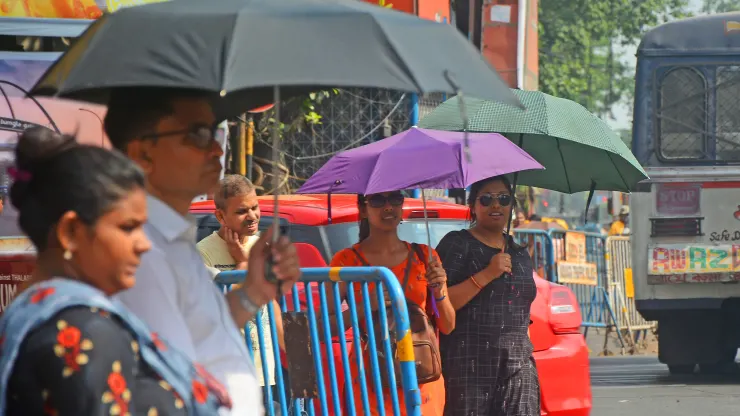
India has been suffering under record-breaking heat for the last couple months.

Last month was the third-hottest April the country has seen over the past 122 years, from 1901 to 2022, according to government officials.

The average maximum temperature was 35.30 degrees Celsius (95.5 degrees Fahrenheit), coming in just behind 35.42 degrees Celsius (95.8 degrees Fahrenheit) in 2010 and 35.32 degrees Celsius (95.6 degrees Fahrenheit) in 2016, the Indian government said in a statement on Monday. That’s more than a degree hotter than the average max temperature in April between the years 1981 and 2010, which was 33.94 degrees Celsius (93.1 degrees Fahrenheit).

The average maximum temperature recorded in March was 33.10 degrees Celsius (91.6 degrees Fahrenheit), which is the highest average maximum in the past 122 years, and just a smidge higher than the previous record high recorded in March 2010. It’s almost two degrees hotter than average maximum temperature in March between the years 1981 and 2010, which was 31.24 degrees Celsius (88.2 degrees Fahrenheit).

To deal with the heat, the Indian meteorological society advised people to avoid direct heat exposure and to stay hydrated. “Drink sufficient water — even if not thirsty,” a written statement from the organization published on Sunday recommended.

“Wear lightweight, light-colored, loose, cotton clothes and cover the head by use of cloth, hat or umbrella,” the Indian government recommended.

Much of India is expected to continue to suffer under high temperatures in May, the government’s meteorological department said. “Above normal minimum temperatures are likely over most parts of northwest, central, east and northeast India,” the monthly forward-looking outlook, which was published on Saturday, says.

What’s particularly notable is the early onset of the heat wave, according to Arpita Mondal, a professor of climate studies at the Indian Institute of Technology. The expected timing of a heat wave like this is May and June, Modal told CNBC. It’s also affecting a notably large geographic region, Mondal said.

The length and geographic size of the heat wave are what’s notable to Zachary Zobel, an assistant scientist at the Woodwell Climate Research Center. “The most shocking part for me has been the geographical extent and the duration,” Zobel told CNBC. “Yes, this heat wave occurring in April is also alarming since May and June are typically the hottest months for India, but the size and length of these heat waves are what has surprised me the most.” 

Human-caused climate change is likely to make heat waves hotter, longer, and more common, according to the National Academies of Sciences, Engineering, and Medicine.

“The scientific community has overwhelming evidence that climate change is causing the distributions of temperature to shift by changing the ‘normal’ state, and shift in distributions would mean more and more chances of extremes,” Mondal told CNBC.

And regions of the globe being hit by this heat wave are likely to be vulnerable to more heat waves in the future, Zobel said. “There is no question that heat waves are made worse by fossil fuels and climate change everywhere in the globe,” he told CNBC. “India and Pakistan are two of the hottest places in the world and will likely continue to see heat waves of this magnitude and worse over the next several decades.”

That said, more research is needed to fully understand the cause of and future implications of this heat wave, according to Mondal. Heat waves are often a response to multiple specific factors, including, for example, ocean events in the Pacific and Atlantic and local weather patterns resulting from dry soil because of limited rainfall, she said.

Northwest and Central India are due for thunderstorms which should being some relief from the record-setting heat wave that has been blanketing much of the country in recent months. Temperatures are expected to drop by several degrees.

Other regions aren’t expected to see much relief in the short term. Gujarat and Maharashtra, in the western part of the country, are expected to have “no significant change” in their maximum temperatures over the next two days and then see their maximum temperatures go up by about 2 degrees Celsius (3.6 degrees Fahrenheit), the Indian meteorological department said on Monday.

500 Ukrainian refugees at camp in Mexico City await US action

0

According to AP, on a dusty field on the east side of Mexico’s sprawling capital, some 500 Ukrainian refugees are waiting in large tents under a searing sun for the United States government to tell them they can come.

The camp has only been open a week and 50 to 100 people are arriving every day. Some have already been to the U.S. border in Tijuana where they were told they would no longer be admitted. Others arrived at airports in Mexico City or Cancun, anywhere they could find a ticket from Europe.

“We are asking the U.S. government to process faster,” said Anastasiya Polo, co-founder of United with Ukraine, a nongovernmental organization, that collaborated with the Mexican government to establish the camp. She said that after a week’s time none of the refugees there “are even close to the end of the program.”

The Mexican government was providing security at the camp with about 50 officers, Polo said. The Navy had also set up a mobile kitchen to provide meals.

She said they felt safe inside the camp, but were asking the government about the possibility of moving the camp to a safer area.

Mykhailo Pasternak and his girlfriend Maziana Hzyhozyshyn, waited at the entrance to the complex Monday afternoon. Both suffering from an apparent head cold, they planned to move to a hotel for a day or two to try to get some sleep and recover before returning to the camp.

Pasternak had left the U.S. to help Hzyhozyshyn get in. The two had spent several days in Tijuana before flying to Mexico City and arriving at the camp Sunday.

The couple stood out on the streets of Iztapalapa and appeared to be withering under the relentless sun. The couple had known each other for six years.

“She’s my love,” Pasternak said.

The program, Uniting for Ukraine, was announced by the U.S. government April 21. Four days later, Ukrainians showing up at the U.S.-Mexico border were no longer exempted from a pandemic-related rule that has been used to quickly expel migrants without an opportunity to seek asylum for the past two years.

Instead, they would have to apply from Europe or other countries such as Mexico. To qualify people must have been in Ukraine as of Feb. 11; have a sponsor, which could be family or an organization; meet vaccination and other public health requirements; and pass background checks.

Polo said U.S. government officials had told her it should take a week to process people, but it appeared like it was just beginning. Some of the first arrivals had received emails from the U.S. government acknowledging they received their documents and the documents of their sponsors, but she had heard of no sponsors being approved yet.

“These people cannot stay in this camp, because it is temporary,” Polo said. More than 100 of the camp’s residents are children.

Nearly 5.5 million Ukrainians, mostly women and children, have fled Ukraine since Russia invaded its smaller neighbor on Feb. 24, according to the U.N. High Commissioner for Refugees.

Giorgi Mikaberidze, 19, is among the waiting. He arrived in Tijuana April 25 and found the U.S. border closed. He complained that the U.S. government had given so little notice, because many people like himself were already in transit. He went from being just yards from the United States to some 600 miles (966 kilometers) now.

When the U.S. government announced in late March that it would accept up to 100,000 Ukrainian refugees, hundreds entered Mexico daily as tourists in Mexico City or Cancun and flew to Tijuana to wait for a few days – eventually only a few hours – to be admitted to the U.S. at a San Diego border crossing on humanitarian parole. Appointments at U.S. consulates in Europe were scarce, and refugee resettlement takes time, making Mexico the best option.

Traveling through Mexico was circuitous, but a loose-knit group of volunteers, largely from Slavic churches in the western United States, greeted refugees at the Tijuana airport and shuttled them to a recreation center that the city of Tijuana made available for several thousand to wait. A wait of two to four days was eventually shortened to a few hours as U.S. border inspectors whisked Ukrainians in.

That special treatment ended the day Mikaberidze arrived in Tijuana.

“We want to go to America because (we’re) already here, some don’t have even money to go back,” he said.

Mikaberidze was visiting relatives in Georgia, south of Ukraine, when the Russian invasion occurred and was not able to return. His mother remains in their village near Kharkhov in eastern Ukraine, afraid to leave her home because Russian troops indiscriminately shoot up cars traveling in the area, he said.

“She said it’s a very dangerous situation,” said Mikaberidze, who traveled to Mexico alone.

The Mexico City camp provides a safe place to wait. It was erected inside a large sports complex, so Ukrainians could be seen pushing strollers with children along sidewalks, playing soccer and volleyball, even swimming.

However, the refugees have been warned that while they are free to leave the complex, no one is responsible for their safety. Iztapalapa, the capital’s most populated borough, is also one of its most dangerous.

in Korean by Eugene Lee (click)
Japan and Thailand announced a new defence agreement

0

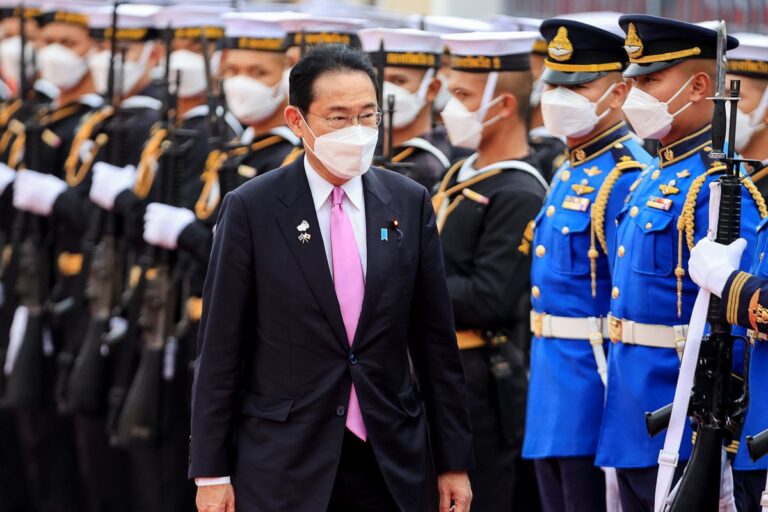
According to Reuters, the leaders of Japan and Thailand announced a new defence agreement on Monday as well as plans to upgrade their economic relations, as Japanese Prime Minister Fumio Kishida wrapped up the last leg of a three-nation tour of Southeast Asia.

The agreement would facilitate the transfer of defence hardware and technology from Japan to Thailand, which has one of the region’s biggest and most equipped armies and a long history of ties with the United States military. Further details of the deal were not disclosed.

Nine Southeast Asian countries backed a United Nations resolution in March condemning the invasion, however, and Kishida thanked Prayuth for Thailand’s support.

“I agreed with Prime Minister Prayuth that in any region the violation of sovereignty and territorial integrity, or unilateral changes to the status quo with force, should not be tolerated,” he said.

Noriyuki Shikata, Japan’s Cabinet Secretary for Public Affairs, earlier on Monday told reporters that Tokyo would be extending a 50 billion yen ($385 million) loan to support Thailand’s COVID mitigation efforts.

“This will help improve national defence and support investment from Japan in this activity which is an important goal for Thailand,” Thai Prime Minister Prayuth Chan-ocha said in a joint statement read alongside Kishida.

Prayuth said he discussed improvements in supply chains and the drafting of a five-year economic partnership with Japan, Thailand’s biggest investor.

Southeast Asia has for decades been an important region for Japan, hosting some of its biggest names in industry, from infrastructure, engineering and industrial zones to the manufacturing of vehicles and electronics.

The region remains a battleground between the United States, Japan’s close ally, and rival China, Southeast Asia’s biggest trade partner. On his three-day trip Kishida also visited Vietnam and Indonesia, where Japanese firms maintain a large presence.

As the leader of Asia’s sole member of the Group of Seven (G7), Kishida discussed Russia’s invasion of Ukraine during his trip to Southeast Asia, where only one nation – Singapore – has joined sanctions against Moscow. Russia calls its actions in Ukraine a “special operation”.

Australia hikes its interest rate for the first time in more than a decade

0

According to CNBC, Australia hiked its interest rate for the first time in more than a decade, a widely expected move as consumer prices surge.

Its central bank said Tuesday that the cash rate will be increased by 25 basis points to 0.35% — the first rate hike since November 2010.

Philip Lowe, governor of the Reserve Bank of Australia, said it is the right time to begin withdrawing some of the “extraordinary monetary support” that was put in place to help the Australian economy during the pandemic.

A further increase in prices is expected in the near term, but as supply side disruptions are resolved, Lowe said inflation is expected to decline back toward the country’s target range of between 2% to 3%.

The outlook for Australia’s gross domestic product also “remains positive” and is forecast to grow by 4.25% over 2022 and 2% next year, Lowe said. However, he noted there were uncertainties that may hit the global economy, such as the Russia-Ukraine war and Covid disruptions in China.

AMP’s Oliver said he expects the cash rate to rise to 1.5% by year end and to 2% by the middle of next year.

“Rate hikes are unlikely to de-rail the economic recovery just yet as monetary policy is still very easy, but they will add to the slowdown in home prices, where we see dwelling prices falling 10 to 15% into early 2024,” he said following the announcement.

“Banks are likely to pass the RBA’s rate hike on in full to their variable rate customers and deposit rates will also start to rise,” Oliver added.

“The economy has proven to be resilient and inflation has picked up more quickly, and to a higher level, than was expected,” Lowe said in a statement. “There is also evidence that wages growth is picking up. Given this, and the very low level of interest rates, it is appropriate to start the process of normalising monetary conditions.”

The hike was more than the analyst estimate for 15 basis points to 0.25%, according to the median forecast of a Reuters poll of 32 economists.

Shane Oliver, head of investment strategy and chief economist at Australian financial services firm AMP, said the scale of the rate increase was above market expectations. He said “the RBA appears to have partly accepted the argument that it had to do something decisive in order [to] signal its resolve to get inflation back down.”

Analysts had widely expected the central bank to hike rates, given the rapid rise in inflation. Prices of food, petrol and other consumer goods were all up in the last quarter.

Australia’s consumer price index jumped 2.1% for the first quarter, exceeding expectations of a 1.7% increase, data showed last week. On an annual basis, consumer inflation rocketed 5.1% — the highest since 2001 and higher than expectations for a 4.6% increase.

Lowe acknowledged in his statement that inflation had picked up more than expected, though it remains lower than in most other advanced economies.

“This rise in inflation largely reflects global factors. But domestic capacity constraints are increasingly playing a role and inflation pressures have broadened, with firms more prepared to pass through cost increases to consumer prices,” he said.

Central Chinese city of Zhengzhou imposes new COVID movement curbs

0

The central Chinese city of Zhengzhou announced on Tuesday it would impose new COVID-related movement curbs for May 4-10.

The new measures would be subject to adjustment after May 10, in accordance with the COVID-19 outbreak situation, the notice said.

Schools in the main city district will go online, while employees with government organisations and companies in the area must work from home during that period, according to a statement on the city’s official WeChat account.

Meanwhile, China’s commercial capital of Shanghai was dealt a blow on Monday as authorities reported 58 new COVID-19 cases outside areas under strict lockdown, while Beijing pressed on with testing millions of people on a May Day holiday few were celebrating.

Tough coronavirus curbs in Shanghai have stirred rare public anger, with millions of the city’s 25 million people stuck indoors for more than a month, some sealed inside fenced-off residential compounds and many struggling for daily necessities.