Home Blog Page 39

Starbucks to cover travel for workers seeking abortions

0

According to AP, Starbucks says it will now offer employees enrolled in its health care plan reimbursement for eligible travel expenses when accessing abortion or gender-affirming procedures, when those services are not available within 100 miles of a worker’s home.

The Seattle-based coffee chain said Monday that the benefit will also be available to dependents of employees enrolled in its health care coverage.

Last year more than 60 companies signed a letter in response to a Texas law banning abortions after roughly six weeks of pregnancy, forcing some women to travel out-of-state to access the procedure. Among others, jeans maker Levi Strauss & Co., the online reviews site Yelp, banking giant Citigroup and ride-hailing company Lyft pledged to cover travel costs for employees who have to travel long distances to access an abortion.

Earlier this month Tesla said it would cover travel costs for employees seeking out-of-state abortions.

More companies are detailing their benefits on abortion care after draft of a Supreme Court opinion leaked that would abolish a nationwide right to abortion.

“Regardless of what the Supreme Court ends up deciding, we will always ensure our partners have access to quality health care,” Sara Kelly, Starbucks acting executive vice president of partner resources, wrote in a letter.

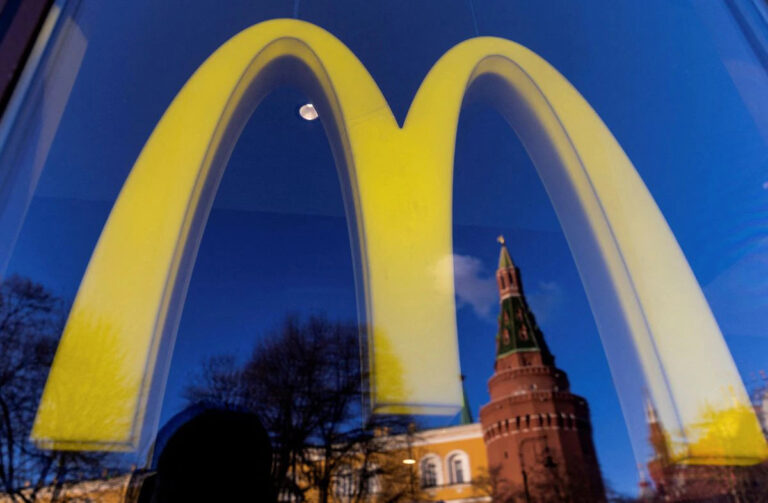
McDonald became one of the biggest global names to exit Russia

0

McDonald’s Corp on Monday became one of the biggest global names to exit Russia, laying out plans to sell all its restaurants after operating for more than 30 years in the country following its invasion of Ukraine.

The world’s largest burger chain, which owns about 84% of its nearly 850 restaurants in Russia, will take a related non-cash charge of up to $1.4 billion, reported by Reuters.

McDonald’s said it would ensure its 62,000 employees in Russia continue to be paid until the close of any transaction and that they have future jobs with any potential buyer.

After McDonald’s decision to close stores in March, several American brands including Starbucks Corp, PepsiCo Inc and Coca-Cola Co  followed suit, scrambling to comply with sanctions and deal with threats from the Kremlin that foreign-owned assets may be seized. 

“I would not be surprised to see other companies follow McDonald’s lead of exiting the market,” Edward Jones analyst Brian Yarbrough said.

Earlier in the day, French carmaker Renault said it would sell its majority stake in Avtovaz to a Russian science institute.

McDonald’s had in March decided to close its restaurants in the country, including the iconic Pushkin Square location in central Moscow – a symbol of flourishing American capitalism in the dying embers of the Soviet Union.

In the Russia of the early nineties, the burger chain became a way to sample Western food and spirit for millions of people, even though the cost of one burger was several times bigger than many city dwellers’ daily budgets.

“Some might argue that providing access to food and continuing to employ tens of thousands of ordinary citizens is surely the right thing to do,” Chief Executive Chris Kempczinski said in a letter to employees. “But it is impossible to ignore the humanitarian crisis caused by the war in Ukraine.”

Though a vast majority of the stores in Russia are closed, a few franchised stores have stayed open, cashing in on its skyrocketing popularity. It generated about 9%, or $2 billion, of its revenue from Russia and Ukraine last year.

Over the weekend, long, snaking queues were seen at the restaurant in Moscow’s Leningradsky Station, one of the capital’s only branches that has remained open, social media footage showed.

McDonald’s said it was looking to sell its restaurants in Russia to a local buyer, but will retain its trademarks.

“Given the circumstances of the sale, the financial challenges faced by potential Russian buyers, and the fact that McDonald’s will not license its brand name or identity, it is unlikely the sale price will be anywhere near the pre-invasion book value of the business,” Neil Saunders, managing director of GlobalData, said.

Atlanta Hawks looking for 5,000 volunteers to pack million meals for families in need

0

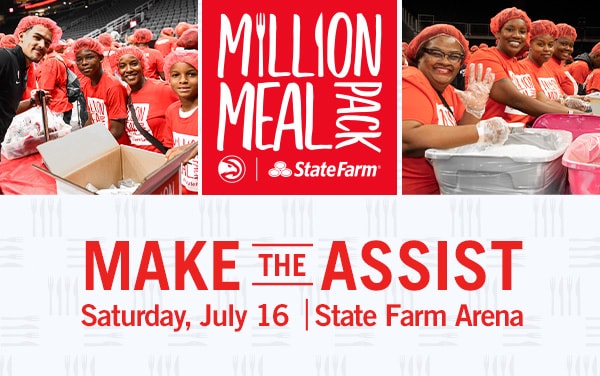
For the first time since the pandemic began, the Atlanta Hawks and State Farm Arena are bringing back their largest service project.

The Million Meal Pack will return this summer on July 16. Channel 2′s Kristen Holloway learned the Hawks will need at least 5,000 volunteers to help pack all the meals.

With inflation, rent and other cost of living increasing, Andrea Carter, the VP of corporate social responsibility for the Hawks, said it was important to bring back the team’s largest community initiative to date.

The volunteers will put together nutritious, shelf-stable, dried Jambalaya mix that produces six servings when it’s prepared.

Once the meals are packed, they’ll go to eight non-profits like the Atlanta Community Food Bank, who will distribute the food to local communities.

Statistics provided by the Atlanta Community Food Bank show that nearly one in eight Georgians are living with food insecurity, including one in six children.

“The Hawks and State Farm, for us, fighting food insecurity is important,” Carter told Holloway.

Volunteers will work at least 90-minute meal packing shifts with about 700-900 volunteers during each shift to reach one million meals or more. The Hawks first held in the event in 2019.

“And this time we will once again be leaning on Hawks players, area celebrities and influencers. We’ll be looking at city and government officials to join us that day, alongside everyone in the community,” Carter said.

“Certainly we can win on the court where we deliver lots of wins X & O’s but we can also deliver wins in the community,” Carter said.

Everyone who volunteers will get a Hawks T-shirt and a voucher for two tickets to a Hawks game next season. Exact game dates will be available once the season schedule is released.

To sign up, visit hawks.com/mealpack.

Covid has damaged China’s economy harder than expected

0

China has reported disappointing economic data for the month of April, underscoring the extensive damage Covid lockdowns have wreaked on the country.

The world’s second largest economy reported shocking drops in retail sales and factory production, widely missing market expectations.

Retail sales contracted 11.1% in April from a year ago, according to China’s National Bureau of Statistics on Monday. That was well below the 6.1% drop forecast in a Reuters survey of economists, and also much lower than the 3.5% decrease seen in March, reported by CNN.

Separately, the Shanghai government said the city will gradually open shops, restaurants, and salons from Monday, which will be a relief for its 25 million residents.

The government has also recently pledged to prop up the economy through more infrastructure spending and targeted monetary easing to support small businesses.

But “the risks to the outlook are tilted to the downside, as the effectiveness of policy stimulus will largely depend on the scale of future Covid outbreaks and lockdowns,” said Tommy Wu, lead China economist for Oxford Economics, on Monday.

“We forecast GDP to grow 4% this year, with a quarterly contraction in the second quarter before returning to growth in the second half.”

Industrial production fell 2.9% last month from a year earlier, reversing a 5% gain in March.

This marks the worst contraction in industrial production since February 2020, when China’s economy came to a near standstill during the initial coronavirus outbreak.

Unemployment also surged to the second highest level on record.

The urban jobless rate hit 6.1% in April, up from 5.8% in March — which was already at a 21-month high.The only time China’s jobless rate was higher was in February 2020.

Asian stock markets struggled for gains after the weak data. Hong Kong’s Hang Seng (HSI), China’s Shanghai Composite (SHCOMP), and Korea’s Kospi (KOSPI) all reversed opening gains, down between 0.3% and 0.5%.

China’s economy was off to a good start in 2022, recording a 4.8% growth for the first quarter.

But Beijing’s efforts to curb its worst Covid outbreak in two years have dealt a hefty blow to activity since March.

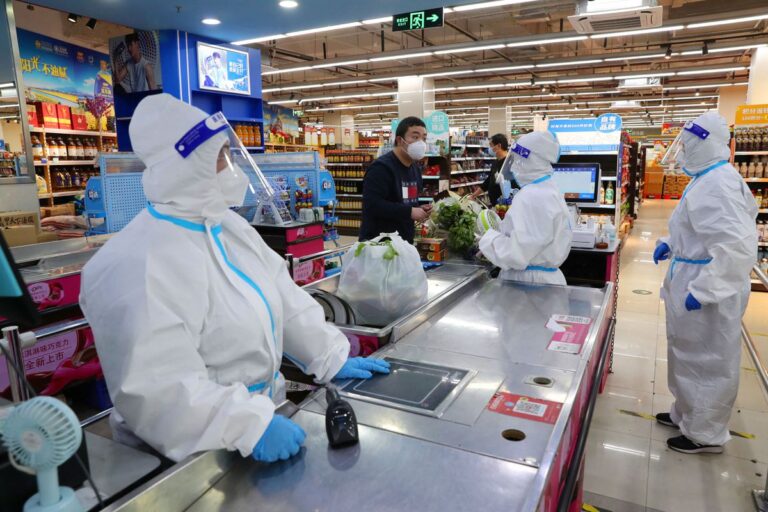
So far, at least 31 cities in the country remain under full or partial lockdown, according to CNN’s latest calculations. Shanghai, the country’s financial center and manufacturing hub, has been under lockdown formore than six weeks.During this period, many companies have been forced to suspend operations, including automakers Tesla (TSLA) and Volkswagen and iPhone assembler Pegatron.

“We think Q2 GDP growth will likely turn negative,” said Zhiwei Zhang, president and chief economist for Pinpoint Asset Management, on Monday.

“The government faces mounting pressure to launch new stimulus to stabilize the economy,”Zhang said.

The leadership in China is aware of the economic pains and has taken some steps recently to bring relief.

The People’s Bank of China announced Sunday that it would cut the mortgage rate for first-time homebuyers, in a move to lift the ailing property market.

Shanghai aims to reopen more businesses shut by COVID, Beijing battles on

0

Shanghai will gradually begin reopening businesses such as shopping malls and hair salons in China’s financial and manufacturing hub from Monday after weeks in strict COVID-19 lockdown, while Beijing battles a small but stubborn outbreak, reported by Reuters.

All but shut down for more than six weeks, Shanghai is tightening curbs in some areas that it hopes marks a final push in its campaign against the virus, which has infuriated and exhausted residents of China’s largest and most cosmopolitan city.

During Shanghai’s lockdown, residents have been mainly limited to buying necessities, with normal online shopping largely suspended due to a shortage of couriers.

And while barbers and hairdressers have been giving haircuts on the street or in open areas of housing compounds, residents recently able to leave homes for brief outings to walk or buy groceries have generally appeared more dishevelled than usual.

In one hopeful sign, Shanghai’s subway operator began testing trains on its vast network in preparation for reopening, a local government media outlet reported, but gave no indication of when it will do so.

Shanghai residents have been frustrated by unclear or inconsistent rules as the city makes tentative steps towards easing curbs.

In the Changning district on Sunday, a woman began walking her dog before being told by a policeman to go home.

“The lockdown hasn’t lifted!”, the policeman shouted.

Shopping malls, department stores, and supermarkets will begin resuming in-store operations and allow customers to shop in “an orderly way”, while hair salons and vegetable markets will reopen with limited capacity, Vice Mayor Chen Tong told a media briefing on Sunday.

He gave no specifics on the pace or extent of reopenings, and many residents in the city of 25 million reacted online with scepticism.

“Who are you lying to? We can’t even go out of our compound. You can open up, no one can go,” said a user of China’s Twitter-like Weibo, whose IP showed as being from Shanghai.

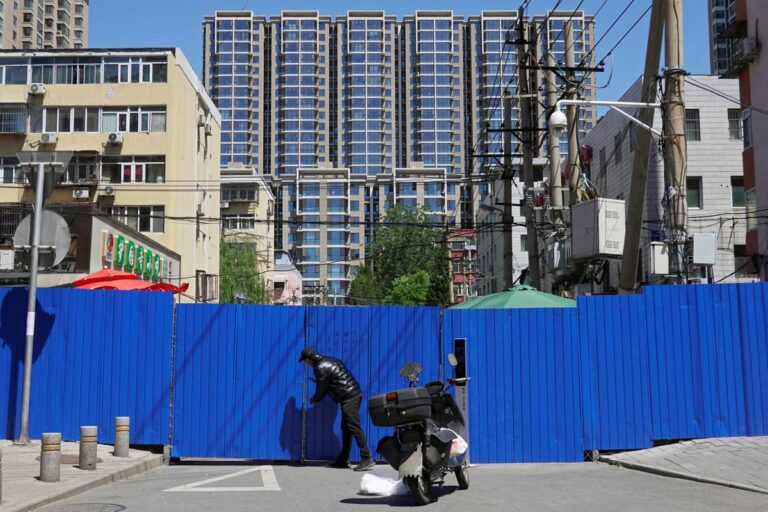
Shanghai has achieved its zero-COVID target in more thinly populated suburban districts and started easing curbs there first, such as allowing shoppers to enter supermarkets, but it continued to tighten restrictions in many areas over the past two weeks, curtailing deliveries and putting up more fencing.

In Beijing, where restaurants have been shut for dining-in, several districts on Sunday extended work-from-home guidance and officials announced three more days of mass daily tests for most of the city’s residents.

Beijing said it found 55 new cases in the 24 hours to 3 p.m. (0700 GMT) on Sunday, 10 of which were outside areas that are under quarantine. The city is scrambling to stamp out such community infections.

N. Korea’s Kim orders military to stabilise supply of COVID-19 drugs

0

Leader Kim Jong Un has ordered North Korea’s military to stabilise distribution of COVID-19 medicines in the capital, Pyongyang, in the battle on the country’s first confirmed outbreak of the disease, state media said.

Last week brought the North’s first acknowledgment of an “explosive” outbreak, with experts warning it could wreak devastation in a country with limited medical supplies and no vaccine programme, reported by Reuters.

Neighbouring South Korea will spare no effort to help the North fight its outbreak, President Yoon Suk-yeol told parliament on Monday, saying it was ready to provide COVID-19 vaccines and other medical support if Pyongyang agrees. 

Seoul’s unification ministry, reponsible for relations between the neighbours, said it would soon propose a plan of support to the North.

North Korea’s tally of the fever-stricken stood at 1,213,550, with 50 deaths by Sunday, after KCNA reported 392,920 more cases of fever, and eight more deaths. It did not say how many suspected infections had tested positive for COVID-19.

The North has blamed a large number of the deaths on people who were “careless in taking drugs” because of a lack of knowledge about the Omicron variant of coronavirus and its correct treatment.

Drugs procured by the state were not reaching people in a timely and accurate way, Kim told an emergency politburo meeting on Sunday, before visiting pharmacies near the capital’s Taedong River, state news agency KCNA said.

Kim ordered immediate deployment of the “powerful forces” of the army’s medical corps to “stabilise the supply of medicines in Pyongyang City,” it added.

Although authorities had ordered distribution of national reserves of medicine, pharmacies were not well-equipped to perform their functions smoothly, Kim added, the agency said.

Among their shortcomings were a lack of adequate drug storage other than showcases, while salespeople were not equipped with the proper sanitary clothing and hygiene in their surroundings fell short of standards, the leader said.

He criticised the “irresponsible” work attitude, organisation and execution by the cabinet and the public health sector, it added.

Mass shooting at Buffalo supermarket was a racist hate crime

0

The 18-year-old suspected of opening fire at a Buffalo supermarket Saturday told authorities he was targeting the Black community, according to an official familiar with the investigation.

According to CNN, the alleged gunman made disturbing statements describing his motive and state of mind following his arrest, the official said. The statements were clear and filled with hate toward the Black community. Investigators also uncovered other information from search warrants and other methods indicating the alleged shooter was “studying” previous hate attacks and shootings, the official said.

The Buffalo attack was the deadliest US mass shooting of the year. There have been at least 198 mass shootings so far in 2022, per the Gun Violence Archive, which — like CNN — defines a mass shooting as four or more people shot, not including the shooter.

The owner of a firearms shop in New York told The New York Times that the suspect recently bought a Bushmaster assault weapon. A background check on the suspect at the time showed nothing, Donald told the Times.

“I knew nothing about it until I got the call from them. I couldn’t believe it,” said Robert Donald, whose shop is in Endicott, about 200 miles from Buffalo.

“I just can’t believe it. I don’t understand why an 18-year-old would even do this,” he added. “I know I didn’t do anything wrong, but I feel terrible about it.”

The revelation comes a day after a gunman killed 10 people and wounded three others at the Tops Friendly Markets store in a predominantly Black neighborhood in Buffalo. Eleven of the people who were shot were Black, officials said. The victims range in age from 20 to 86, police said. Buffalo police identified all 13 victims Sunday. Among them were a former police officer who tried to stop the shooter, the octogenarian mother of the city’s former fire commissioner and a long-term substitute teacher.

Two people remain hospitalized in stable condition, a spokesman for Erie County Medical Center said Saturday night.

The suspect was identified as Payton S. Gendron, a rifle-toting 18-year-old from Conklin, New York, who allegedly wrote a White supremacist manifesto online, traveled about 200 miles to the store and livestreamed the attack, authorities said.

Buffalo Police Commissioner Joseph Gramaglia said Sunday the attack was a racist hate crime and will be prosecuted as such.”The evidence that we have uncovered so far makes no mistake that this is an absolute racist hate crime. It will be prosecuted as a hate crime,” he said. “This is someone who has hate in their heart, soul and mind.”

Investigators believe the suspect acted on his own in the shooting, Gramaglia said. The suspect was in Buffalo a day before the shooting and did some reconnaissance at the Tops Friendly Markets store, the commissioner said.

Gendron, the suspect, surrendered to police and was taken into custody. He was charged with first-degree murder, prosecutors said, and pleaded not guilty in court Saturday night, Buffalo City Court Chief Judge Craig Hannah told CNN.

Erie County Sheriff John Garcia said Gendron is currently under suicide watch.

On Sunday, New York Gov. Kathy Hochul announced $2.8 million in federal and state funding for the victims and their families, according to a statement from her office.

“The past 24 hours have been traumatizing for New Yorkers, and my administration will spare no effort to ensure the victims of this act of terrorism by a white supremacist are receiving all the resources and support they need,” Hochul said in the statement. “The entire world is watching how we will come together as New Yorkers to overcome this unthinkable tragedy. Buffalo, my hometown, is the City of Good Neighbors and New York State will be good neighbors for them.”

New York State’s Office of Victim Services will be in Buffalo throughout the week to help administer funding and assist victims and families in obtaining financial assistance from the state, according to the statement.

In addition, Hochul announced a partnership with rideshare services Uber and Lyft to provide transport to and from local grocery stores for affected community members.

The grocery store company, Tops Markets, is also providing free transportation to members of the Buffalo community affected by the shooting “to ensure our neighbors are able to meet their grocery and pharmacy needs,” according to an update on Twitter from the grocery chain.

“While the Tops location at Jefferson Avenue will remain closed until further notice, we are steadfast in our commitment to serving every corner of our community as we have for the past 60 years,” the statement reads. “Knowing the importance of this location and serving families on the east side of the city, we have taken immediate steps to ensure our neighbors are able to meet their grocery and pharmacy needs by providing free bus shuttle service starting today.”

Saturday’s attack bears similarities to a number of mass shootings in recent years that were motivated by hate and intended to be seen online, including the shootings at two mosques in Christchurch, New Zealand, in 2019.

Iran raises prices of food staples as much as 300%, stirring panic and anger

0

 Iran abruptly raised prices as much as 300% for a variety of staples such as cooking oil, chicken, eggs and milk on Thursday. Scores of alarmed Iranians waited in long lines to snatch up bundles of food and emptied supermarket shelves across the country in the hours before the price hike took effect.

Panicked shoppers raided stores and stuffed basic goods into large plastic bags, according to footage shared widely on social media. Lines in Tehran snaked out of grocery stores late Wednesday. On Thursday, Iran’s currency dropped to a low of 300,000 rial to the dollar.

Internet disruptions were reported across Iran as the government braced for possible unrest, advocacy group NetBlocks.org said. Protests appeared to spring up in the remote and impoverished south, according to videos shared online. The Associated Press could not verify their authenticity but the footage corresponded to reported events.

Supporters of the government have described the price hikes as “necessary economic surgery” — part of a parliament-approved reform package. Some social media users have ridiculed the term, saying officials have removed the patient’s heart instead of the tumor.

As outrage over rising inflation surges online, Iranian authorities appear to be bracing for the worst.

Internet monitoring group NetBlocks.org told the AP that it was tracking internet disruptions at a “national scale” that “are likely to impact the public’s ability to communicate.” Article 19, a global research organization that fights censorship, reported on Thursday that authorities appeared to have shut down almost all internet connectivity in cities across Khuzestan province.

Since the country’s 2009 disputed presidential election and the Green Movement protests that drew millions to the streets, Iran has tightened its control over the internet.

Videos have surfaced on social media in recent days of Iranians gathering in the dark in the streets of the southern Khuzestan province, chanting slogans against price hikes and against the country’s leaders. Iranian state media has not publicly addressed the protests.

The issue of high prices “is security-related,” lawmaker Majid Nasserinejad said ominously. “People cannot tolerate it anymore.”

The scenes revealed not only deep anxiety gripping the country and frustration with Iran’s leaders, but also underscored the staggering economic and political challenges facing them.

Food prices across the Middle East have surged due to global supply chain snarls and Russia’s invasion of Ukraine, which both export many essentials. Iran imports half of its cooking oil from Ukraine, where fighting has kept many farmers from the fields.

Although Iran produces roughly half of its own wheat, it imports much of the rest from Russia. The war has added to inflationary pressures. Smuggling of Iran’s highly subsidized bread into neighboring Iraq and Afghanistan has spiked as hunger spreads across the region.

Drought is already ravaging Iran’s economy. Western sanctions over Iran’s nuclear deal have caused additional difficulties. Inflation has soared to nearly 40%, the highest level since 1994. Youth unemployment also remains high. Some 30% of Iranian households are below the poverty line, reports Iran’s Statistics Center.

Iranian President Ebrahim Raisi has promised to create jobs, lift sanctions and rescue the economy, but talks to revive Iran’s tattered nuclear deal with world powers remain deadlocked. Iranian families have seen their purchasing power rapidly diminish.

The government is trying to act swiftly to blunt the pain. Authorities have promised to pay every Iranian citizen some $14 a month to compensate for the price hikes.

The cost of special and artisan breads, such as French baguette and sandwich bread, has multiplied by 10, bakery owners say. But authorities are careful not to touch subsidies on the country’s flatbread, which contributes more to the Iranians’ daily diet than anything else.

Subsidies, and bread subsidies in particular, remain a highly sensitive issue for Iran, which has been roiled by bread riots throughout its history. In the 1940s, bread shortages triggered mass street protests and a deadly crackdown that brought down then-Premier Ahmad Qavam.

Memories of Iran’s fuel price hike three years ago also remain fresh. Widespread protests — the most violent since the creation of the Islamic Republic in 1979 — rocked the country. Hundreds of demonstrators were killed in the crackdown, according to Amnesty International.

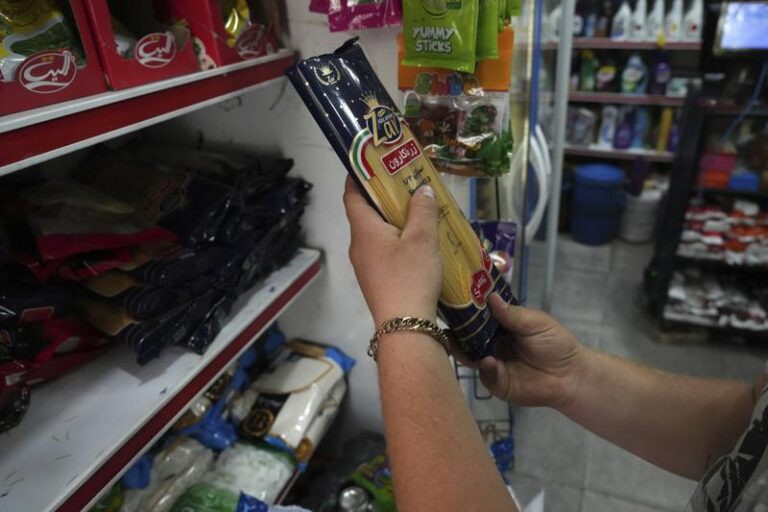
But in recent weeks, the government has allowed prices to surge for almost every other staple, including pasta, until Thursday’s hike for remaining Iranian dinner table basics.

As Iranians vent about the rising prices of flour, the top trending hashtag on Twitter in recent weeks has been #macaroni — the term Iranians use for all types of pasta.

“I am sure the government does not care about average people,” Mina Tehrani, a mother of three told the AP as she browsed a supermarket in Tehran. She stared in shock at a price tag for pasta — now 165,000 rials for a pound, compared to 75,000 rials last month.

Iranians who had forgone meat or dairy to save money have nothing left to cut, complained Tehran resident Hassan Shahbazzadeh.

“Now even macaroni is taken off their dining table,” he said.

“This jump in the price of flour has made people crazy,” said Saleh, a grocery store worker in Susangerd, a city in the oil-rich southwestern province of Khuzestan, home to an ethnic Arab population that has alleged discrimination and includes a separatist movement.

Saleh said that the price of a sack of 40 kilograms of flour had soared to the equivalent of $18 from $2.5 in recent weeks, stoking intense anger in the restive province.

“Many rushed to groceries to buy macaroni and other things for their daily needs,” he said, giving only his first name for fear of reprisals.

Tempers have also flared in Iran’s parliament.

“The waves of increasing in prices have made people breathless,” Kamal Hosseinpour, a lawmaker for the Kurdish area, thundered in a parliament session earlier this week. “Macaroni, bread and cooking oil are the main staples of Iran’s weaker people. … Where are the officials and what are they doing?”

Other lawmakers have directly rebuked hard-line President Raisi.

“The administration is incapable in managing the country’s affairs,” said Jalil Rahimi Jahanabad, a lawmaker for the Taibad province near Iran’s border with Afghanistan.

Shanghai aims to ring-fence its COVID over next week as Beijing hunkers down

0

Locked-down Shanghai aims to ringfence its COVID outbreak over the next week, officials said on Friday, while residents in China’s capital Beijing largely heeded the advice of authorities to work from home to stem the virus’ spread.

Easing weeks of punishing restrictions in the commercial hub would bring relief to China’s battered economy, although there is growing concern that Beijing may yet take a similar course of action if it fails to get a nascent outbreak under control.

China has rejected criticism of its uncompromising “zero COVID” policy, saying that saving lives is worth the huge short-term costs and that activity would gradually resume once outbreaks are eradicated.

“Whoever bets that China is at risk of a self-inflicted recession will suffer the consequences of their mistakes,” state-backed nationalist tabloid the Global Times said in an editorial.

According to Reuters, Shanghai’s deputy mayor, Wu Qing, said the city of 25 million aims to eliminate COVID outside of quarantined zones within the next week or so.

After that, the city’s lockdown will be “lifted in batches”, with shops opened and traffic restictions eased, he said in the announcement which confirmed a Reuters story from Sunday. 

The vast majority of Shanghai’s more than 2,000 new cases are in areas already under the tightest controls, while those found in the relatively freer communities are the ones most closely watched for clues as to where Shanghai’s outbreak is heading.

The number of such cases rose to four on May 12, up from two the previous day.

Last week, some of Shanghai’s residents were allowed outside their housing compounds for brief walks and grocery shopping but the city has in recent days been tightening curbs.

More and more areas have entered what authorities call “silent management mode”, which typically means boards or fences around buildings, no deliveries and residents once again stuck indoors.

Officials in Shanghai, China’s most populous city and its commercial centre, said economic activity was gradually resuming, with many factories operating in “closed loop” systems, with workers living on site.

More than 9,000 large-scale enterprises in Shanghai were now operating at close to 50% capacity, officials said.

Still, some economists expect China’s economic growth to slow sharply in the second quarter, or even shrink, endangering the annual growth target of about 5.5%.

China’s yuan fell to its weakest since September 2020.

Han Wenxiu, deputy head of the Communist Party’s office for financial and economic affairs, said on Thursday that China would not hesitate to introduce new policies to prop up growth.

N. Korea announces first Covid deaths amid ‘explosive’ outbreak

0

North Korea has announced an “explosive” Covid-19 outbreak that has likely killed six people and infected more than 350,000, according to state media, prompting fears of an impending and deadly crisis in the isolated and impoverished nation, reported by CNN.

The announcement comes a day after the country reported its first ever coronavirus case, calling the situation a “major national emergency.”

As China battles its own outbreak, the Chinese National Immigration Administration urged Jilin Province — which borders North Korea — to strengthen health inspections at its customs after North Korea reported its first Covid-19 case.

South Korea and the United States also agreed to continue discussions on ways to provide humanitarian aid to North Korea with the international community, South Korea’s Foreign Ministry said in a press release.

South Korea’s Foreign Minister Park Jin and US Secretary of State Anthony Blinken spoke on a call on Friday and shared concerns over the Covid-19 situation in North Korea, the ministry said. Both countries are open to dialogue with the north, they said.

On Thursday, North Korea reported 18,000 new “fever cases” and six deaths, one of which tested positive for the BA.2 sub-variant of Omicron, state media KCNA reported on Friday.

North Korea has not confirmed that all “fever” cases and deaths are Covid-19, likely due to its limited testing capability.

“A fever whose cause couldn’t be identified explosively spread nationwide since late April,” the newspaper said. “As of now up to 187,800 people are being isolated.”

An outbreak of Covid-19 could prove disastrous for North Korea. The country’s dilapidated health care infrastructure is unlikely to be up to the task of treating a large number of patients with a highly infectious disease and the nation is not known to have imported any coronavirus vaccines.

North Korea had not previously acknowledged any coronavirus cases, though few believe that a country of around 25 million people has been spared by a virus that has infected millions worldwide.

North Korean leader Kim Jong Un visited the state emergency epidemic prevention headquarters on Thursday and acknowledged the spreading outbreak meant there was a “vulnerable point” in the country’s epidemic prevention system, according to KCNA.

In images of the meeting published by state media, Kim is seen wearing a surgical mask as he enters and leaves the meeting room. Officials accompanying him are also shown wearing masks throughout.

“It is the most important challenge and supreme tasks facing our party to reverse the immediate public health crisis situation,” Kim said, according to KCNA.

Following a meeting of the country’s powerful politburo on Thursday, North Korea placed all cities into lockdown and ordered “people with fever or abnormal symptoms” into quarantine, KCNA said.

A reporter for Chinese state media CGTN released a rare video from Pyongyang on Friday, recounting his experience on the ground.

“As far as we know, not many people in Pyongyang have been vaccinated, and the medical and epidemic prevention facilities are in short supply,” reporter Zang Qing said in a Weibo post.

“Because the capital is in lockdown, the food I have at home is only enough for a week. We are still awaiting what policy the government will announce next.”

On Thursday, China said its ready to provide support to North Korea in its fight against Covid-19.

North Korea’s borders have been sealed since January 2020 to keep the virus at bay, despite the knock-on effects on trade with Beijing, an economic lifeline the impoverished country needs to keep its people from going hungry.

“As comrades, neighbors and friends, China stands ready to provide full support to the DPRK in its fight against the epidemic,” China’s Ministry of Foreign Affairs spokesperson Zhao Lijian said in a briefing.