Home Blog Page 37

Female referees to officiate men’s World Cup for first time

0

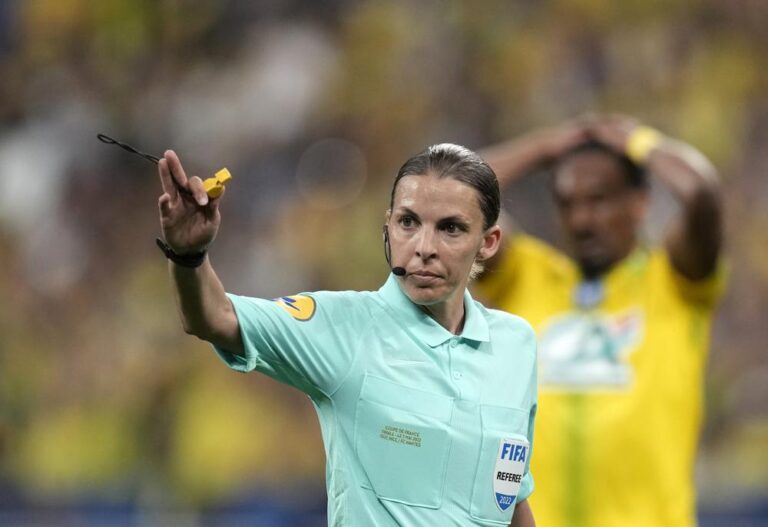
 Female referees will make World Cup history this year by working games at a major men’s tournament for the first time in Qatar.

According to AP, three female referees and three female assistant referees were announced Thursday by FIFA among 129 officials selected for World Cup duty, including one man who caused controversy when refereeing a chaotic African Cup of Nations game in January while suffering with heatstroke.

French referee Stéphanie Frappart already worked men’s games in World Cup qualifying and the Champions League, after handling the 2019 Women’s World Cup final. She also refereed the final of the men’s French Cup this month.

FIFA has picked 24 men to work on video reviews. The VAR system made its debut in 2018.

FIFA said 50 referee-and-assistant trios began preparing in 2019 for World Cup duty, with the project affected by limits on international travel during the COVID-19 pandemic.

Two referees were picked from each of Argentina, Brazil, England and France.

All the officials — who were not allocated into specific teams of three — face future technical, physical and medical assessments this year, FIFA said.

“As always, the criteria we have used is ‘quality first’ and the selected match officials represent the highest level of refereeing worldwide,” said FIFA Referees Committee chairman Pierluigi Collina, who worked the 2002 World Cup final. “In this way, we clearly emphasize that it is quality that counts for us and not gender.”

Salima Mukansanga of Rwanda and Yoshimi Yamashita of Japan are also on the list of 36 referees preparing for the 64 games at the tournament, which will be played from Nov. 21-Dec. 18.

The 69 assistant referees include Neuza Back of Brazil, Karen Díaz Medina of Mexico and Kathryn Nesbitt of the United States.

“I would hope that in the future the selection of elite women’s match officials for important men’s competitions will be perceived as something normal and no longer as sensational,” Collina said.

Among the male referees is Janny Sikazwe of Zambia, who blew the final whistle at an African Cup group match after 85 minutes and again 13 seconds before the 90 minutes were complete, with Mali leading Tunisia 1-0.

About 30 minutes after the match, officials ordered the teams back on the field to restart play but Tunisia refused. The result was later ratified by the Confederation of African Football despite an official protest by Tunisia.

The match was played in heat and humidity in Cameroon, and Sikazwe later explained he started to become confused in the intense conditions.

Sikazwe will be working at his second World Cup after handling two group games at the 2018 tournament in Russia.

The extreme heat in Qatar led FIFA to decide in 2015 to move the tournament to the cooler months in the Gulf emirate.

Buffalo shooting suspect Payton Gendron faces victims’ relatives in court

0

Avowed white supremacist Payton Gendron appeared in court Thursday — where he faced grieving relatives of some of the 10 people he is charged with slaughtering in a Buffalo supermarket.

The 18-year-old was brought into the Buffalo city court in an orange jumpsuit and shackled legs and surrounded by a mass of deputies amid intense heightened security.

He allegedly detailed plans to hit the Tops Friendly Markets and kill as many black people as possible — sharing it on Discord about a half-hour before the massacre.

It was unclear how many read what he had written or logged on to view the assault live. It also wasn’t clear whether anyone tried to alert law enforcement.

“Payton, you’re a coward!” a woman shouted from the gallery when he was led away after the hearing that lasted mere minutes.

The teen did not react to the slur as he was watched by relatives of some of the 10 people he has been indicted of killing in Saturday’s slaughter at Tops Friendly Markets.

Judge Craig Hannah remanded him custody for the murders that see him facing a maximum sentence of life without the possibility of parole if convicted. He set the next hearing for June 9.

The hearing came as authorities — including the FBI — continue to investigate the possibility of adding hate crime and terrorism charges.

Buffalo supermarket shooting suspect Payton Gendron arrives for an appearance at Erie County Court on Thursday, May 19, 2022 in Buffalo, N.Y.
Payton Gendron allegedly killed 10 people and injured three others at the Tops Friendly Markets mass shooting.

A court officer confirmed to The Post that they had “beefed up” security as a mass of press from local, national and international media arrived.

Reporters were taken to a basement courtroom for extra screening, with their belongings also taken to a separate room to be sniffed by a K9 before the scribes were allowed into Gendron’s hearing.

Gendron had been busted in camouflage and body armor at the scene of the slaughter, which was livestreamed from a helmet camera and was about 200 miles from his home in Conklin, NY.

Buffalo shooting suspect, Payton S. Gendron, appears in court accused of killing 10 people in a live-streamed supermarket shooting in a Black neighborhood of Buffalo, New York, U.S., May 19, 2022.
Payton Gendron was brought into the Buffalo city court in an orange jumpsuit and shackled legs and surrounded by a mass of deputies.
Payton Gendron stands with his defense team during a hearing at Erie County Court, in Buffalo, N.Y., Thursday, May 19, 2022.
Payton Gendron stands with his defense team during a hearing at Erie County Court, May 19, 2022.

The AR-15-style weapon used was covered in deranged racist scrawlings — including the N-word on the scope.

All but two of the 13 of the people shot were black — and the footage showed the shooter apologizing to one of the white people who came into view.

It later emerged that Gendron had meticulously detailed his twisted race-hate views in a diary, showing he was radicalized during the early days of the COVID-19 pandemic and had planned attacks months beforehand.

Payton Gendron is led into the courtroom for a hearing at Erie County Court, in Buffalo, N.Y., Thursday, May 19, 2022
Payton Gendron had been busted in camouflage and body armor at the scene of the slaughter.

A Japanese man reportedly gambled away millions of Japanese yen’s worth of COVID relief funds that he received by mistake.

0

Last month, the Japanese government inadvertently sent a COVID relief fund meant for 463 people worth 46.3 million yen ($360,890) to a 24-year-old man.

Based on the authorities’ investigation, the man withdrew 600,000 yen ($4,682) daily in the span of about two weeks. By the time the authorities were able to contact him, he claimed he no longer had the money.

“I’ve already moved the money. It can’t be returned,” he reportedly said. “It cannot be undone any more. I will not run. I will pay for my crime.”

Abu Mayor Norihiko Hanada has since apologized for the error, telling local residents that he is “deeply sorry” and that his office “will do our utmost to take back the large amount of public money.”

Following the blunder, a new batch of payouts amounting to 100,000 yen ($780) each has been issued to the target households.

The Abu Municipal Government is now suing the man for 51 million yen ($397,716), including legal fees.

After receiving the amount, the man initially said he would cooperate with local authorities but eventually went into hiding. His sudden disappearance prompted the southern town of Abu in Japan’s Yamaguchi Prefecture to file a civil lawsuit while also considering criminal action.

While he remains in hiding, his lawyer spoke to the press on Tuesday, saying the man had been cooperating with officials and is willing to be questioned by prefecture authorities.

However, after the lawsuit against him was filed on May 12, he has since evaded communication with officials.

According to his lawyer, the man lost the entire amount via online casino sites on his mobile phone.

“I don’t currently have the money and I don’t have anything with property value at hand. It’s actually difficult to return it,” the lawyer quoted his client as saying.

The relief fund was part of a local government program to help mitigate the financial effects of COVID on low-income households. The selected 463 families were supposed to receive 100,000 yen ($780) each.

However, the entire funding amounting to 46.3 million yen was deposited to the man’s personal bank account in error on April 8.

World Bank to offer $30 billion as Ukraine war threatens food security

0

 The World Bank said on Wednesday it will make $30 billion available to help stem a food security crisis threatened by Russia’s war in Ukraine, which has cut off most grain exports from the two countries.

The total will include $12 billion in new projects and over $18 billion funds from existing food and nutrition-related projects that have been approved but have not yet been disbursed, the bank said, reported by Reuters.

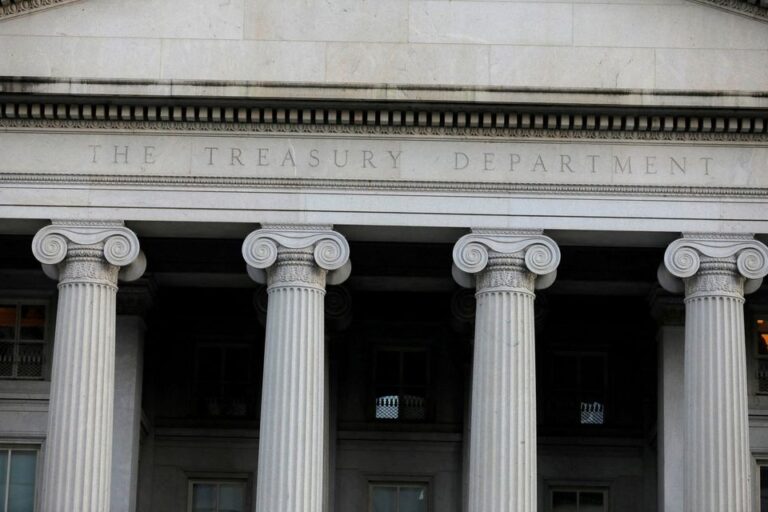
The World Bank’s plans were the largest component of a U.S. Treasury Department report summarizing food security action plans from international financial institutions released on Wednesday.

The European Bank for Reconstruction and Development plans to make 500 million euros ($523.50 million) available for food security and trade finance for agricultural and food products, out of a 2 billion euro package for Ukraine and neighboring countries affected by the war, the Treasury report said. Ukraine would get 200 million euros and neighboring countries would get 300 million euros.

The International Monetary Fund will provide financing support through its normal channels, which are limited by countries’ shareholdings and whether their debt is deemed sustainable.

“Food price increases are having devastating effects on the poorest and most vulnerable,” said World Bank Group President David Malpass said in a statement. “To inform and stabilize markets, it is critical that countries make clear statements now of future output increases in response to Russia’s invasion of Ukraine.”

The bank said the new projects are expected to support agriculture, social protection to cushion the effects of higher food prices on the poor, and water and irrigation projects. The majority of resources going to Africa and the Middle East, Eastern Europe and Central Asia, and South Asia.

These areas are among the hardest hit by the impact of the war in Ukraine on grain supplies. Countries such as Egypt are highly dependent on Ukrainian and Russian wheat and are scrambling for supplies as Russia has blockaded Ukraine’s agricultural exports from Black Sea ports and has imposed domestic export restrictions.

Largest retailers, confirmed this week that inflation headwinds are intensifying. 

0

Walmart and Target, two of the nation’s largest retailers, confirmed this week that inflation headwinds are intensifying. 

“The strength of the consumer will be tested as both Walmart and Target signal rising pricing pressures are not easing,” wrote Edward Moya, Senior Markets Analyst, Oanda.

Target shares, on Wednesday, dropped 25% the most since 1987 contributing to the Dow Jones Industrial Average’s 1,164.52 point skid, pushing the benchmark to its lowest level since March 2021. 

Rising costs coupled with a pullback in consumer spending, which accounts for about 70% of the U.S. economy, may cement a U.S. recession, Jeff Sica of Circle Squared Alternative Investments told FOX Business. 

“What we saw out of these two major retail earnings reports is that the consumer is about to break and that the consumer cutting back on spending with less confidence in the future indicates where we’re headed, I believe we’re already in the recession, but it indicates that we’re headed into a deeper recession,” said Sica.

“Growth was challenged by unusually high costs, resulting in profitability well below what we expected to be and where we expect to operate overtime,” said Target CEO Brian Cornell on the company’s earnings call Wednesday. Adjusted earnings fell 40.7% compared to the year-ago period to $2.10 per share.

The S&P 500 is also lingering at the lowest since March 2021, as tracked by Dow Jones Market Data Group.  

The day prior, Walmart shares got whacked to the tune of 11%, also the worst day since 1987, after CEO Doug McMillon delivered a sobering outlook. 

“On the food side, we’re seeing double-digit inflation and I’m concerned that, that inflation may continue to increase” he said in response to a question on the retailer’s quarterly earnings call. Adjusted earnings fell 23% to $1.30 per share. 

Overall consumer inflation hit 8.3% in April, a 40-year high, with food and fuel costs even higher. Annually, the price of unleaded gas is up 44%, eggs 22.6% and milk 14.7%, as tracked by the Bureau of Labor Statistics Consumer Price Index

The U.S. economy surprisingly contracted 1.4% in the first quarter, another back-to-back dip, which would confirm a recession. Currently, estimates for second-quarter economic growth remain at 2.4%, as tracked by GDPNow, the Federal Reserve Bank of Atlanta’s real-time tracker. 

Climate change has made record-breaking heatwaves in India and Pakistan 100 times more likely

0

Climate change has made the odds of a record-breaking heatwave hitting northwestern India and Pakistan 100 times more likely to happen, scientists said Wednesday, as the two countries experience high temperatures that are disrupting daily life.

In an analysis, climate scientists with the UK’s Met Office found that the natural probability of a heatwave exceeding average temperatures from 2010 would be once in 312 years, but when climate change is factored in, the chances increase to once in every 3.1 years.

April and May in 2010 was used as a point of comparison because those months had the highest average temperatures since 1900.

India and Pakistan are highly vulnerable to the impacts of the climate crisis, particularly in terms of extreme heat.

Chandni Singh, from the IPCC, said earlier this month that there was a limit to how far humans could adapt to such heat, adding that the heatwave was “testing the limits of human survivability.”

The scientists said that a new temperature record was likely to have been reached in the region during the recent heatwave.

Temperatures in the sub-continent have eased slightly in recent days, but the respite is likely to be short-lived, according to Paul Hutcheon, of the Met Office’s Global Guidance Unit.

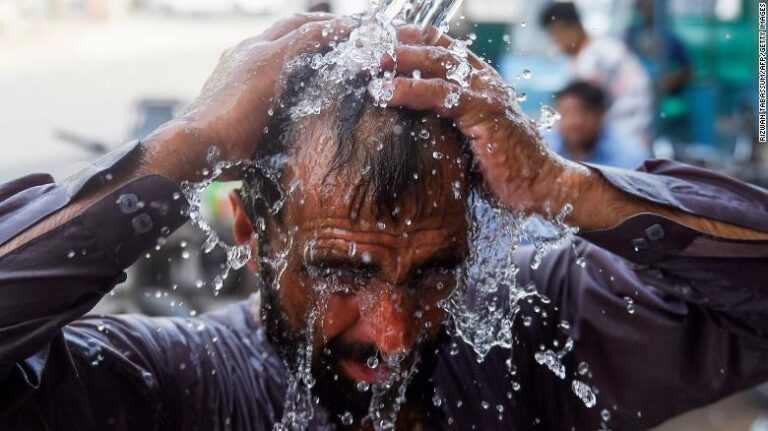
Soaring temperatures in parts of Pakistan and India in recent weeks have forced schools to close, damaged crops, put pressure on energy supplies and kept residents indoors. It even prompted experts to question whether such heat is fit for human survival.

Jacobabad, one of the hottest cities in the world, in Pakistan’s Sindh province, hit 51 degrees Celsius (123.8F) on Sunday, and 50C (122F) the day before. In neighboring India, temperatures in the capital region of Delhi surpassed 49C (120F) on Sunday.

The analysis also made projections, showing the frequency of such heatwaves in the region would increase to increase to once every 1.15 years by the end of the century.

“Spells of heat have always been a feature of the region’s pre-monsoon climate during April and May. However, our study shows that climate change is driving the heat intensity of these spells making record-breaking temperatures 100 times more likely,” said the Met Office’s Nikos Christidis, who produced the analysis. “By the end of the century increasing climate change is likely to drive temperatures of these values on average every year.”

“The heat looks likely to build again from mid-week, peaking later in the week or into the weekend, with maximum temperatures again likely to reach 50°C in some spots, with continued very high overnight temperatures,” he said on the Met Office’s website.

“Through the weekend temperatures are likely to lower again closer to average. There is also a continued enhanced risk of fires (largely from planned agricultural burning) in the region which would further add to the poor air quality. Some strong winds will lift dust plumes at times too.”

The U.S. Soccer Federation reached milestone agreements to pay its men’s and women’s teams equally

0

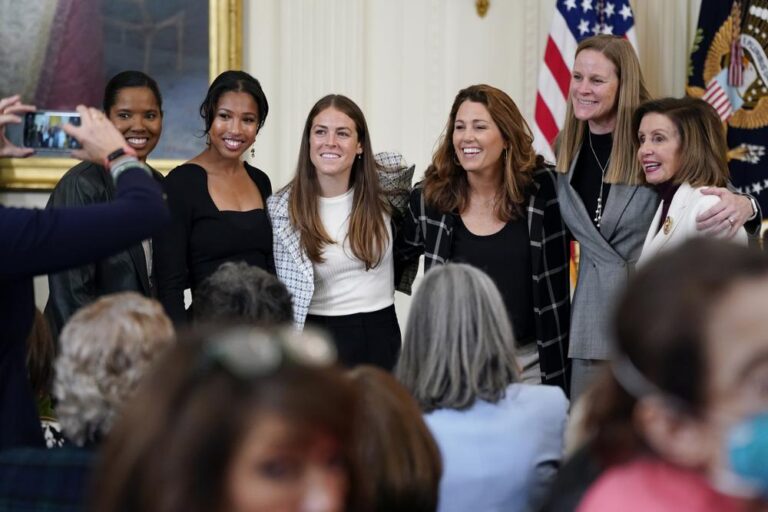
The U.S. Soccer Federation reached milestone agreements to pay its men’s and women’s teams equally, making the American national governing body the first in the sport to promise both sexes matching money.

The federation on Wednesday announced separate collective bargaining agreements through December 2028 with the unions for both national teams, ending years of often acrimonious negotiations.

The deals grew partly out of a push by players on the more successful women’s team, including stars like Alex Morgan and Megan Rapinoe, who were at the forefront of the gender equity fight while leading the team to a Women’s World Cup championship in 2019. The struggle became so much a part of the team’s story that chants of “Equal pay! Equal pay!” rose from the crowd as U.S. players celebrated winning the title in France.

Women ended six years of litigation over equal pay in February in a deal calling for the USSF to pay $24 million, a deal contingent on reaching new collective bargaining agreements.

According to AP, as part of the settlement, players will split $22 million, about one-third of what they had sought in damages. The USSF also agreed to establish a fund with $2 million to benefit the players in their post-soccer careers and charitable efforts aimed at growing the sport for women.

Morgan and Rapinoe could still be beneficiaries of the deal, though the next Women’s World Cup is in 2023 and the makeup of the team will have changed by then.

“I feel a lot of pride for the girls who are going to see this growing up, and recognize their value rather than having to fight for it. However, my dad always told me that you don’t get rewarded for doing what you’re supposed to do — and paying men and women equally is what you’re supposed to do,” U.S. forward Margaret Purce said. “So I’m not giving out any gold stars, but I’m grateful for this accomplishment and for all the people who came together to make it so.”

The men have been playing under the terms of a CBA that expired in December 2018. The women’s CBA expired at the end of March, but talks continued after the federation and the players agreed to settle a gender discrimination lawsuit brought by some of the players in 2019. The settlement was contingent on the federation reaching labor contracts that equalized pay and bonuses between the two teams.

Perhaps the biggest sticking point was World Cup prize money, which is based on how far a team advances in the tournament. While the U.S. women have been successful on the international stage with back-to-back World Cup titles, differences in FIFA prize money meant they took home far less than the men’s winners. American women received a $110,000 bonus for winning the 2019 World Cup; the U.S. men would have received $407,000 had they won in 2018.

The unions agreed to pool FIFA’s payments for the men’s World Cup later this year and next year’s Women’s World Cup, as well as for the 2026 and 2027 tournaments.

Each player will get matching game appearance fees in what the USSF said makes it the first federation to pool FIFA prize money in this manner.

“We saw it as an opportunity, an opportunity to be leaders in this front and join in with the women’s side and U.S. Soccer. So we’re just excited that this is how we were able to get the deal done,” said Walker Zimmerman, a defender who is part of the U.S. National Team Players Association leadership group.

Women’s union projections have compensation for a player who has been under contract to increase 34% from 2018 to this year, from $245,000 to $327,000. The 2023-28 average annual pay would be $450,000 for a player making all rosters, with the possibility of doubling the figure in World Cup years depending on results.

The federation previously based bonuses on payments from FIFA, which earmarked $400 million for the 2018 men’s tournament, including $38 million to champion France, and $30 million for the 2019 women’s tournament, including $4 million to the champion United States.

FIFA has increased the total to $440 million for the 2022 men’s World Cup, and its president, Gianni Infantino, has proposed that FIFA double the women’s prize money to $60 million for the 2023 Women’s World Cup, in which FIFA has increased the number of teams to 32.

For the current World Cup cycles, the USSF will pool the FIFA funds, taking 10% off the top and then splitting the rest equally among 46 players — 23 players on the roster of each team. For the 2026-27 cycle, the USSF cut increases to 20% before the split.

After missing the 2018 World Cup, the men qualified for this year’s World Cup in Qatar starting in November. The women’s team will seek to qualify this year for the 2023 World Cup, cohosted by Australia and New Zealand.

“There were moments when I thought it was all going to fall apart and then it came back together and it’s a real credit to all the different groups coming together, negotiating at one table,” said federation President Cindy Parlow Cone, a former national team player who became head of the governing body in 2020. “I think that’s where the turning point really happened. Before, trying to negotiate a CBA with the women and then turn around and negotiate CBA terms with the men and vice versa was really challenging. I think the real turning point was when we finally were all in the same room sitting at the same table, working together and collaborating to reach this goal.”

N. Korea COVID outbreak is ‘worrying’ for new variants

0

A senior World Health Organization official said on Tuesday that high levels of transmission of the coronavirus among unvaccinated people, such as in North Korea, creates a higher risk of new variants, reported by Reuters.

The isolated country, a WHO member, is grappling with its first acknowledged COVID-19 outbreak, fuelling concerns over a major crisis due to a lack of vaccines and medical infrastructure. 

The UN health agency has previously said Pyongyang has yet to inform it officially of the outbreak in an apparent violation of the country’s legal obligations under the WHO’s International Health Regulations.

Asked about how the WHO would respond, Ryan said that the body was ready to help but had no power to interfere in a sovereign country.

“Certainly it’s worrying if countries … are not using the tools that are now available,” said WHO emergencies director Mike Ryan in response to a question about the outbreak in North Korea.

“WHO has repeatedly said that where you have unchecked transmission, there is always a higher risk of new variants emerging,” he said.

At the same press briefing, WHO chief Tedros Adhanom Ghebreyesus also said he was “deeply concerned” about the spreading virus among an unvaccinated population with many underlying conditions.

In S. Korea, K-pop fans have something to cheer (and chant) about again

0

Concerts and sporting events came back to South Korea this year, but with a caveat: To minimize the spread of coronavirus, no cheering was allowed.

That meant baseball games without crowds making noise — and K-pop concerts without “fanchants.”

For the uninitiated, a fanchant is a dedicated script that K-pop fans can do together together during specific songs.

“I think originally it was created by the fans to show the members and the group support during songs,” says longtime K-pop fan Kayla Balba. “But now a lot of groups actually do fanchant guides so that you know exactly what to say and when.”

Balba went to the Stray Kids concert in Seoul and reveled in the comeback.

“There’s so much going on. There’s people taking pictures, there’s people running for freebies, it’s like a whole free-for-all. There’s just a lot of fans excited,” she said from the venue.

The masks may still be required, but cheering and chanting is back in South Korea.

“It’s mostly so that the fans can be involved in the performance, but it also contributes to the atmosphere of the overall concert.”

Balba went to a few concerts earlier this year, but said they had “absolutely no screaming, singing along or dancing or standing up.”

Of course, that didn’t stop fans from making noise in other ways. Paper folded back and forth makes for pretty impressive sounding clappers and fills the void left by no cheering.

South Korea lifted the cheering ban last month, and fanchants have made their triumphant return.

North Korea’s Kim faces ‘huge dilemma’ on aid as virus surges

0

During more than a decade as North Korea’s leader, Kim Jong Un has made “self-reliance” his governing lynchpin, shunning international help and striving instead for domestic strategies to fix his battered economy.

But as an illness suspected to be COVID-19 sickens hundreds of thousands of his people, Kim stands at a critical crossroad: Either swallow his pride and receive foreign help to fight the disease, or go it alone, enduring potential huge fatalities that may undermine his leadership.

Experts are divided over what support North Korea most needs. Some call for sending 60 million to 70 million vaccine doses to inoculate its people multiple times. Others say it’s too late to send such a large volume, and that North Korea needs fever reducers, test kits, masks and other daily necessities more.

Because preventing a virus spread across the country’s unvaccinated population is already unrealistic, the aim should be providing a limited supply of vaccines to reduce deaths among high-risk groups, including the elderly and people with existing medical conditions, said Jung Jae-hun, a professor of preventive medicine at South Korea’s Gachon University.

“Combating COVID-19 requires a comprehensive national ability, including the capacity for testing, treatment and inoculating people with vaccines,” Jung said. “The problem can’t be solved if the outside world helps with only one or two of those elements.”

“Kim Jong Un is in a dilemma, a really huge dilemma,” said Lim Eul-chul, a professor at Kyungnam University’s Institute for Far Eastern Studies in Seoul. “If he accepts U.S. or Western assistance, that can shake the self-reliance stance that he has steadfastly maintained and public confidence in him could be weakened.”

Doing nothing, however, could be calamitous.

Since acknowledging a COVID-19 outbreak last week, North Korea has said “an explosively spreading fever” has killed 56 people and sickened about 1.5 million others. Outside observers suspect most of those cases were caused by the coronavirus.

Whatever North Korea’s state-controlled media say about those who are sick, the outbreak is likely several times worse. North Korea lacks sufficient COVID-19 tests, and experts say it is significantly understating deaths to avoid possible public unrest that could hurt Kim politically.

Some observers say the stated death toll is low for a country where most of the 26 million people are unvaccinated and medicine is in short supply.

The North’s apparent underreporting of deaths is meant to defend Kim’s authority as he faces “the first and biggest crisis” of his decade of rule, Nam Sung-wook, a professor at Korea University, said.

The North Korean outbreak may be linked to a massive military parade in Pyongyang in late April that Kim organized to feature new weapons and loyal troops. The parade drew tens of thousands of soldiers and residents from around the country. After the event, Kim spent several days taking dozens of commemorative group photos with parade participants, all of whom were without masks. Most of the photos involved dozens or hundreds of people.

North Korea may be able to publicly hide the real number of deaths, but the country’s strengthened restrictions on movement and quarantine rules could hurt its agricultural cultivation. Its economy is already battered by more than two years of pandemic-caused border shutdowns and other curbs.

North Korea is also worried about a shortage of medical supplies and food and daily necessities that have dried up in markets during the border closures, Yang Moo-jin, a professor at Seoul’s University of North Korean Studies, said.

“They are experiencing another ‘arduous march,”’ Yang said, referring to the state’s euphemism for a devastating famine in the 1990s that killed hundreds of thousands of people.

According to AP, Kim has previously rebuffed millions of doses of vaccines offered by the U.N.-backed COVAX distribution program. After the North admitted to an outbreak, South Korean and China offered to send vaccines, medicine and other medical supplies to North Korea. The United States said it supports international aid efforts, though it has no current plans to share its vaccine supplies with the North.

Receiving outside help would put the North, which is always intensely proud, despite its poverty, in a difficult position. Kim had repeatedly touted his country as “impregnable” to the pandemic during the past two years. On Saturday, however, he said his country faces “a great upheaval” and that officials must study how China, his country’s only major ally, and other nations have handled the pandemic.

Nam, the professor, said Kim will likely eventually want to receive Chinese aid shipments, but not from South Korea, the United States or COVAX.

“Overcoming ‘the great upheaval’ with help from what North Korea calls American imperialists and from South Korea won’t be tolerated because that goes against the dignity of its supreme leader,” he said.

And North Korea will only accept Chinese aid if it’s made in an informal, unpublicized manner, because it’s “a matter of national pride,” analyst Seo Yu-Seok at the Seoul-based Institute of North Korean Studies said. He said China will likely agree to this because it views aid shipments as a way to bolster ties with a partner as it confronts the West.

But Cho Han Bum, an analyst at Seoul’s Korea Institute for National Unification, said North Korea may look to South Korea for support because it questions the effectiveness of Chinese vaccines. He said South Korean shipments over the Korean land border would also be faster.