Home Blog Page 116

Survey found companies are planning for a 3.9% increase in wages in 2022

0

The Consumer Price Index jumped 6.8% in November over the same time last year, according to fresh data from the Bureau of Labor Statistics, the highest percentage increase since the 1980s.

Wage growth accelerated over the last six to eight months, especially among workers under the age of 25 and workers who switched jobs over the past year, said Gad Levanon, founder of the Labor Market Institute and leader of the Help Wanted OnLine program for The Conference Board, in a blog post.

Faster wage growth among new hires leads to pay compression, which means more experienced workers decide they also want more, he said. With historically high quit rates, new jobs are easier to find. The percentage of Americans who quit their jobs dropped to 2.8% in October — down from the all-time high of 3% recorded by the Bureau of Labor Statistics in September.

The confluence of those factors is forcing employers to spend more on salaries.

Companies are planning some of their biggest salary increases in more than a decade, according to a new survey.

The Conference Board’s Salary Increase Budget survey found companies are planning for a 3.9% increase in wages in 2022, compared to the 3% companies had expected back in April. The Conference Board decided to field the survey again in November after seeing high wage growth and inflation roil the labor markets.

Average total salary budgets for 2021 jumped from 2.6% in the April to 3% in November, according to the survey.

The biggest drivers of wage growth are new hires and accelerating inflation. About 46% of those responding to the survey said the increase in wages for new hires played a factor in their revised 2022 estimates, while 39% said inflation played a factor.

“When more experienced workers feel that their pay advantage is no longer significant, they may seek new jobs in the tight labor market, which leads to high labor turnover of more experienced workers,” Levanon said. “Employers faced with extensive departures of experienced workers will raise wages faster for current employees in order to maintain an effective workforce.”

Levanon said it’s likely the severe labor shortages will continue through 2022, with wage growth remaining well above 4%. High inflation might also increase the need for cost-of-living adjustments as well.

“A wage-price spiral — where higher prices and rising wages feed each other, leading to faster increases in both — may already be in the works,” Levanon said. 

Other surveys have found similar plans for growth in salary budgets. A survey conducted by HR solutions provider XpertHR in October found companies expecting to raise their salary budgets a median of 3% in 2022.

Experts say rising inflation may push wages even higher, as businesses need to factor the increased costs employees are facing into their annual raises. Failing to do so could increase their risk for turnover at a time when it’s expensive to be in the market for talent.

Many businesses are turning to bonuses, with the amount of the average bonus having more than tripled in size, according to fresh data from payroll services provider Gusto. About 14% of all paychecks on the company’s platform in November included a bonus, up from 11% in 2020. The average size of that bonus was $1,674 in November — up from $552.06 in November 2020.

Meanwhile, about half of workers are expecting a bonus by the end of the year, according to a survey of nearly 1,000 full-time workers by financial product comparison company Magnify Money.

Another 42% believe they will get a pay raise in 2022, which is higher than the 39% who believed that heading into 2021. By contrast, about 47% believed they would get a pay raise heading into 2020.

A new record high temperature for the Arctic “38 C”

0

“This new Arctic record is one of a series of observations reported to the WMO Archive of Weather and Climate Extremes that sound the alarm bells about our changing climate,” WMO Secretary-General Prof. Petteri Taalas said in a statement.

In 2020, there was also a new temperature record (18.3°C) for the Antarctic continent,” said WMO,” he added.

The United Nations has officially recognized a new record high temperature for the Arctic, confirming a reading of 38 degrees Celsius (100.4 Fahrenheit) taken in June of last year.

The World Meteorological Organization (WMO) issued a statement on Tuesday calling the temperature reading “more befitting the Mediterranean than the Arctic.”

The high reading, taken on June 20, 2020, in the Russian town of Verkhoyansk, came amid a prolonged Siberian heatwave that year in which the region reached as much as 10 degrees C above normal for much of the summer.

The WMO said the Arctic “is among the fastest-warming regions in the world” and that the unprecedented temperatures caused it to add a new climate category for “highest recorded temperature at or north of 66.5⁰, the Arctic Circle” to its archives.

The high temperatures were “fueling devastating fires [and] driving massive sea ice loss” that played “a major role in 2020 being one of the three warmest years on record,” it said.

As NPR’s Rebecca Hersher reported in June of last year, 20,000 tons of diesel spilled in northern Siberia when storage tanks collapsed, likely because of melting permafrost.

The WMO said the new Arctic record high was just one of many record high temperatures in 2020 and 2021 that it was working to verify — including a reading of 54.4 C (129.9 F) in Death Valley, Calif., the world’s hottest place, and 48.8 C (119.8 F) on the island of Sicily.

Canada will set $40 billion to compensate Indigenous people who faced abuses

0

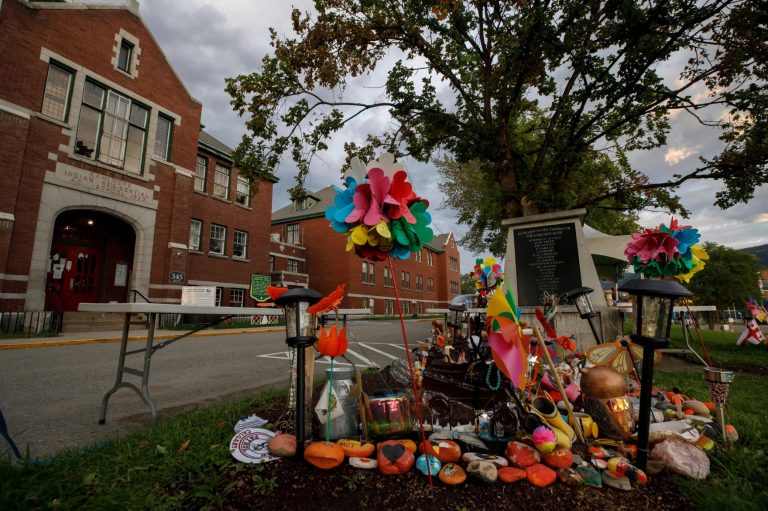
The Canadian government will set aside $40 billion — more than $30 billion in U.S. currency — to compensate Indigenous people who faced abuses as children in the country’s residential schools, officials announced Monday. The funds will also be used to reform the country’s troubled child welfare system.

“While the Government of Canada’s promise to put $40 billion towards ending ongoing discrimination and compensating the children and families who were hurt is an important step, there are more legal steps to take before victims get the compensation they are owed and First Nations children get the services they deserve,” Cindy Blackstock, executive director of the First Nations Child & Family Caring Society of Canada, said in a statement.

The pledge comes amid ongoing negotiations between Canadian authorities and First Nations groups over how to make amends for the historical mistreatment of Indigenous children.

“We have been unequivocal throughout these historic negotiations: we will compensate those harmed by the federal government’s discriminatory funding practices and we will lay the foundation for an equitable and better future for First Nations children, their families and communities,” Minister of Indigenous Services Patty Hajdu and Minister of Crown-Indigenous Relations Marc Miller said in a joint statement.

From 1831 to 1998, the government separated some 150,000 Indigenous children from their families and sent them to residential schools where they routinely faced physical and sexual abuse. At least 6,000 students died, though officials say that number could be higher.

The money will be used to settle a Canadian Human Rights Tribunal order and two class action lawsuits as well as pay for longer-term improvements to the Indigenous child welfare system, the CBC reported.

Blackstock noted that many Indigenous children and young adults in Canada still face challenges in attaining basic public services.

Negotiations are continuing, but both sides have agreed to a deadline of Dec. 31, according to the CBC.

CA requires masks “for all individuals” as COVID-19 cases sharply increase

0

California’s restrictions, which go into effect on Wednesday, require masks “for all individuals in all indoor public settings, regardless of vaccination status.”

New York’s mandate requires masks indoors, regardless of vaccination status, at healthcare and adult care facilities and schools. Masks are also required at indoor public places that don’t require proof of vaccination.

Both states have seen a steep increase in coronavirus infections just as more cases of the omicron variant have been detected across the country. In California, the per capita rate of cases has jumped 47% in the past two weeks, according to The Associated Press.

New York and California, whose mandates will remain in effect until Jan. 15, join Washington, Oregon, Illinois, New Mexico, Nevada and Hawaii, which already have similar restrictions in place.

In a statement last week, Hochul alluded to many people in her state who have refused vaccination.

“We shouldn’t have reached the point where we are confronted with a winter surge, especially with the vaccine at our disposal, and I share many New Yorkers’ frustration that we are not past this pandemic yet,” she said.

California is also ordering unvaccinated people who attend indoor events of 1,000 or more people to have a negative test within one or two days, depending on the type of test.

Biden plan to build 500,000 electric vehicle charging network

0

According to AP, the Biden administration is set to release a federal strategy Monday to implement an ambitious plan to build 500,000 charging stations for electric vehicles across the country and ultimately transform the U.S. auto industry.

The $1 trillion infrastructure law President Joe Biden signed last month authorizes the charging stations and sets aside $5 billion for states, with a goal to build a national charging network. The law also provides an additional $2.5 billion for local grants to support charging stations in rural areas and in disadvantaged communities.

“President Biden, American families, automakers, and autoworkers agree: the future of transportation is electric,″ the White House said in a statement. “The electric car future is cleaner, more equitable, more affordable and an economic opportunity to support good-paying, union jobs.″

Accelerated adoption of electric vehicles for personal cars and commercial fleets would help achieve Biden’s goal of net-zero greenhouse gas emission by 2050 while creating thousands of jobs, the White House said.

The effort also is intended to help the U.S. leapfrog China in the plug-in EV market. Currently, the U.S. market share of plug-in electric vehicle sales is one-third the size of the Chinese EV market.

Biden has set a goal that electric cars and trucks account for half of new vehicles sold by 2030.

The new EV charging strategy establishes a joint electric vehicles office between the federal Energy and Transportation departments; issues guidance and standards for states; and ensures consultations with manufacturers, state and local governments, environmental justice and civil rights groups, tribes and others.

The two departments also will launch an advisory committee on electric vehicles that officials hope is up and running early next year.

The Brandywine site features electric vehicle chargers that currently are the only ones in the local area, filling what the White House called “a key gap in the region’s electric vehicle charging network.″

Harris is expected to renew her call for Democrats to approve Biden’s $2 trillion social and environmental policy bill, now pending in the Senate. The bill, officially known as the Build Back Better Act, will cut the sticker price of new and used electric vehicles, among other benefits, the White House said.

Republicans, including some who voted in favor of the new infrastructure law, have criticized Biden for being preoccupied with electric vehicle technology when Americans are contending with a spike in gasoline and natural gas prices.

Biden last month ordered a record 50 million barrels of oil released from America’s strategic reserve, in coordination with other major energy consuming nations. Gas prices have fallen in recent weeks as fears grow of a possible economic slowdown from the coronavirus pandemic.

Kim Jong Un at critical crossroads decade into rule

0

According to SP, since taking power following his father’s sudden death 10 years ago this week, Kim Jong Un has erased those widespread doubts that greeted his early attempts to extend his family’s brutal dynastic grip over North Korea.

Early predictions about a regency, a collective leadership or a military coup were crushed by an estimated hundreds of executions and purges targeting family members and the old guard. That ruthless consolidation of power, together with a larger-than-life personality seemingly made for carefully packaged TV propaganda, has allowed Kim to make clear that his authority is absolute.

But as North Korea’s first millennial dictator marks a decade in rule this Friday, he may be facing his toughest moment yet, as crushing sanctions, the pandemic and growing economic trouble converge. If Kim can’t uphold his public pledge to develop both nukes and his moribund economy, something many experts see as impossible, it could spell trouble for his long-term rule.

The modest economic growth he achieved for several years through trade and market-oriented reforms was followed by a tightening of international sanctions since 2016, when Kim accelerated his pursuit of nuclear weapons and missiles targeting the United States and its Asian allies.

After basking in the global spotlight at summits with former U.S. President Donald Trump in 2018 and 2019, Kim is now stuck at home, grappling with a decaying economy worsened by pandemic-related border closures.

Negotiations with Washington have been deadlocked for more than two years after he failed to win badly needed sanctions relief from Trump. President Joe Biden’s administration seems in no hurry to cut a deal unless Kim shows a willingness to wind down his nuclear weapons program, a “treasured sword” he sees as his biggest guarantee of survival.

While still firmly in control, Kim appears increasingly unlikely to achieve his stated goals of simultaneously keeping his nukes and bringing prosperity to his impoverished populace. Kim laid out this goal in his first public speech as leader in early 2012, vowing that North Koreans would “never have to tighten their belts again.”

How Kim handles the economy in the coming years could determine the long-term stability of his rule and possibly the future of his family’s dynasty, said Park Won Gon, a professor of North Korea studies at Seoul’s Ewha Womans University.

“The nuclear weapons program, the economy and the stability of the regime are all interconnected. If the nuclear issue doesn’t get resolved, the economy doesn’t get better, and that opens the possibility of disquiet and confusion in North Korea’s society,” Park said.

Kim desperately needs the removal of U.S.-led sanctions to build his economy, which has also been damaged by decades of mismanagement and aggressive military spending.

But the global COVID-19 crisis has hampered some of Kim’s major economic goals by forcing the country into a self-imposed lockdown that crippled its trade with China, its only major ally and economic lifeline.

South Korea’s spy agency recently told lawmakers that North Korea’s annual trade with China declined by two-thirds to $185 million through September 2021. North Korean officials are also alarmed by food shortages, soaring goods prices and a lack of medicine and other essential supplies that have accelerated the spread of water-borne diseases like typhoid fever, according to lawmakers briefed by the agency.

There have also been signs that North Korean officials are suppressing the use of U.S. dollars and other foreign currencies in markets, an apparent reflection of worry about depleting foreign currency reserves.

Restoring central control over the economy could also be crucial for mobilizing state resources so that Kim could further expand his nuclear program, which would otherwise be challenging as the economy worsens.

While Kim has suspended the testing of nuclear devices and long-range missiles for three years, he has ramped up testing of shorter-range weapons threatening U.S. allies South Korea and Japan.

“Nukes brought Kim to this mess, but he’s maintaining a contradictory policy of further pushing nukes to get out of it,” said Go Myong-hyun, a senior analyst at Seoul’s Asan Institute for Policy Studies.

“The U.S.-led sanctions regime will persist, and a return to a state-controlled economy was never the answer for North Korea in the past and won’t be the answer now. At some point, Kim will face a difficult choice over how long he will hold on to his nukes, and that could happen relatively soon,” Go added.

US affordable-housing sector faces new hurdles through pandemic

0

Preserving and building affordable housing, a challenge in relatively normal times, has gotten harder as rents skyrocket, competition for land heats up and construction costs rise.

According to Bizjournals, the U.S. has a shortage of 6.8 million rental homes for extremely low-income renters, or households earning at or below 30% of their area median income, according to a National Low-Income Housing Coalition report from earlier this year. That doesn’t account for households at 60% AMI, 80% AMI and 120% AMI, the latter two of which are considered workforce housing levels.

A persistent lack of affordable housing results in renters being cost burdened, or paying more than 30% of their income on housing costs. The NLIHC says 70% of extremely low-income renter households are severely cost-burdened, which means spending 50% or more of their income on housing.

With metro areas seeing double-digit growth in rental and for-sale home price appreciation, the needs have accelerated.

“The pandemic gave rise to a huge increase in both the price of for-sale housing and rents of rental housing,” said Eric Maribojoc, executive director of George Mason University’s Center for Real Estate Entrepreneurship. “Both of those have gone up by double digits because of suppressed demand. All of a sudden, there are even more people whose wages have not kept up with the jump in the price of for-sale housing and the rates of rental housing.”

Asking rents for move-in leases in apartments rose 13.9% year over year in November, an all-time record pace, according to RealPage Inc. Meanwhile, the median home-sale price nationally hit a new all-time high of $360,250 the week ending Dec. 4, up 14% year over year and a 30% increase from the same period in 2019.

Matt Rieger, president and CEO at Miami-based Housing Trust Group LLC, which develops market-rate and affordable housing, said recent challenges relating to construction costs, supply-chain issues and hot multifamily demand have exacerbated challenges of building below-market-rate units.

“It’s gone from complicated to nearly impossible,” he said.

Rieger said, for projects in the affordable space HTG is working on, the company has to take a long-term view — negotiating contract extensions on land sales and locking in lumber pricing as early as possible, for example — to try to manage costs.

But, he said, there’s a bigger problem: the federal low-income housing tax-credit program needs to be expanded, bolstered and fine-tuned.

The social-spending portion of the federal infrastructure bill, Build Back Better, has more than $150 billion earmarked for affordable-housing efforts. But members of Congress continue to debate and negotiate over aspects of that legislation.

The bill calls for expansion of housing vouchers, in addition to building, preserving and improving 1 million-plus affordable rental and for-sale homes, as well as several LIHTC provisions.

“All eyes are on Build Back Better,” Rieger said. “(But) even if they gave (the industry) all of the resources — a blank check — it would be years before we got through the drawings and the permitting and the zoning and the construction” to build new affordable units.

Beyond LIHTC, some industry groups are lobbying for other aspects of the legislation to be reintroduced.

A number of industry associations — including the National Housing and Rehabilitation Association, which represents affordable housing and multifamily owners and developers — sent a letter earlier this month to Democratic leadership asking for historic tax-credit enhancements to be reinstated in Build Back Better.

The best view of the Geminid meteor shower will be on late Monday

0

The Geminid meteor shower, which lights up our sky every December, will be at its most visible late Monday into early Tuesday morning.

Although the moon will brighten up the sky and make it harder to see the Geminids this year, astronomers say from about 2:00 a.m. to sunrise will be prime viewing time.

“Rich in green-colored fireballs, the Geminids are the only shower I will brave cold December nights to see,” Bill Cooke, lead for NASA’s Meteoroid Environment Office, said in a statement.

The Geminids — which appear to emanate from the constellation Gemini — come from debris left behind by a celestial object known as 3200 Phaethon. Scientists believe 3200 Phaethon is either an extinct comet or an asteroid.

Because of their density, Geminids can get as low as 29 miles above the Earth’s surface before burning up, according to NASA.

Viewers in the Northern Hemisphere will have the best show, though the Geminids can be seen from almost anywhere on the planet. Night owls in the Southern Hemisphere may simply see fewer meteors as the shower will be closer to the horizon.

The Geminids will last until Dec. 17.

Documents with personal information found at a recycling center

0

Sonya Hooks was putting her junk papers into a bin at a popular recycling center on a recent Sunday in Decatur, when she couldn’t believe what she saw inside: Documents with names, phone numbers, a photocopied driver’s license, and Social Security numbers.

“I was just in shock,” Hooks said, noting the paperwork was related to services for senior citizens. “And they’re the most vulnerable… Somebody can take this information and come to some elderly person’s house and take advantage of them.”

According to AJC, the papers were left in the paper recycling bin at the Your DeKalb Farmers Market, which is open to the general public. To recycle paper, people climb a stepladder to reach a window at the top of a dumpster, where they find themselves looking inside.

Privacy experts say both federal and Georgia laws were almost certainly violated when the records were discarded. No local or stategovernment or agency has taken responsibility for the documents.

Under federal law, whoever is responsible for dumping the documents improperly can be fined up to $50,000 per violation, and each victim could be counted as a violation.

The pages Hooks found there, often photocopies, have letterhead from a variety of organizations and are dated from 2006 to 2016.

A DeKalb County Board of Health Form reports the medical history for a person, perhaps a job applicant. A resume and photocopies of identification cards have no letterhead. A Georgia Department of Community Health form presents a Georgia Nurse Aide Registry certificate. An Emory Healthcare form presents a passing drug test. A Fulton County form requests services for a person with dementia who needs help with grooming and getting in and out of the tub.

The most common letterhead is from “Senior Connections,” found on documents ranging from personnel forms to daily activity logs listing how much assistance a particular senior citizen required on which days. Senior Connections was a nonprofit organization that contracted with government agencies to provide senior services in the Atlanta area until it shut down in 2018.

Senior Connections was first set up in the 1970s to fill a gap in DeKalb County services for seniors. In the beginning it contracted with the Atlanta Regional Commission to do that work. According to the ARC, which operates the Area Agency on Aging, Senior Connections was licensed through the state DCH as a private home care provider. From 2003 to 2018, Senior Connections contracted with DeKalb County to do such work, according to DeKalb.

Contacted by The Atlanta Journal-Constitution, those governments all said theyhad policies requiring proper protection and disposal of private documents, as mandated by the state.

Most also said they also said they had no knowledge of the documents. DeKalb County, however, said that when Senior Connections shut down, it transferred documents to DeKalb, and the county currently has those documents safely stored in its Office of Aging. None of the documents found in the dumpster can be verified as documents belonging to DeKalb County, it noted.

Carol Amick, director of health care services at CompliancePoint, based in Duluth, guides health care companies in managing confidential documents. Under the federal health privacy law, HIPAA, Amick said, the documents with private health information needed to be shielded from public view, even if they were still in the offices of an agency.

When disposed of, it would have been okay if they were shredded and impossible to read, she said. But leaving them intact in the public dumpster violated the law.

“In this case, they should have been shredded in such a way that nothing could be identified,” Amick said. “You’re still liable for that even after you go out of business.”

David Katz, an Atlanta-based attorney on cybersecurity and privacy, said non-medical private documents such as driver’s licenses and Social Security numbers are protected too, under state law. The attorney general’s office has the authority to investigate potential violations whether they involve medical or other private information.

Amick and Katz agreed that the incident demonstrates that people should remain vigilant about their data, even if organizations they’ve given it to no longer exist. People can order credit monitoring in order to track whether anyone is opening new accounts in their name.

But the most important protection they have is for organizations to follow the law and the government to enforce it.

“It’s really hard to protect yourself from someone doing something like this,” Amick said.

Genise Barber, a resident of Fulton County, received help from Senior Connections in 2013. Her records were among those found in the dumpster.

Several years ago Barber applied for assistance with home repairs and Senior Connections arranged for the repairs.

Now, those documents were exposedcontaining her phone number, address and that she was a senior. “I’m mad. I’m mad about that,” said Barber, when reached at the phone number on the documents. “That shouldn’t be.”

Feeling a sense of outrage, Hooks, who studied journalism, has worked in film and is working on an unrelated freelance documentary, took the documents out of the dumpster so no one could use them for scams. She turned them over to the AJC and its attorneys.

“It looked,” Hooks said, “as if someone had started shredding, they got tired, and they’re like, ‘Oh, I don’t want to do this anymore. Let me just take it to the Farmers Market and get rid of it.’”


Town grieves in tornado aftermath

0

Across the state, about 26,000 homes and businesses were without electricity, according to poweroutage.us, including nearly all of those in Mayfield.

According to AP, residents of a Kentucky town devastated by a tornado could be without heat, water and electricity in chilly temperatures for a long time, the mayor warned Monday, as officials struggled to restore services after a swarm of twisters leveled neighborhoods and killed dozens of people in five states.

Authorities are still tallying the devastation from Friday night’s storms, though they believe the death toll will be lower than initially feared since it appeared many more people escaped a candle factory in Mayfield, Kentucky, than first thought.

“This is a tough morning … but it’s ok, we’re still going to be all right,” Mayfield Mayor Kathy Stewart O’Nan said on ”CBS Mornings.”

But those who survived faced highs in the 50s and a low below freezing Monday without any utilities.

Kentucky was the worst-hit by far in the cluster of twisters across several states, remarkable because they came at a time of year when cold weather normally limits tornadoes. At least 64 people died in the state, Gov. Andy Beshear said Monday. There were at least another 14 deaths in Illinois, Tennessee, Arkansas and Missouri.

Authorities are still trying to pin down the full death toll, and the storms made door-to-door searches impossible in some places. “There are no doors,” said Beshear.

“We’re going to have over 1,000 homes that are gone, just gone,” he said.